9GAB | pdb_00009gab

Structure and catalytic mechanism of SAM-AMP lyase in Clostridium botulinum CorA-associated type III CRISPR system


Experimental Data Snapshot

  • Method: X-RAY DIFFRACTION
  • Resolution: 1.65 Å
  • R-Value Free: 
    0.224 (Depositor), 0.236 (DCC) 
  • R-Value Work: 
    0.189 (Depositor), 0.201 (DCC) 
  • R-Value Observed: 
    0.191 (Depositor) 

Starting Model: in silico
View more details

wwPDB Validation   3D Report Full Report


Ligand Structure Quality Assessment 


This is version 1.1 of the entry. See complete history


Literature

SAM-AMP lyases in type III CRISPR defence.

Chi, H.McMahon, S.Daniel-Pedersen, L.Graham, S.Gloster, T.M.White, M.F.

(2025) Nucleic Acids Res 53

  • DOI: https://doi.org/10.1093/nar/gkaf655
  • Primary Citation of Related Structures:  
    9GAB, 9GAD

  • PubMed Abstract: 

    Type III CRISPR systems detect non-self RNA and activate the enzymatic Cas10 subunit, which generates nucleotide second messengers for activation of ancillary effectors. Although most signal via cyclic oligoadenylate, an alternative class of signalling molecule SAM-AMP, formed by conjugating ATP and S-adenosylmethionine, was described recently. SAM-AMP activates a trans-membrane effector of the CorA magnesium transporter family to provide anti-phage defence. Intriguingly, immunity also requires SAM-AMP degradation by means of a specialized CRISPR-encoded NrN family phosphodiesterase in Bacteroides fragilis. In Clostridium botulinum, the nrn gene is replaced by a gene encoding a SAM-AMP lyase. Here, we investigate the structure and activity of C. botulinum SAM-AMP lyase, which can substitute for the nrn gene to provide CorA-mediated immunity in Escherichia coli. The structure of SAM-AMP lyase bound to its reaction product 5'-methylthioadenosine-AMP reveals key details of substrate binding and turnover by this PII superfamily protein. Bioinformatic analysis revealed a phage-encoded SAM-AMP lyase that degrades SAM-AMP efficiently in vitro, consistent with an anti-CRISPR function.


  • Organizational Affiliation
    • School of Biology, University of St Andrews, St Andrews, Fife KY16 9ST, United Kingdom.

Macromolecules
Find similar proteins by:  (by identity cutoff)  |  3D Structure
Entity ID: 1
MoleculeChains Sequence LengthOrganismDetailsImage
SAM-AMP Lyase131Clostridium botulinumMutation(s): 0 
Gene Names: CBO2178
UniProt
Find proteins for A5I3U9 (Clostridium botulinum (strain Hall / ATCC 3502 / NCTC 13319 / Type A))
Explore A5I3U9 
Go to UniProtKB:  A5I3U9
Entity Groups  
Sequence Clusters30% Identity50% Identity70% Identity90% Identity95% Identity100% Identity
UniProt GroupA5I3U9
Sequence Annotations
Expand
  • Reference Sequence
Small Molecules
Ligands 2 Unique
IDChains Name / Formula / InChI Key2D Diagram3D Interactions
A1IJB (Subject of Investigation/LOI)
Query on A1IJB

Download Ideal Coordinates CCD File 
G [auth D]
I [auth A]
J [auth A]
K [auth B]
L [auth C]
G [auth D],
I [auth A],
J [auth A],
K [auth B],
L [auth C],
M [auth F]
[(2~{R},3~{S},4~{R},5~{R})-5-(6-aminopurin-9-yl)-3,4-bis(oxidanyl)oxolan-2-yl]methyl [(2~{S},3~{S},4~{R},5~{R})-5-(6-aminopurin-9-yl)-2-(methylsulfanylmethyl)-4-oxidanyl-oxolan-3-yl] hydrogen phosphate
C21 H27 N10 O9 P S
NNWVUANIXUHJMY-NAGRZYTCSA-N
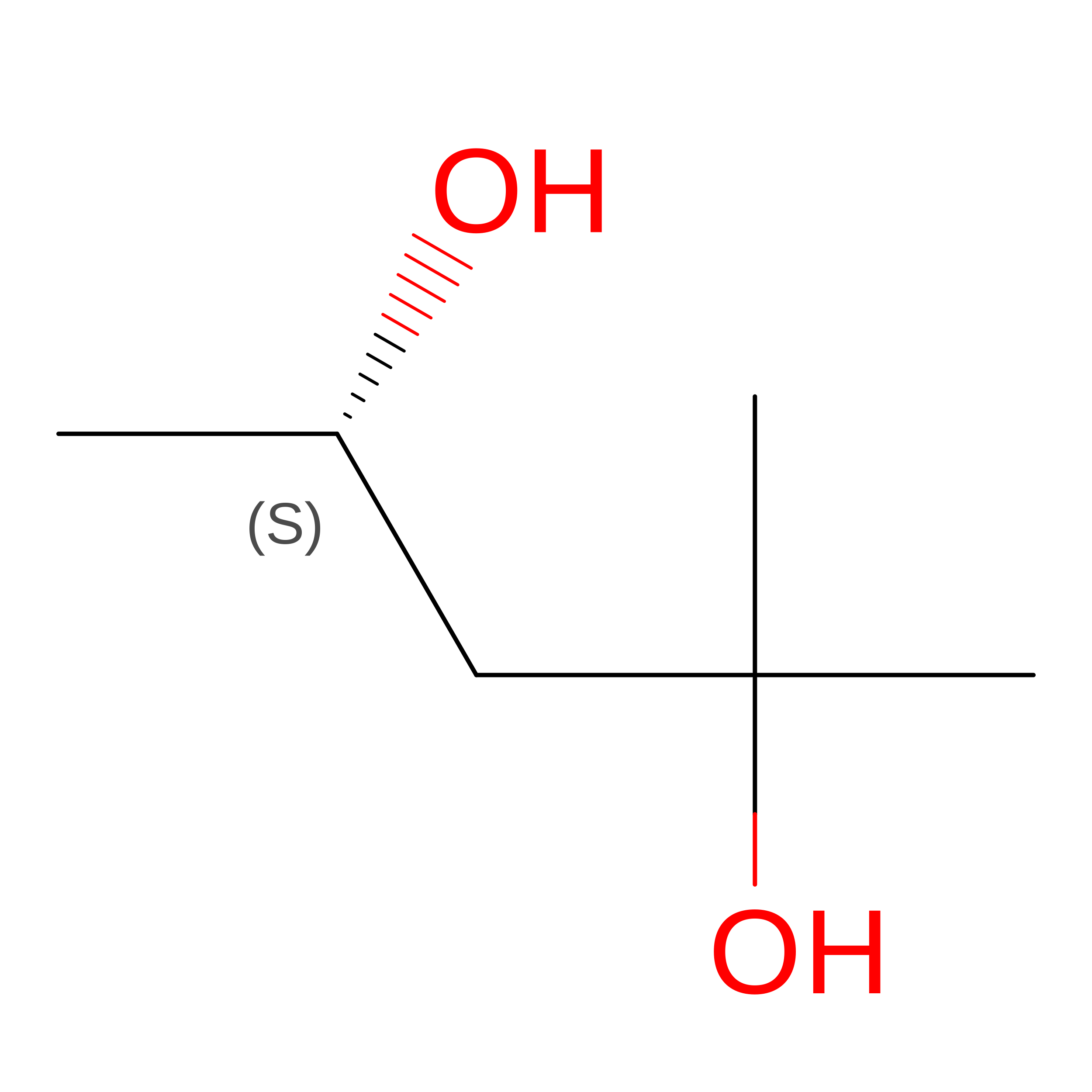
MPD
Query on MPD

Download Ideal Coordinates CCD File 
H [auth A],
N [auth F]
(4S)-2-METHYL-2,4-PENTANEDIOL
C6 H14 O2
SVTBMSDMJJWYQN-YFKPBYRVSA-N
Experimental Data & Validation

Experimental Data

  • Method: X-RAY DIFFRACTION
  • Resolution: 1.65 Å
  • R-Value Free:  0.224 (Depositor), 0.236 (DCC) 
  • R-Value Work:  0.189 (Depositor), 0.201 (DCC) 
  • R-Value Observed: 0.191 (Depositor) 
Space Group: P 1
Unit Cell:
Length ( Å )Angle ( ˚ )
a = 53.794α = 87.7
b = 55.484β = 72.62
c = 81.972γ = 61.01
Software Package:
Software NamePurpose
REFMACrefinement
DIALSdata reduction
DIALSdata scaling
PHASERphasing

Structure Validation

View Full Validation Report


Ligand Structure Quality Assessment 


Entry History & Funding Information

Deposition Data


Funding OrganizationLocationGrant Number
Biotechnology and Biological Sciences Research Council (BBSRC)United Kingdom--

Revision History  (Full details and data files)

  • Version 1.0: 2025-07-02
    Type: Initial release
  • Version 1.1: 2025-07-23
    Changes: Database references