Download Mendeley
Antibody-secreting cell repertoires hold high-affinity anti-rocuronium specificities that can induce anaphylaxis in vivo.
Dejoux, A., Zhu, Q., Woolfe, A., Godon, O., Ellouze, S., Mottet, G., Castrillon, C., Gillis, C., Pecalvel, C., Ganneau, C., Iannascoli, B., Lemoine, F., Saul, F., England, P., Reber, L.L., Gouel-Cheron, A., de Chaisemartin, L., Haouz, A., Millot, G.A., Bay, S., Gerard, A., Jonsson, F., Chollet-Martin, S., Bruhns, P.(2025) J Allergy Clin Immunol 155: 1557-1574
- PubMed: 39892658 Search on PubMed
- DOI: https://doi.org/10.1016/j.jaci.2025.01.025
- Primary Citation Related Structures:
9G6Q, 9G6R, 9G6S - PubMed Abstract:
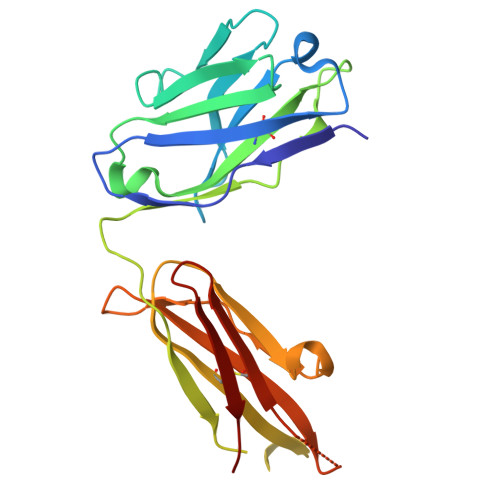
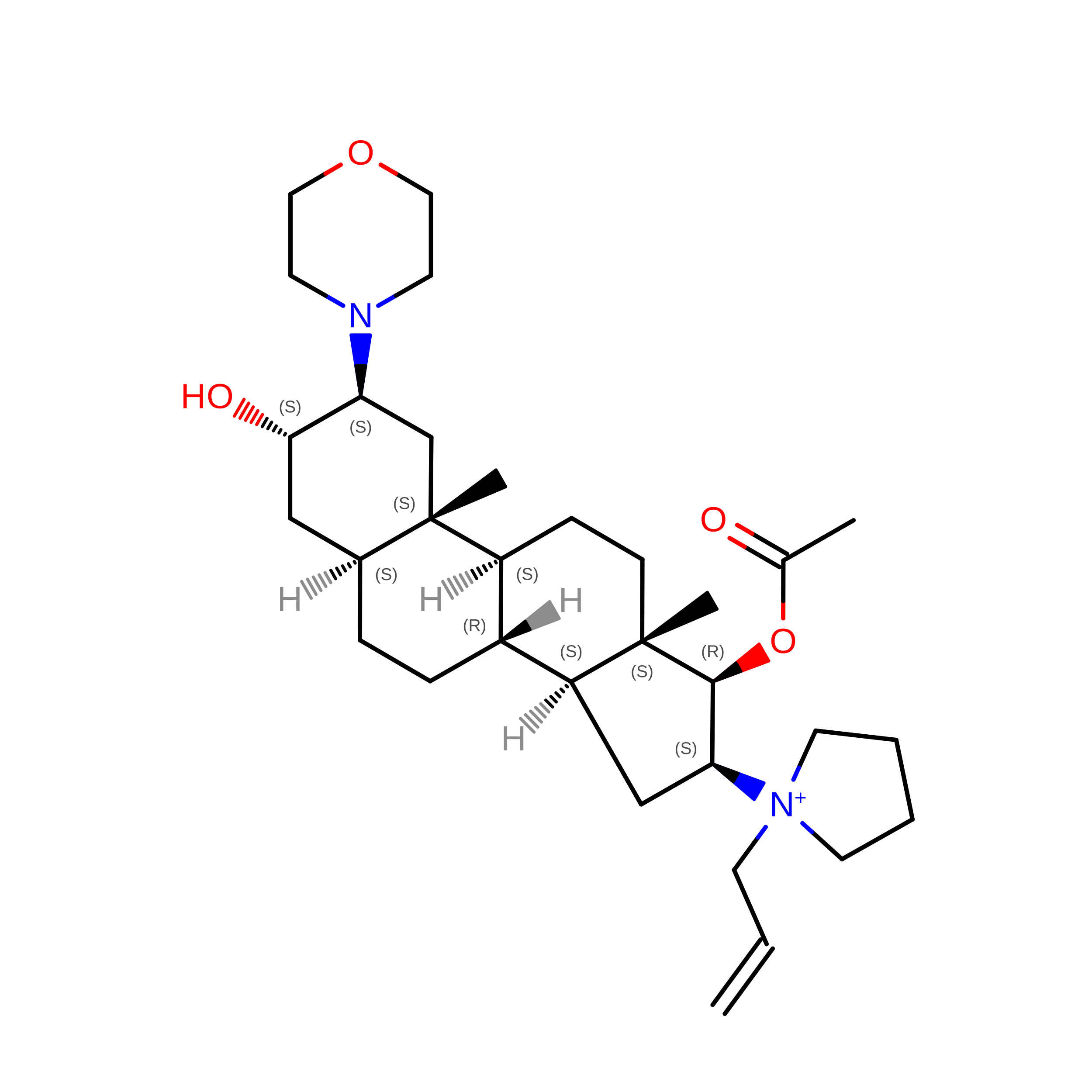
Neuromuscular blocking agents (NMBAs) are muscle relaxants used to assist mechanical ventilation but lead in 1 per 10,000 anesthesia cases to severe acute hypersensitivity reactions-that is, anaphylaxis. Incidences vary between types of NMBAs. Rocuronium, a widely used nondepolarizing aminosteroid NMBA, induces among the highest anaphylaxis rates. Rocuronium-induced anaphylaxis is proposed to rely on preexisting rocuronium-binding antibodies, but no such antibodies have ever been identified. We sought to identify rocuronium-specific antibody repertoires from plasma cells or plasmablasts of rocuronium-immunized mice to determine the affinities, structures, and anaphylactogenic potential of these antibodies for rocuronium. We engrafted rocuronium onto carrier proteins allowing immunization of mice against rocuronium, screening for rocuronium-specific antibody responses, and sorting of rocuronium-specific plasma cells using droplet microfluids coupled to single-cell antibody gene (variable heavy chain [VH] and variable light chain [VL]) sequencing. The 2 different repertoires of >500 VH-VL pairs were oligoclonal, comprised 3 major clonal families, and displayed convergence. Expressed as human IgG1, these antibodies demonstrated subnanomolar affinities for rocuronium with families either monospecific for rocuronium or cross-reactive only for closely related NMBAs. Expressed as human IgE, they triggered human mast cell and basophil activation, and severe passive systemic anaphylaxis in mice humanized for the IgE receptor FcεRI. Cocrystal structures between rocuronium and antibody representatives of 3 different VH-VL families revealed distinct interaction modes, with the ammonium group involved systematically in the binding interface. This work identifies the epitopes of antibody reactivity to rocuronium, demonstrates anaphylactogenic potential of anti-rocuronium IgE, and establishes the first mouse model of NMBA anaphylaxis.
- Institut Pasteur, Université Paris Cité, Institut National de la Santé et de la Recherche Médicale (INSERM) UMR1222, Antibodies in Therapy and Pathology, Paris, France; Collège Doctoral, Sorbonne Université, Paris, France.
Organizational Affiliation: