Download Mendeley
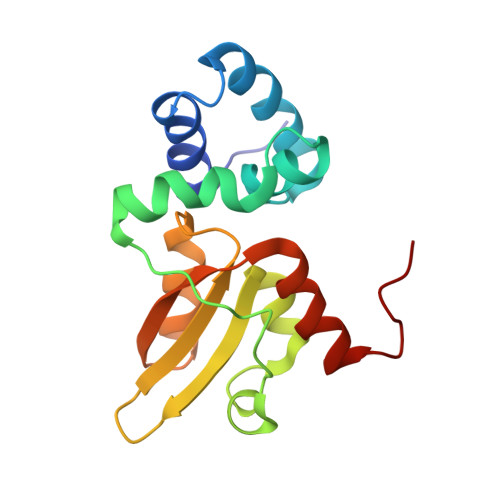
NMR Solution Structure of the N-Terminal GSPII Domain from the Thermus Thermophilus Traffic ATPase PilF and Reconstruction of its c-di-GMP Binding Capability.
Neissner, K., Frohnapfel, C., Keller, H., Duchardt-Ferner, E., Schneider, V., Kamjou, Z., Averhoff, B., Wohnert, J.(2025) Chembiochem 26: e202400959-e202400959
- PubMed: 39960869 Search on PubMedSearch on PubMed Central
- DOI: https://doi.org/10.1002/cbic.202400959
- Primary Citation Related Structures:
9G1W - PubMed Abstract:
The cyclic dinucleotide c-di-GMP is an important second messenger molecule in bacteria and interacts with a variety of receptor molecules including RNA and protein domains. An important class of c-di-GMP-binding protein domains are the general secretory pathway type II (GSPII) domains as exemplified by the N-terminal domain of the ATPase MshE from Vibrio cholerae (MshEN). MshEN binds monomeric c-di-GMP via two consecutive copies of a 24-residue sequence motif, which form a compact 4-α-helical bundle. The ATPase PilF from Thermus thermophilus regulates pilus formation, motility and DNA-uptake. Its N-terminal section contains three consecutive GSPII domains (GSPII-A-GSPII-C) all with considerable sequence homology to MshEN. While the GSPII-B and the GSPII-C domains bind c-di-GMP, the GSPII-A domain does not. To determine why it is incapable of c-di-GMP-binding we determined the NMR-solution structure of this domain. Our structure shows how small deviations in the consensus motif sequence, a stabilizing N-terminal helical capping motif and intersubdomain interactions absent in MshEN cooperate to prevent c-di-GMP-binding. By combining point mutations and truncations, we re-established the c-di-GMP binding capability. Our findings shed new light on the evolution and functional diversification of GSPII domains and the importance of sequence variations for protein activity in this domain family.
- Center for Biomolecular Magnetic Resonance (BMRZ), Goethe-University Frankfurt/M., Max-von-Laue-Str. 9, 60438, Frankfurt, Germany.
Organizational Affiliation: