Download Mendeley
Ideal efficacy photoswitching for chromocontrol of TRPC4/5 channel functions in live tissues.
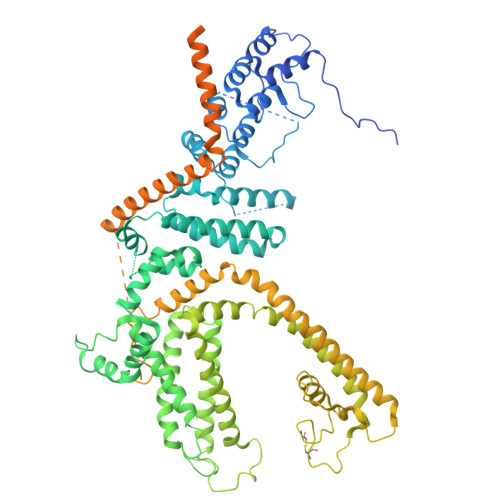
Muller, M., Niemeyer, K., Ojha, N.K., Porav, S.A., Vinayagam, D., Urban, N., Buchau, F., Oleinikov, K., Makke, M., Bauer, C.C., Johnson, A.V., Muench, S.P., Zufall, F., Bruns, D., Schwarz, Y., Raunser, S., Leinders-Zufall, T., Bon, R.S., Schaefer, M., Thorn-Seshold, O.(2026) Nat Chem Biol 22: 180-191
- PubMed: 41545580 Search on PubMedSearch on PubMed Central
- DOI: https://doi.org/10.1038/s41589-025-02085-x
- Primary Citation Related Structures:
9FXL, 9FXM - PubMed Abstract:
Precisely probing the endogenous roles of target proteins is crucial for biological research. Photochemical tools can be photoactuated with high spatiotemporal resolution but often they are unreliable in vivo because spatiotemporal variations of reagent concentration result in inhomogeneous bioactivity. We now describe ideal efficacy photoswitching, a paradigm that internally compensates for reagent concentration by self-competitive binding, allowing purely wavelength-dependent chromocontrol over bioactivity that is consistent from cell culture to deep tissues. We demonstrate this with photoswitches for endogenous transient receptor potential (TRP) C4 and C5 ion channels, reproducibly delivering strong agonism under 360-nm illumination, weak agonism under 385-nm illumination and strong antagonism under 440-nm illumination. These ligands unlock a range of high-precision investigations in TRP biology, from neuronal activity to exocytosis, reproductive signaling and smooth muscle contractility. The ideal efficacy photoswitching paradigm should also unlock high-performance chromocontrol over a wide range of sensory or signaling channels and receptors even in vivo.
- Faculty of Chemistry and Food Chemistry, Dresden University of Technology, Dresden, Germany.
Organizational Affiliation: