9F7Z | pdb_00009f7z

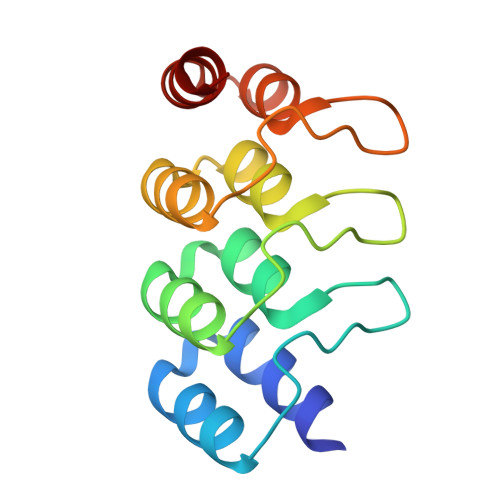
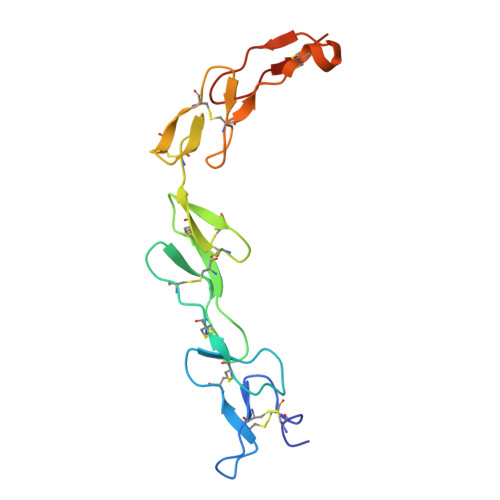
Crystal structure of human 4-1BB/TNFRSF9 in complex with the anti-4-1BB DARPin protein


Experimental Data Snapshot

  • Method: X-RAY DIFFRACTION
  • Resolution: 2.81 Å
  • R-Value Free: 
    0.291 (Depositor), 0.288 (DCC) 
  • R-Value Work: 
    0.241 (Depositor), 0.242 (DCC) 
  • R-Value Observed: 
    0.244 (Depositor) 

Starting Model: experimental
View more details

wwPDB Validation 3D Report Full Report

Validation slider image for 9F7Z

Ligand Structure Quality Assessment 


This is version 1.1 of the entry. See complete history

Literature

Improvement of daratumumab- or elotuzumab-mediated NK cell activity by the bi-specific 4-1BB agonist, DARPin alpha-FAPx4-1BB: A preclinical study in multiple myeloma.

Saltarella, I.Link, A.Lamanuzzi, A.Reichen, C.Robinson, J.Altamura, C.Melaccio, A.Solimando, A.G.Ria, R.Mariggio, M.A.Vacca, A.Frassanito, M.A.Desaphy, J.F.

(2024) Biomed Pharmacother 176: 116877-116877

  • DOI: https://doi.org/10.1016/j.biopha.2024.116877
  • Primary Citation Related Structures: 
    9F7Z

  • PubMed Abstract: 

    Multiple myeloma (MM) progression is closely dependent on cells in the bone marrow (BM) microenvironment, including fibroblasts (FBs) and immune cells. In their BM niche, MM cells adhere to FBs sustaining immune evasion, drug resistance and the undetectable endurance of tumor cells known as minimal residual disease (MRD). Here, we describe the novel bi-specific designed ankyrin repeat protein (DARPin) α-FAPx4-1BB (MP0310) with FAP-dependent 4-1BB agonistic activity. The α-FAPx4-1BB DARPin simultaneously binds to FAP and 4-1BB overexpressed by activated FBs and immune cells, respectively. Although flow cytometry analysis showed that T and NK cells from MM patients were not activated and did not express 4-1BB, stimulation with daratumumab or elotuzumab, monoclonal antibodies (mAbs) currently used for the treatment of MM, significantly upregulated 4-1BB both in vitro and in MM patients following mAb-based therapy. The mAb-induced 4-1BB overexpression allowed the engagement of α-FAPx4-1BB that acted as a bridge between FAP + FBs and 4-1BB + NK cells. Therefore, α-FAPx4-1BB enhanced both the adhesion of daratumumab-treated NK cells on FBs as well as their activation by improving release of CD107a and perforin, hence MM cell killing via antibody-mediated cell cytotoxicity (ADCC). Interestingly, α-FAPx4-1BB significantly potentiated daratumumab-mediated ADCC in the presence of FBs, suggesting that it may overcome the BM FBs' immunosuppressive effect. Overall, we speculate that treatment with α-FAPx4-1BB may represent a valuable strategy to improve mAb-induced NK cell activity fostering MRD negativity in MM patients through the eradication of latent MRD cells.


  • Organizational Affiliation
    • Section of Pharmacology, Department of Precision and Regenerative Medicine and Ionian Area, University of Bari Aldo Moro, Bari, Italy.

Macromolecule Content 

  • Total Structure Weight: 229.14 kDa 
  • Atom Count: 15,717 
  • Modeled Residue Count: 2,079 
  • Deposited Residue Count: 2,112 
  • Unique protein chains: 2

Macromolecules

Find similar proteins by:|  3D Structure
Entity ID: 1
MoleculeChains  Sequence LengthOrganismDetailsImage
anti-4-1BB DARPin
A, C, E, G, I
A, C, E, G, I, K, M, O
126synthetic constructMutation(s): 0 
Find similar proteins by:|  3D Structure
Entity ID: 2
MoleculeChains  Sequence LengthOrganismDetailsImage
Tumor necrosis factor receptor superfamily member 9
B, D, F, H, J
B, D, F, H, J, L, N, P
138Homo sapiensMutation(s): 0 
Gene Names: TNFRSF9CD137ILA
UniProt & NIH Common Fund Data Resources
Find proteins for Q07011 (Homo sapiens)
Explore Q07011 
Go to UniProtKB:  Q07011
PHAROS:  Q07011
GTEx:  ENSG00000049249 
Entity Groups
Sequence Clusters30% Identity50% Identity70% Identity90% Identity95% Identity100% Identity
UniProt GroupQ07011
Glycosylation
Glycosylation Sites: 1Go to GlyGen: Q07011-1
Sequence Annotations
Expand
Reference Sequence

Oligosaccharides

Help  
Entity ID: 3
MoleculeChains Length2D Diagram GlycosylationD Interactions
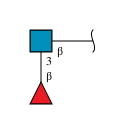
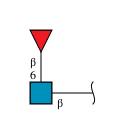
beta-L-fucopyranose-(1-3)-2-acetamido-2-deoxy-beta-D-glucopyranose
Q
2N-Glycosylation
Glycosylation Resources
GlyTouCan: G95595RA
GlyCosmos: G95595RA
GlyGen: G95595RA
Entity ID: 4
MoleculeChains Length2D Diagram GlycosylationD Interactions
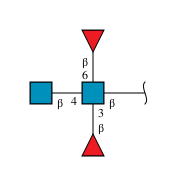
beta-L-fucopyranose-(1-3)-[2-acetamido-2-deoxy-beta-D-glucopyranose-(1-4)][beta-L-fucopyranose-(1-6)]2-acetamido-2-deoxy-beta-D-glucopyranose
R, S, T, U, W
4N-Glycosylation
Glycosylation Resources
GlyTouCan: G44123WW
GlyCosmos: G44123WW
GlyGen: G44123WW
Entity ID: 5
MoleculeChains Length2D Diagram GlycosylationD Interactions
beta-L-fucopyranose-(1-6)-2-acetamido-2-deoxy-beta-D-glucopyranose
V
2N-Glycosylation
Glycosylation Resources
GlyTouCan: G61843VN
GlyCosmos: G61843VN
GlyGen: G61843VN

Small Molecules

Ligands 1 Unique
IDChains Name / Formula / InChI Key2D Diagram3D Interactions
NAG

Query on NAG


Download:Ideal Coordinates CCD File
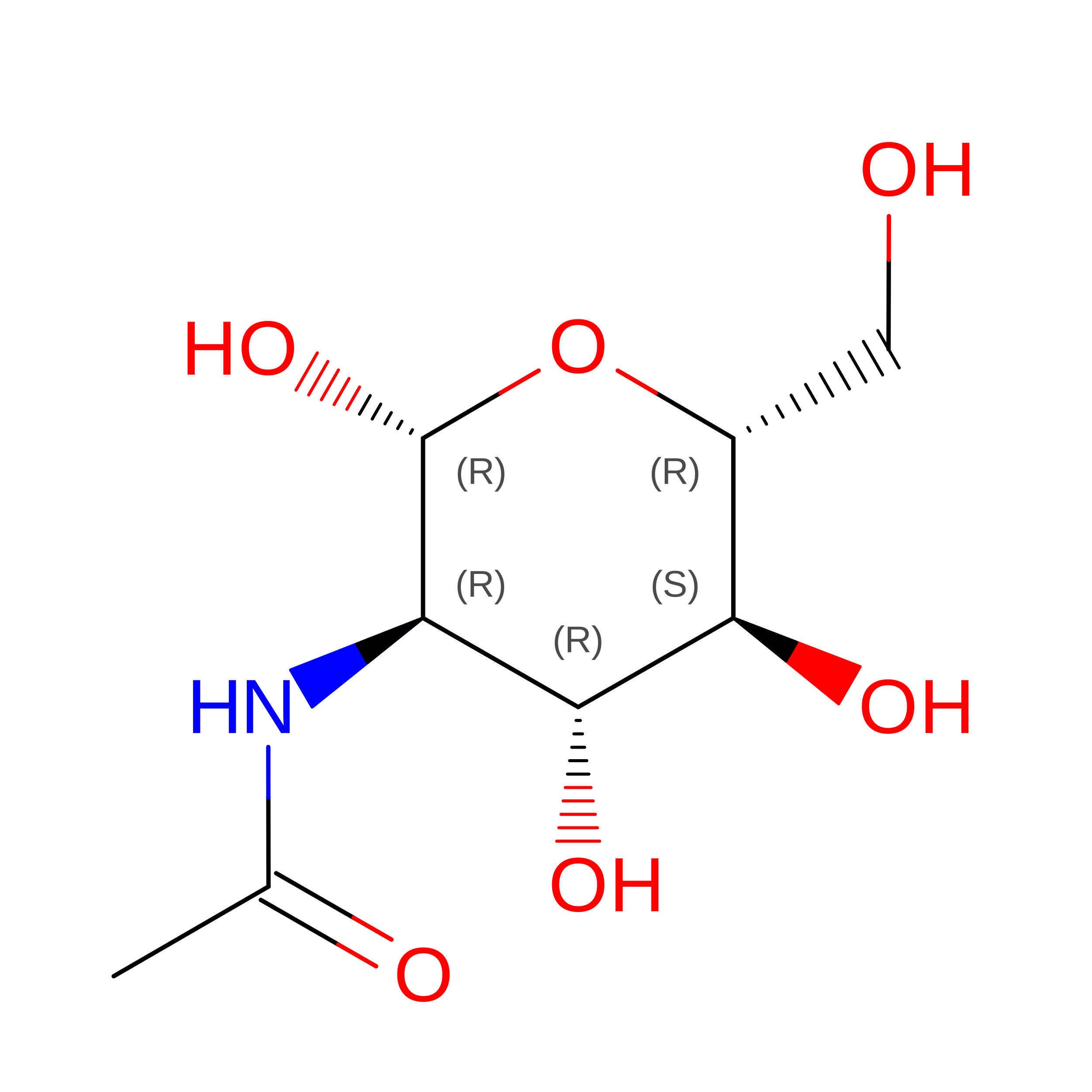
X [auth N]2-acetamido-2-deoxy-beta-D-glucopyranose
C8 H15 N O6
OVRNDRQMDRJTHS-FMDGEEDCSA-N

Experimental Data & Validation

Experimental Data

  • Method: X-RAY DIFFRACTION
  • Resolution: 2.81 Å
  • R-Value Free:  0.291 (Depositor), 0.288 (DCC) 
  • R-Value Work:  0.241 (Depositor), 0.242 (DCC) 
  • R-Value Observed: 0.244 (Depositor) 
Space Group: C 1 2 1
Unit Cell:
Length ( Å )Angle ( ˚ )
a = 170.33α = 90
b = 102.469β = 91.54
c = 167.366γ = 90
Software Package:
Software NamePurpose
REFMACrefinement
PDB_EXTRACTdata extraction
XDSdata reduction
Aimlessdata scaling
PHASERphasing

Structure Validation

View Full Validation Report


Ligand Structure Quality Assessment 


Entry History 

& Funding Information

Deposition Data


Funding OrganizationLocationGrant Number
Not funded--

Revision History  (Full details and data files)

  • Version 1.0: 2025-05-21
    Type: Initial release
  • Version 1.1: 2026-06-03
    Changes: Database references