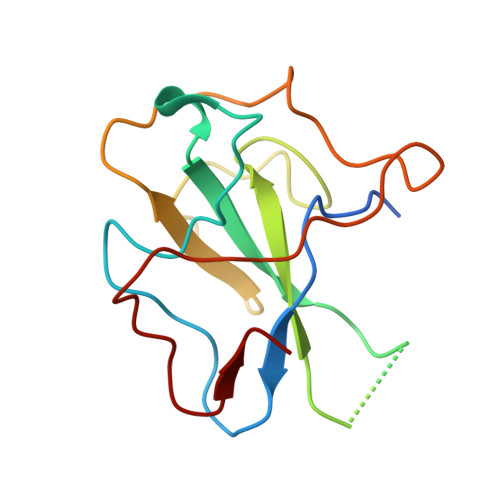
9F7A | pdb_00009f7a

SARS-CoV-2 Nucleocapsid N-terminal domain (NTD) mutant P80R


Experimental Data Snapshot

  • Method: X-RAY DIFFRACTION
  • Resolution: 1.90 Å
  • R-Value Free: 
    0.348 (Depositor), 0.348 (DCC) 
  • R-Value Work: 
    0.277 (Depositor), 0.276 (DCC) 

Starting Model: experimental
View more details

wwPDB Validation 3D Report Full Report

Validation slider image for 9F7A

This is version 1.1 of the entry. See complete history

Literature

A core network in the SARS-CoV-2 nucleocapsid NTD mediates structural integrity and selective RNA-binding.

Dhamotharan, K.Korn, S.M.Wacker, A.Becker, M.A.Gunther, S.Schwalbe, H.Schlundt, A.

(2024) Nat Commun 15: 10656-10656

  • DOI: https://doi.org/10.1038/s41467-024-55024-0
  • Primary Citation Related Structures: 
    9EVY, 9EWH, 9EXB, 9EZB, 9F5J, 9F5L, 9F7A, 9F7C, 9F83, 9FBG

  • PubMed Abstract: 

    The SARS-CoV-2 nucleocapsid protein is indispensable for viral RNA genome processing. Although the N-terminal domain (NTD) is suggested to mediate specific RNA-interactions, high-resolution structures with viral RNA are still lacking. Available hybrid structures of the NTD with ssRNA and dsRNA provide valuable insights; however, the precise mechanism of complex formation remains elusive. Similarly, the molecular impact of nucleocapsid NTD mutations that have emerged since 2019 has not yet been fully explored. Using crystallography and solution NMR, we investigate how NTD mutations influence structural integrity and RNA-binding. We find that both features rely on a core network of residues conserved in Betacoronaviruses, crucial for protein stability and communication among flexible loop-regions that facilitate RNA-recognition. Our comprehensive structural analysis demonstrates that contacts within this network guide selective RNA-interactions. We propose that the core network renders the NTD evolutionarily robust in stability and plasticity for its versatile RNA processing roles.


  • Organizational Affiliation
    • Institute for Molecular Biosciences, Goethe University, Frankfurt, Germany.

Macromolecule Content 

  • Total Structure Weight: 15.02 kDa 
  • Atom Count: 972 
  • Modeled Residue Count: 117 
  • Deposited Residue Count: 136 
  • Unique protein chains: 1

Macromolecules

Find similar proteins by:|  3D Structure
Entity ID: 1
MoleculeChains  Sequence LengthOrganismDetailsImage
Nucleoprotein136Severe acute respiratory syndrome coronavirus 2Mutation(s): 1 
UniProt
Find proteins for P0DTC9 (Severe acute respiratory syndrome coronavirus 2)
Explore P0DTC9 
Go to UniProtKB:  P0DTC9
Entity Groups
Sequence Clusters30% Identity50% Identity70% Identity90% Identity95% Identity100% Identity
UniProt GroupP0DTC9
Sequence Annotations
Expand
Reference Sequence

Small Molecules

Experimental Data & Validation

Experimental Data

  • Method: X-RAY DIFFRACTION
  • Resolution: 1.90 Å
  • R-Value Free:  0.348 (Depositor), 0.348 (DCC) 
  • R-Value Work:  0.277 (Depositor), 0.276 (DCC) 
Space Group: P 65 2 2
Unit Cell:
Length ( Å )Angle ( ˚ )
a = 66.753α = 90
b = 66.753β = 90
c = 121.214γ = 120
Software Package:
Software NamePurpose
REFMACrefinement
REFMACrefinement
Cootmodel building
BUCCANEERmodel building
Aimlessdata scaling
pointlessdata scaling
STARANISOdata scaling
autoPROCdata reduction
XDSdata reduction
PHASERphasing

Structure Validation

View Full Validation Report


Entry History 

& Funding Information

Deposition Data


Funding OrganizationLocationGrant Number
German Research Foundation (DFG)GermanySCHL2062/2-1 and 2-2
German Research Foundation (DFG)Germany161793742
Other governmentGoethe-Corona-Funds
Other governmentJohanna Quandt Young Academy at Goethe (stipend number 2019/AS01)

Revision History  (Full details and data files)

  • Version 1.0: 2024-11-20
    Type: Initial release
  • Version 1.1: 2024-12-18
    Changes: Database references