9EYD | pdb_00009eyd

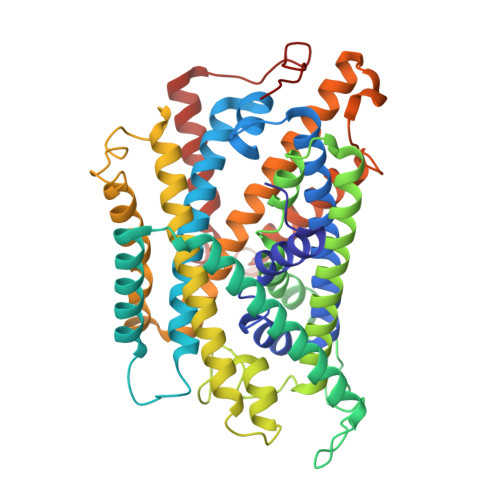
Structural basis of specific lysine transport by Pseudomonas aeruginosa permease LysP


Experimental Data Snapshot

  • Method: ELECTRON MICROSCOPY
  • Resolution: 3.68 Å
  • Aggregation State: PARTICLE 
  • Reconstruction Method: SINGLE PARTICLE 

wwPDB Validation   3D Report Full Report


This is version 1.3 of the entry. See complete history


Literature

Structural basis of specific lysine transport by Pseudomonas aeruginosa permease LysP.

Bicer, D.Matsuoka, R.Moumbock, A.F.A.Sukumar, P.Suades, A.Cheruvara, H.Quigley, A.Drew, D.Pardon, E.Steyaert, J.Henderson, P.J.F.Caffrey, M.Griese, J.J.Nji, E.

(2025) Nat Commun 

  • DOI: https://doi.org/10.1038/s41467-025-66618-7
  • Primary Citation of Related Structures:  
    9EYD

  • PubMed Abstract: 

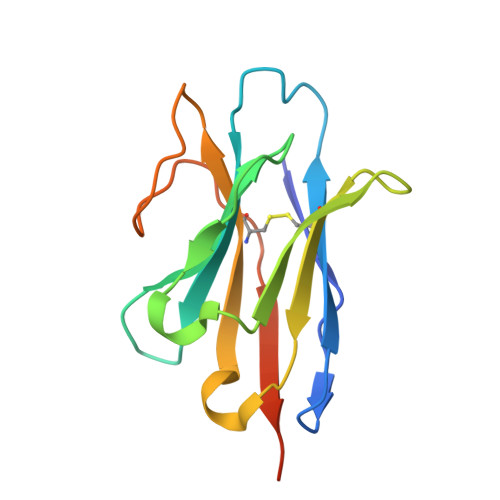
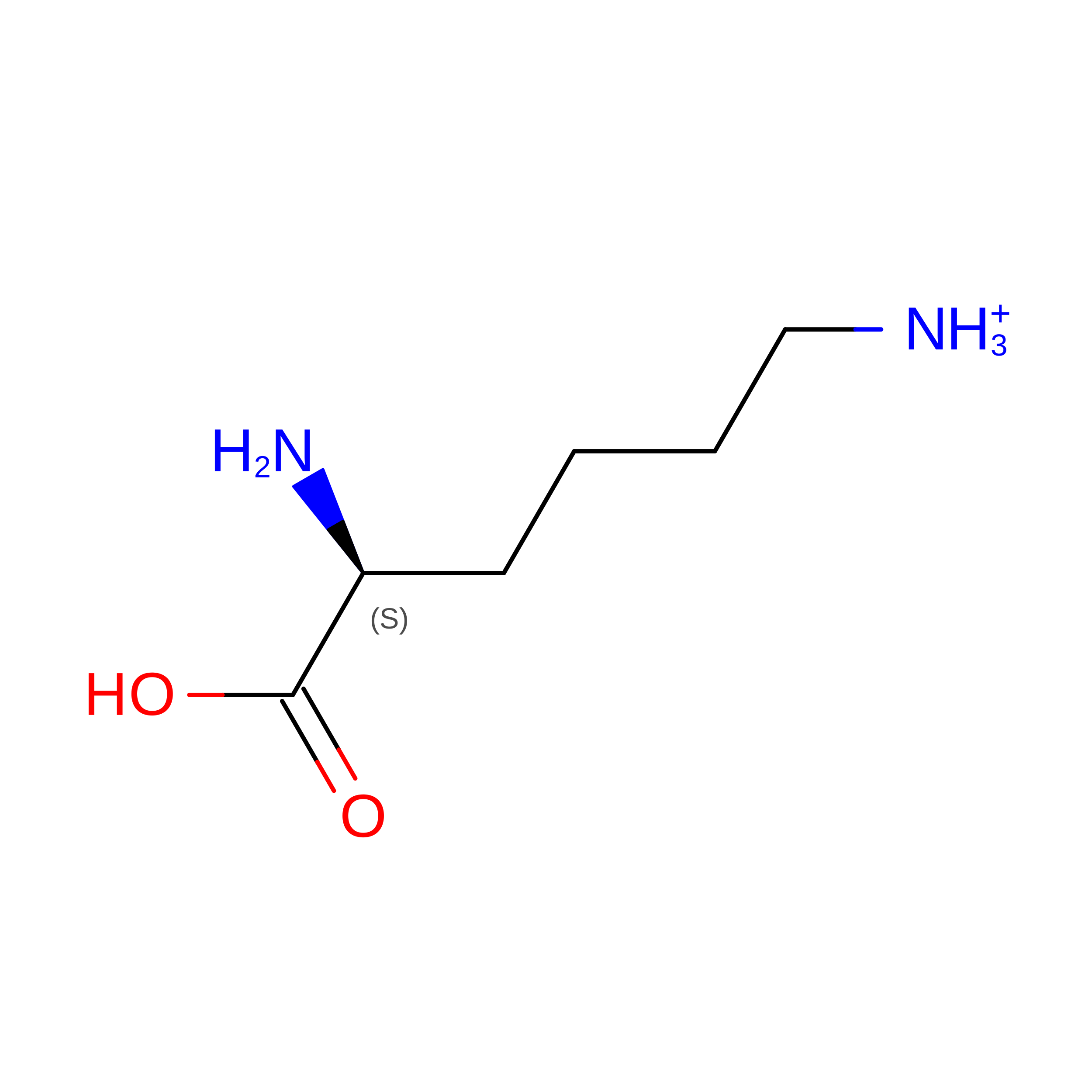
    Under conditions of extreme acidity, the lysine-specific permease, LysP, not only mediates the import of L-lysine it also interacts with the transcriptional regulator, CadC, to activate expression of the cadAB operon. This operon encodes the lysine decarboxylase, CadA, which converts lysine to cadaverine while consuming a cytoplasmic proton, and the antiporter, CadB, which exports protonated cadaverine in exchange for extracellular lysine. Together, these processes contribute to cytoplasmic pH homeostasis and support bacterial acid resistance - a mechanism essential for the survival of pathogenic bacteria in acidic host environments. Here, we present the cryo-EM structure of LysP from Pseudomonas aeruginosa in an inward-occluded conformation (3.2-5.3 Å resolution), bound to L-lysine and a nanobody. L-Lysine is coordinated by hydrophobic contacts, cation-π interactions, and by hydrogen bonding mostly with polar uncharged residues. Reconstitution of LysP into proteoliposomes confirms specific L-lysine transport, which is competitively inhibited by L-4-thialysine. These findings provide a structural framework for understanding selective lysine recognition and inhibition, with implications for antibacterial drug design.


  • Organizational Affiliation
    • BioStruct-Africa, Nairobi, Kenya.

Macromolecules
Find similar proteins by:  (by identity cutoff)  |  3D Structure
Entity ID: 1
MoleculeChains Sequence LengthOrganismDetailsImage
Lysine-specific permease475Pseudomonas aeruginosa PAO1Mutation(s): 0 
Gene Names: lysPPA4628
UniProt
Find proteins for Q9HVG3 (Pseudomonas aeruginosa (strain ATCC 15692 / DSM 22644 / CIP 104116 / JCM 14847 / LMG 12228 / 1C / PRS 101 / PAO1))
Explore Q9HVG3 
Go to UniProtKB:  Q9HVG3
Entity Groups  
Sequence Clusters30% Identity50% Identity70% Identity90% Identity95% Identity100% Identity
UniProt GroupQ9HVG3
Sequence Annotations
Expand
  • Reference Sequence
Find similar proteins by:  (by identity cutoff)  |  3D Structure
Entity ID: 2
MoleculeChains Sequence LengthOrganismDetailsImage
Nanobody CA5755132Lama glamaMutation(s): 0 
Entity Groups  
Sequence Clusters30% Identity50% Identity70% Identity90% Identity95% Identity100% Identity
Sequence Annotations
Expand
  • Reference Sequence
Small Molecules
Experimental Data & Validation

Experimental Data

  • Method: ELECTRON MICROSCOPY
  • Resolution: 3.68 Å
  • Aggregation State: PARTICLE 
  • Reconstruction Method: SINGLE PARTICLE 
EM Software:
TaskSoftware PackageVersion
MODEL REFINEMENTPHENIX

Structure Validation

View Full Validation Report


Entry History & Funding Information

Deposition Data


Funding OrganizationLocationGrant Number
Wellcome TrustUnited Kingdom222999/Z/21/Z

Revision History  (Full details and data files)

  • Version 1.0: 2025-10-29
    Type: Initial release
  • Version 1.1: 2025-11-26
    Changes: Data collection, Database references
  • Version 1.2: 2025-12-03
    Changes: Data collection, Structure summary
  • Version 1.3: 2025-12-17
    Changes: Data collection, Database references