Download Mendeley
Amphipathic Antimicrobial Peptides Illuminate a Reciprocal Relationship Between Self-assembly and Cytolytic Activity.
Laguera, B., Golden, M.M., Wang, F., Gnewou, O., Tuachi, A., Egelman, E.H., Wuest, W.M., Conticello, V.P.(2025) Angew Chem Int Ed Engl 64: e202500040-e202500040
- PubMed: 40073424 Search on PubMedSearch on PubMed Central
- DOI: https://doi.org/10.1002/anie.202500040
- Primary Citation Related Structures:
9EKC - PubMed Abstract:
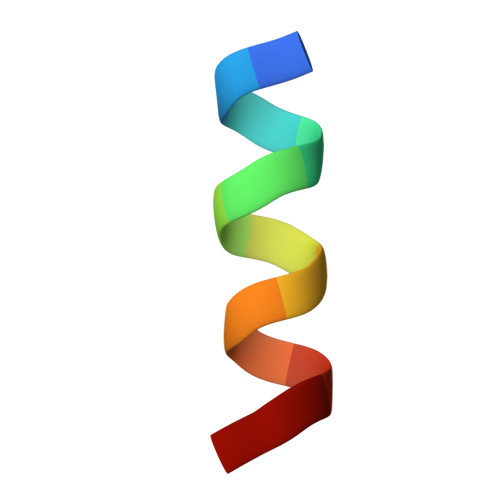
Amphipathic character, encoded within the polar sequence patterns of antimicrobial peptides, is a critical structural feature that influences membrane disruptive behavior. Similarly, polar sequence patterns induce self-assembly of amphipathic peptides, which results in the formation of ordered supramolecular structures. The relationship between self-assembly and membrane activity remains an open question of relevance for the development of effective antimicrobial peptides. Here, we report the structural investigation of a class of lytic peptides that self-assemble into filamentous nanomaterials. CryoEM analysis was employed to determine the structure of one of the filaments, which revealed that the peptides are self-assembled into a bilayer nanotube, in which the interaction between layers of amphipathic α-helices was mediated through hydrophobic interactions. The relative stability of the filament peptide assemblies depended on the influence of sequence modifications on the helical conformation. Antimicrobial assays indicated that cytolytic activity was associated with dynamic disassociation of the filamentous assemblies under the assay conditions. Structural modifications of the peptides that stabilized the filaments abrogated lytic activity. These results illuminate a reciprocal relationship between self-assembly and antimicrobial activity in this class of amphipathic peptides and that reversible assembly was critical for the observation of biological activity.
- Department of Chemistry, Emory University, Atlanta, GA, 30322, USA.
Organizational Affiliation: