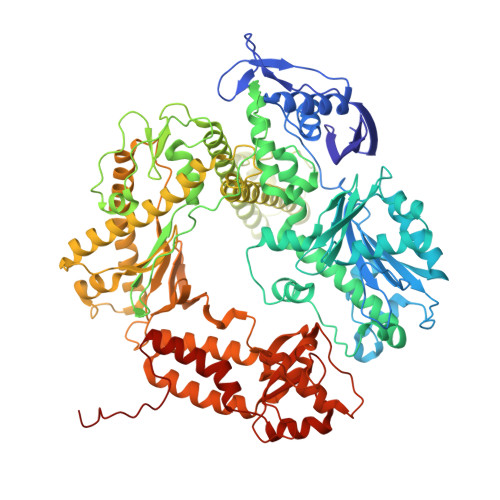
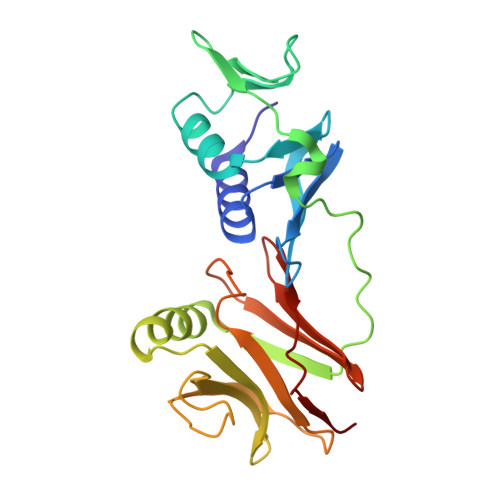
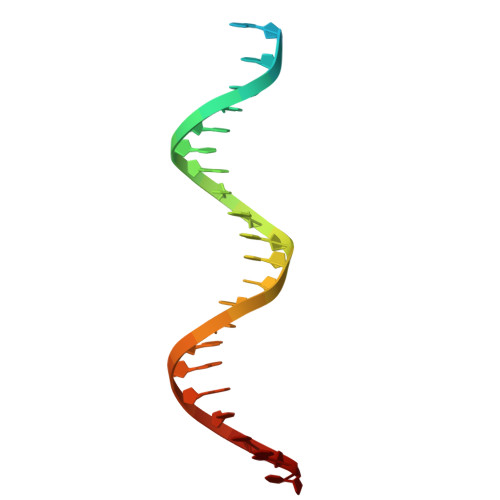
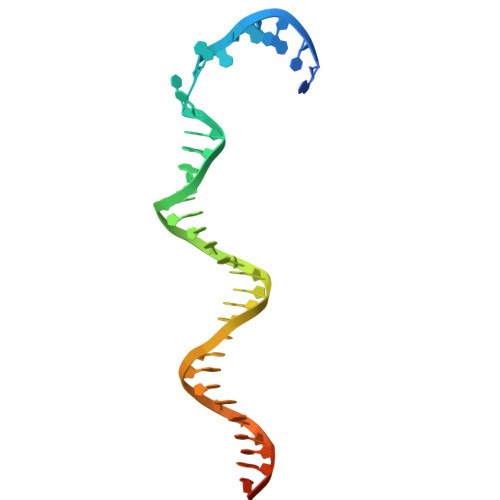
9EA2 | pdb_00009ea2

T4 Bacteriophage Replicative Polymerase Captured in Polymerase Exchange State 2


Experimental Data Snapshot

  • Method: ELECTRON MICROSCOPY
  • Resolution: 3.70 Å
  • Aggregation State: PARTICLE 
  • Reconstruction Method: SINGLE PARTICLE 

Starting Models: experimental, in silico
View more details

wwPDB Validation   3D Report Full Report


This is version 1.1 of the entry. See complete history


Literature

Structural insights into the exchange mechanism of a replicative DNA polymerase.

Feng, X.Spiering, M.M.Ruda de Luna Santos, A.Benkovic, S.J.Li, H.

(2025) Nucleic Acids Res 53

  • DOI: https://doi.org/10.1093/nar/gkaf1359
  • Primary Citation of Related Structures:  
    9E5Y, 9EA2, 9EA3, 9EA6

  • PubMed Abstract: 

    Replicative DNA polymerases are distinguished by their speed, processivity, and fidelity. While speed and fidelity arise from the polymerase's intrinsic catalytic and proofreading activities, processivity is typically attributed to the DNA sliding clamp that tethers the polymerase to DNA. However, additional mechanisms may also contribute. The T4 bacteriophage polymerase can exchange on-the-fly, a process likely contributing to its ∼10-fold higher synthesis rate compared with human polymerases. Here, we reconstituted the T4 holoenzyme and polymerase exchange complexes using purified gp43 polymerase, gp45 sliding clamp, and a primer-template DNA substrate. Cryo-electron microscopy (cryo-EM) analysis revealed either one or two polymerases bound to the clamp and DNA. In the one-polymerase complex, the DNA threads perpendicularly through the clamp, supporting processive synthesis. In contrast, the two-polymerase complex displays a markedly tilted DNA orientation, impeding sliding and representing exchange intermediates. Three distinct conformational states of the two-polymerase complex define a multistep exchange mechanism. To our knowledge, these findings provide the first molecular-level view of replicative polymerase exchange.


  • Organizational Affiliation
    • Department of Structural Biology, Van Andel Institute, Grand Rapids, MI 49503, United States.

Macromolecules

Find similar proteins by:  (by identity cutoff)  |  3D Structure
Entity ID: 1
MoleculeChains Sequence LengthOrganismDetailsImage
DNA-directed DNA polymerase
A, C
898Escherichia phage T4Mutation(s): 1 
EC: 2.7.7.7 (PDB Primary Data), 3.1.11 (PDB Primary Data)
UniProt
Find proteins for A0A7S9SVB6 (Escherichia phage T4)
Explore A0A7S9SVB6 
Go to UniProtKB:  A0A7S9SVB6
Entity Groups  
Sequence Clusters30% Identity50% Identity70% Identity90% Identity95% Identity100% Identity
UniProt GroupA0A7S9SVB6
Sequence Annotations
Expand
  • Reference Sequence
Find similar proteins by:  (by identity cutoff)  |  3D Structure
Entity ID: 2
MoleculeChains Sequence LengthOrganismDetailsImage
Sliding clamp
B, D, E
228Escherichia phage T4Mutation(s): 0 
Gene Names: 45
UniProt
Find proteins for P04525 (Enterobacteria phage T4)
Explore P04525 
Go to UniProtKB:  P04525
Entity Groups  
Sequence Clusters30% Identity50% Identity70% Identity90% Identity95% Identity100% Identity
UniProt GroupP04525
Sequence Annotations
Expand
  • Reference Sequence

Find similar nucleic acids by:  Sequence   |   3D Structure  

Entity ID: 3
MoleculeChains LengthOrganismImage
DNA (5'-AGC TAT GAC CAT GAT TAC GAA TTG ddC-3')F [auth P]25synthetic construct
Sequence Annotations
Expand
  • Reference Sequence
Find similar nucleic acids by:  (by identity cutoff)  |  3D Structure
Entity ID: 4
MoleculeChains LengthOrganismImage
DNA (38-MER)G [auth T]38synthetic construct
Sequence Annotations
Expand
  • Reference Sequence
Experimental Data & Validation

Experimental Data

  • Method: ELECTRON MICROSCOPY
  • Resolution: 3.70 Å
  • Aggregation State: PARTICLE 
  • Reconstruction Method: SINGLE PARTICLE 
EM Software:
TaskSoftware PackageVersion
RECONSTRUCTIONcryoSPARC4.2.1
MODEL REFINEMENTPHENIX1.20
MODEL REFINEMENTCoot0.9.8

Structure Validation

View Full Validation Report


Entry History & Funding Information

Deposition Data


Funding OrganizationLocationGrant Number
National Institutes of Health/National Institute of General Medical Sciences (NIH/NIGMS)United StatesGM013306
National Institutes of Health/National Institute of General Medical Sciences (NIH/NIGMS)United StatesGM131754

Revision History  (Full details and data files)

  • Version 1.0: 2025-11-19
    Type: Initial release
  • Version 1.1: 2026-01-14
    Changes: Data collection, Database references