9E1T | pdb_00009e1t

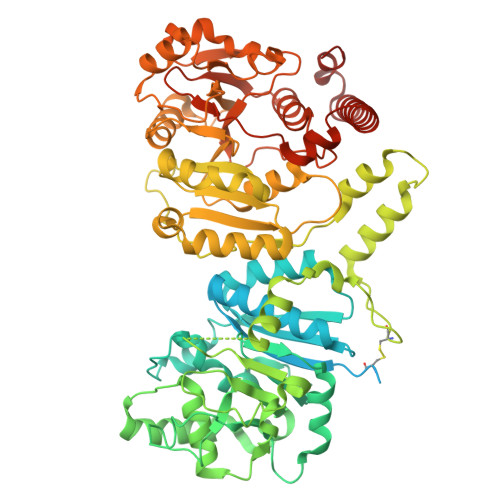
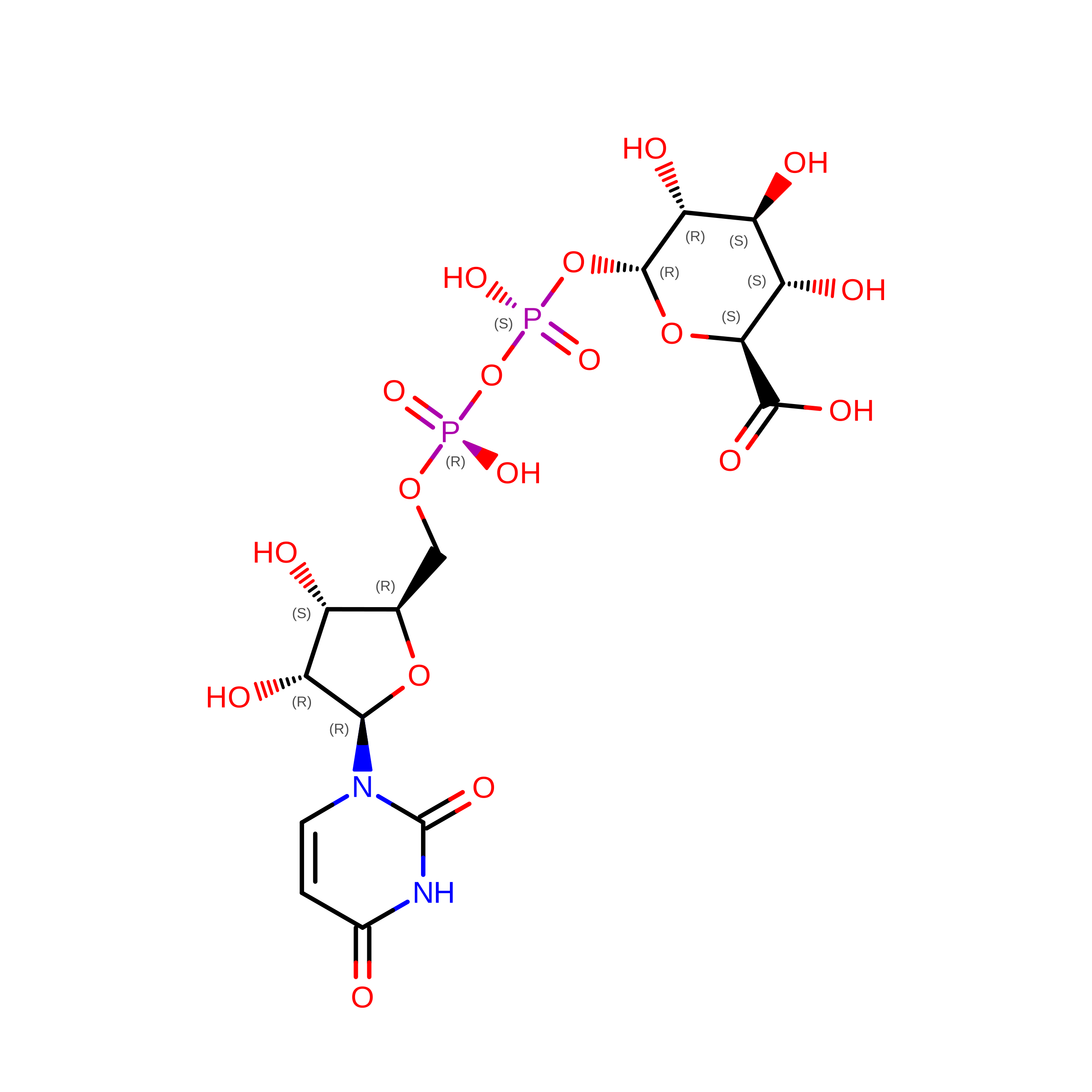
CryoEM structure of LARGE1 bound to UDP-GlcA

  • Classification: TRANSFERASE
  • Organism(s): Homo sapiens
  • Expression System: Homo sapiens
  • Mutation(s): No 

  • Deposited: 2024-10-21 Released: 2025-02-12 
  • Deposition Author(s): Joseph, S., Spellmon, N., Campbell, K.P.
  • Funding Organization(s): Howard Hughes Medical Institute (HHMI), National Institutes of Health/Eunice Kennedy Shriver National Institute of Child Health & Human Development (NIH/NICHD)

Experimental Data Snapshot

  • Method: ELECTRON MICROSCOPY
  • Resolution: 3.00 Å
  • Aggregation State: PARTICLE 
  • Reconstruction Method: SINGLE PARTICLE 

wwPDB Validation 3D Report Full Report

Validation slider image for 9E1T

This is version 2.0 of the entry. See complete history

Literature

LARGE1 processively polymerizes length-controlled matriglycan on prodystroglycan.

Joseph, S.Schnicker, N.J.Spellmon, N.Xu, Z.Yan, R.Yu, Z.Davulcu, O.Yang, T.Hopkins, J.Anderson, M.E.Venzke, D.Campbell, K.P.

(2025) Nat Commun 16: 9028-9028

  • DOI: https://doi.org/10.1038/s41467-025-64080-z
  • Primary Citation Related Structures: 
    9E1T

  • PubMed Abstract: 

    Matriglycan is a linear glycan (xylose-β1,3-glucuronate) n , which binds proteins in the extracellular matrix that contain laminin-globular domains and Lassa Fever Virus. It is indispensable for neuromuscular function. Matriglycan of insufficient length can cause muscular dystrophy with abnormal brain and eye development. LARGE1 (Like-acetylglucosaminyltransferase-1) uniquely synthesizes matriglycan on dystroglycan. The mechanism of matriglycan synthesis is not obvious from cryo-EM reconstructions of LARGE1. However, by reconstituting activity in vitro on recombinant prodystroglycan we show that the presence of the dystroglycan N-terminal domain (DGN), phosphorylated core M3, and a xylose-glucuronate primer are necessary for matriglycan polymerization by LARGE1. By introducing active site mutations, we demonstrate that LARGE1 processively polymerizes matriglycan on prodystroglycan, with its length regulated by the dystroglycan prodomain, DGN. Our enzymatic analysis of LARGE1 uncovers the mechanism of matriglycan synthesis on dystroglycan, which can form the basis for therapeutic strategies to treat matriglycan-deficient neuromuscular disorders and arenaviral infections.


  • Organizational Affiliation
    • Senator Paul D. Wellstone Muscular Dystrophy Specialized Research Center, University of Iowa Roy J. and Lucille A. Carver College of Medicine, Iowa City, IA, USA.

Macromolecule Content 

  • Total Structure Weight: 180.88 kDa 
  • Atom Count: 10,056 
  • Modeled Residue Count: 1,204 
  • Deposited Residue Count: 1,540 
  • Unique protein chains: 1

Macromolecules

Find similar proteins by:|  3D Structure
Entity ID: 1
MoleculeChains  Sequence LengthOrganismDetailsImage
Xylosyl- and glucuronyltransferase LARGE1
A, B
770Homo sapiensMutation(s): 0 
Gene Names: LARGE1KIAA0609LARGE
EC: 2.4 (PDB Primary Data), 2.4.2 (PDB Primary Data), 2.4.1 (PDB Primary Data)
UniProt & NIH Common Fund Data Resources
Find proteins for O95461 (Homo sapiens)
Explore O95461 
Go to UniProtKB:  O95461
PHAROS:  O95461
GTEx:  ENSG00000133424 
Entity Groups
Sequence Clusters30% Identity50% Identity70% Identity90% Identity95% Identity100% Identity
UniProt GroupO95461
Sequence Annotations
Expand
Reference Sequence

Experimental Data & Validation

Experimental Data

  • Method: ELECTRON MICROSCOPY
  • Resolution: 3.00 Å
  • Aggregation State: PARTICLE 
  • Reconstruction Method: SINGLE PARTICLE 
EM Software:
TaskSoftware PackageVersion
RECONSTRUCTIONRELION
RECONSTRUCTIONPHENIX

Structure Validation

View Full Validation Report


Entry History 

& Funding Information

Deposition Data


Funding OrganizationLocationGrant Number
Howard Hughes Medical Institute (HHMI)United States--
National Institutes of Health/Eunice Kennedy Shriver National Institute of Child Health & Human Development (NIH/NICHD)United StatesU54 NS053672
National Institutes of Health/Eunice Kennedy Shriver National Institute of Child Health & Human Development (NIH/NICHD)United StatesU24 GM129547

Revision History  (Full details and data files)

  • Version 1.0: 2025-02-12
    Type: Initial release
  • Version 1.1: 2025-05-21
    Changes: Data collection
  • Version 2.0: 2025-10-22
    Type: Coordinate replacement
    Reason: Ligand geometry
    Changes: Advisory, Atomic model, Author supporting evidence, Data collection, Database references, Derived calculations, Non-polymer description, Refinement description, Structure summary