9DZE | pdb_00009dze

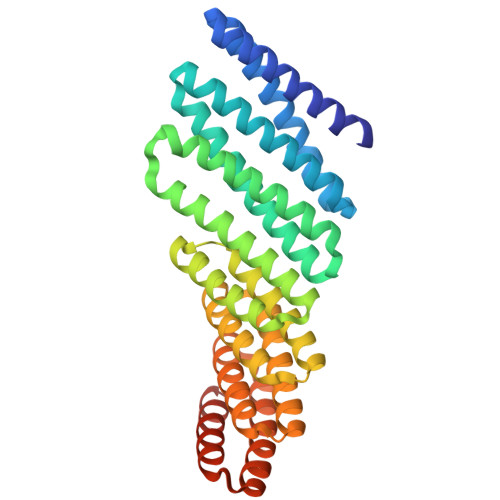
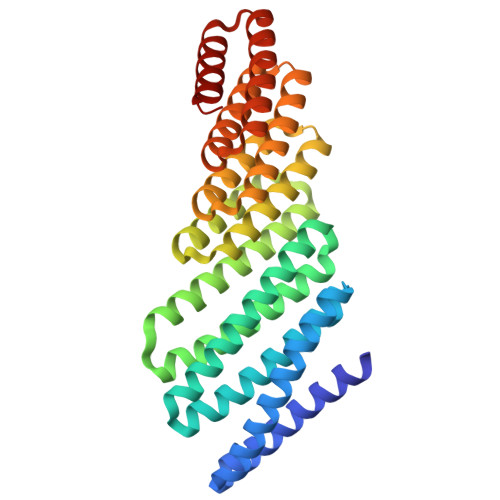
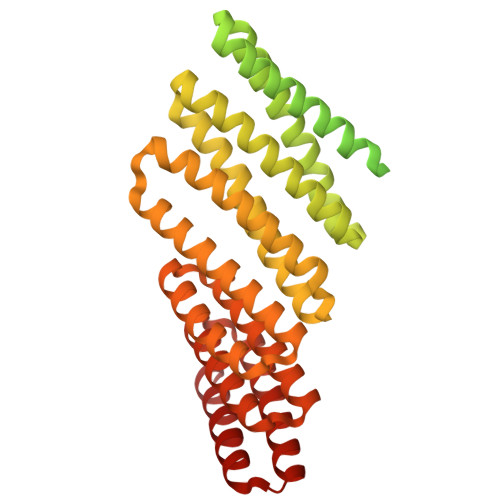
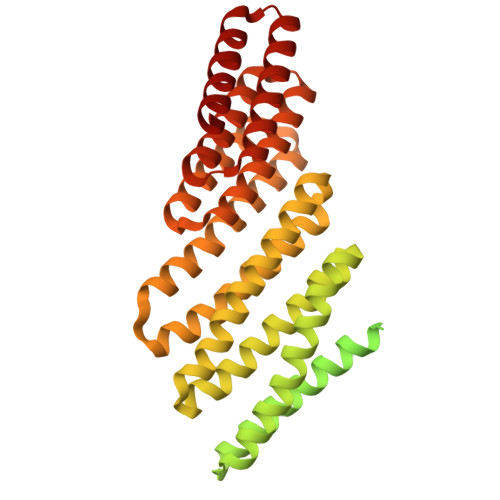
Computationally Designed Bifaceted Protein Nanomaterial pD5-14

  • Classification: DE NOVO PROTEIN
  • Organism(s): synthetic construct
  • Expression System: Escherichia coli
  • Mutation(s): No 

  • Deposited: 2024-10-16 Released: 2024-10-30 
  • Deposition Author(s): Carr, K.D., Borst, A.J., Weidle, C.
  • Funding Organization(s): Bill & Melinda Gates Foundation, National Institutes of Health/National Institute Of Allergy and Infectious Diseases (NIH/NIAID), Howard Hughes Medical Institute (HHMI), Swedish Research Council

Experimental Data Snapshot

  • Method: ELECTRON MICROSCOPY
  • Resolution: 4.30 Å
  • Aggregation State: PARTICLE 
  • Reconstruction Method: SINGLE PARTICLE 

wwPDB Validation   3D Report Full Report


This is version 1.2 of the entry. See complete history


Literature

Computational design of bifaceted protein nanomaterials with tailorable properties.

Rankovic, S.Carr, K.D.Decarreau, J.Skotheim, R.Kibler, R.D.Ols, S.Lee, S.Chun, J.Tooley, M.Dauparas, J.Eisenach, H.E.Glogl, M.Weidle, C.Borst, A.J.Baker, D.King, N.P.

(2024) bioRxiv 

  • DOI: https://doi.org/10.1101/2024.10.18.619149
  • Primary Citation of Related Structures:  
    9DZE

  • PubMed Abstract: 

    Recent advances in computational methods have led to considerable progress in the design of self-assembling protein nanoparticles. However, nearly all nanoparticles designed to date exhibit strict point group symmetry, with each subunit occupying an identical, symmetrically related environment. This property limits the structural diversity that can be achieved and precludes anisotropic functionalization. Here, we describe a general computational strategy for designing multi-component bifaceted protein nanomaterials with two distinctly addressable sides. The method centers on docking pseudosymmetric heterooligomeric building blocks in architectures with dihedral symmetry and designing an asymmetric protein-protein interface between them. We used this approach to obtain an initial 30-subunit assembly with pseudo-D5 symmetry, and then generated an additional 15 variants in which we controllably altered the size and morphology of the bifaceted nanoparticles by designing de novo extensions to one of the subunits. Functionalization of the two distinct faces of the nanoparticles with de novo protein minibinders enabled specific colocalization of two populations of polystyrene microparticles coated with target protein receptors. The ability to accurately design anisotropic protein nanomaterials with precisely tunable structures and functions will be broadly useful in applications that require colocalizing two or more distinct target moieties.


  • Organizational Affiliation
    • Department of Biochemistry, University of Washington, Seattle, WA, USA.

Macromolecules
Find similar proteins by:  (by identity cutoff)  |  3D Structure
Entity ID: 1
MoleculeChains Sequence LengthOrganismDetailsImage
pD5-14 A component
A, B, C, D, E
A, B, C, D, E, F, G, H, I, J
331synthetic constructMutation(s): 0 
Entity Groups  
Sequence Clusters30% Identity50% Identity70% Identity90% Identity95% Identity100% Identity
Sequence Annotations
Expand
  • Reference Sequence
Find similar proteins by:  (by identity cutoff)  |  3D Structure
Entity ID: 2
MoleculeChains Sequence LengthOrganismDetailsImage
pD5-14 B component
K, L, M, N, O
K, L, M, N, O, P, Q, R, S, T
320synthetic constructMutation(s): 0 
Entity Groups  
Sequence Clusters30% Identity50% Identity70% Identity90% Identity95% Identity100% Identity
Sequence Annotations
Expand
  • Reference Sequence
Find similar proteins by:  (by identity cutoff)  |  3D Structure
Entity ID: 3
MoleculeChains Sequence LengthOrganismDetailsImage
pD5-14 C componentU [auth a],
V [auth b],
W [auth c],
X [auth d],
Y [auth e]
511synthetic constructMutation(s): 0 
Entity Groups  
Sequence Clusters30% Identity50% Identity70% Identity90% Identity95% Identity100% Identity
Sequence Annotations
Expand
  • Reference Sequence
Find similar proteins by:  (by identity cutoff)  |  3D Structure
Entity ID: 4
MoleculeChains Sequence LengthOrganismDetailsImage
pD5-14 D componentAA [auth g],
BA [auth h],
CA [auth i],
DA [auth j],
Z [auth f]
515synthetic constructMutation(s): 0 
Entity Groups  
Sequence Clusters30% Identity50% Identity70% Identity90% Identity95% Identity100% Identity
Sequence Annotations
Expand
  • Reference Sequence
Experimental Data & Validation

Experimental Data

  • Method: ELECTRON MICROSCOPY
  • Resolution: 4.30 Å
  • Aggregation State: PARTICLE 
  • Reconstruction Method: SINGLE PARTICLE 
EM Software:
TaskSoftware PackageVersion
MODEL REFINEMENTPHENIX
MODEL REFINEMENTISOLDE
MODEL REFINEMENTCoot
RECONSTRUCTIONcryoSPARC4.4.0

Structure Validation

View Full Validation Report


Entry History & Funding Information

Deposition Data


Funding OrganizationLocationGrant Number
Bill & Melinda Gates FoundationUnited States--
National Institutes of Health/National Institute Of Allergy and Infectious Diseases (NIH/NIAID)United States--
Howard Hughes Medical Institute (HHMI)United States--
Swedish Research CouncilSweden--

Revision History  (Full details and data files)

  • Version 1.0: 2024-10-30
    Type: Initial release
  • Version 1.1: 2024-11-06
    Changes: Data collection, Structure summary
  • Version 1.2: 2024-11-13
    Changes: Data collection, Database references