Download Mendeley
Ion channel structure and function of the MERS coronavirus E protein.
Sucec, I., Xia, B., Somberg, N.H., Wang, Y., Jo, H., Li, S., Perrone, B., Gao, Z., Hong, M.(2025) Sci Adv 11: eadx1788-eadx1788
- PubMed: 40632851
- DOI: https://doi.org/10.1126/sciadv.adx1788
- Primary Citation Related Structures:
9DCJ - PubMed Abstract:
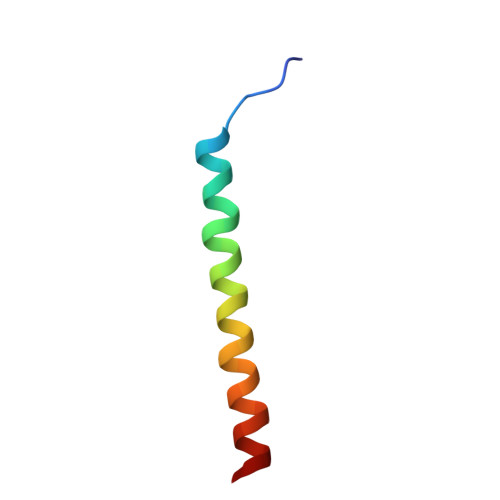
Coronavirus envelope (E) proteins form drug-targeted ion channels that cause virulence to infected cells. The Middle East respiratory syndrome (MERS) virus has high mortality rates, but its E structure and function are unknown. We report the single-channel conductance and structure of membrane-bound MERS E protein. MERS E conducts K + ions with a unitary conductance of 113 picosiemens, fivefold larger than the conductance of severe acute respiratory syndrome coronavirus 2 E. Solid-state nuclear magnetic resonance data indicate that the MERS E transmembrane domain forms a five-helix bundle that spans the lipid bilayer. The amino-terminal helical interface features multiple interacting phenylalanine (Phe) residues and an asparagine (Asn), whereas the carboxyl-terminal channel pore contains Phe 33 . Mutation of Phe 17 abolished K + conductance, whereas mutations of Phe 33 and Asn 15 suppressed most channel activity. These results indicate that MERS E contains two Phe-centered ion-conduction apparatuses, which likely permeate ions through cation-π interactions, providing the structural basis for developing antiviral drugs to inhibit this pathogenic viroporin.
- Department of Chemistry, Massachusetts Institute of Technology, 170 Albany Street, Cambridge, MA 02139, USA.
Organizational Affiliation: