9C9P | pdb_00009c9p

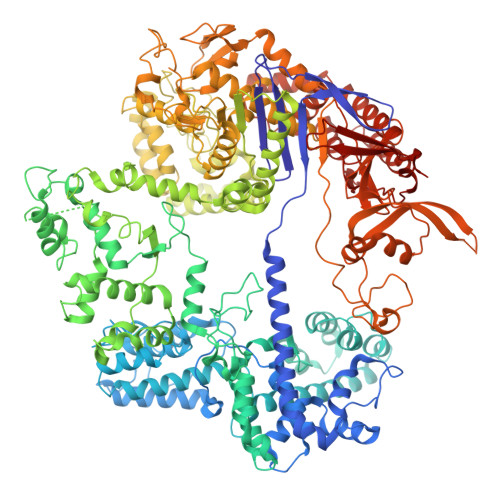
Cas9 ternary complex, 14-nt sgRNA, State I (linear)


Experimental Data Snapshot

  • Method: ELECTRON MICROSCOPY
  • Resolution: 3.10 Å
  • Aggregation State: PARTICLE 
  • Reconstruction Method: SINGLE PARTICLE 

wwPDB Validation   3D Report Full Report


This is version 1.2 of the entry. See complete history


Literature

Structural basis of Cas9 DNA interrogation with a 5' truncated sgRNA.

Kiernan, K.A.Kwon, J.Merrill, B.J.Simonovic, M.

(2025) Nucleic Acids Res 53

  • DOI: https://doi.org/10.1093/nar/gkae1164
  • Primary Citation of Related Structures:  
    9C9P, 9CGU

  • PubMed Abstract: 

    The efficiency and accuracy of CRISPR-Cas9 targeting varies considerably across genomic targets and remains a persistent issue for using this system in cells. Studies have shown that the use of 5' truncated single guide RNAs (sgRNAs) can reduce the rate of unwanted off-target recognition while still maintaining on-target specificity. However, it is not well-understood how reducing target complementarity enhances specificity or how truncation past 15 nucleotides (nts) prevents full Cas9 activation without compromising on-target binding. Here, we use biochemistry and cryogenic electron microscopy to investigate Cas9 structure and activity when bound to a 14-nt sgRNA. Our structures reveal that the shortened path of the displaced non-target strand (NTS) sterically occludes docking of the HNH L1 linker and prevents proper positioning of the nuclease domains. We show that cleavage inhibition can be alleviated by either artificially melting the protospacer adjacent motif (PAM)-distal duplex or providing a supercoiled substrate. Even though Cas9 forms a stable complex with its target, we find that plasmid cleavage is ∼1000-fold slower with a 14-nt sgRNA than with a full-length 20-nt sgRNA. Our results provide a structural basis for Cas9 target binding with 5' truncated sgRNAs and underline the importance of PAM-distal NTS availability in promoting Cas9 activation.


  • Organizational Affiliation
    • Department of Biochemistry and Molecular Genetics, University of Illinois Chicago, 900 S Ashland Ave, Chicago, IL 60607, USA.

Macromolecules

Find similar proteins by:  (by identity cutoff)  |  3D Structure
Entity ID: 1
MoleculeChains Sequence LengthOrganismDetailsImage
CRISPR-associated endonuclease Cas9/Csn11,368Streptococcus pyogenesMutation(s): 0 
Gene Names: cas9csn1SPy_1046
EC: 3.1
UniProt
Find proteins for Q99ZW2 (Streptococcus pyogenes serotype M1)
Explore Q99ZW2 
Go to UniProtKB:  Q99ZW2
Entity Groups  
Sequence Clusters30% Identity50% Identity70% Identity90% Identity95% Identity100% Identity
UniProt GroupQ99ZW2
Sequence Annotations
Expand
  • Reference Sequence
Find similar nucleic acids by:  (by identity cutoff)  |  3D Structure
Entity ID: 2
MoleculeChains LengthOrganismImage
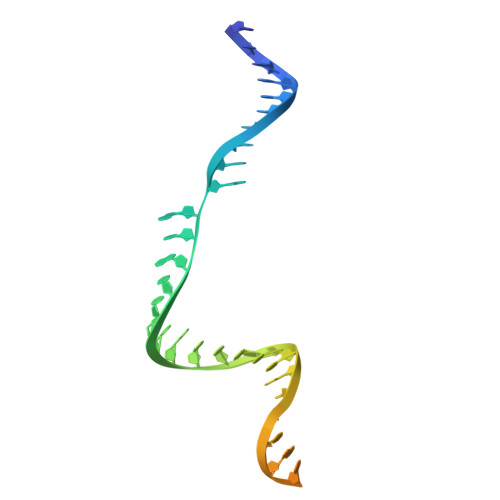
sgRNA94synthetic construct
Sequence Annotations
Expand
  • Reference Sequence
Find similar nucleic acids by:  (by identity cutoff)  |  3D Structure
Entity ID: 3
MoleculeChains LengthOrganismImage
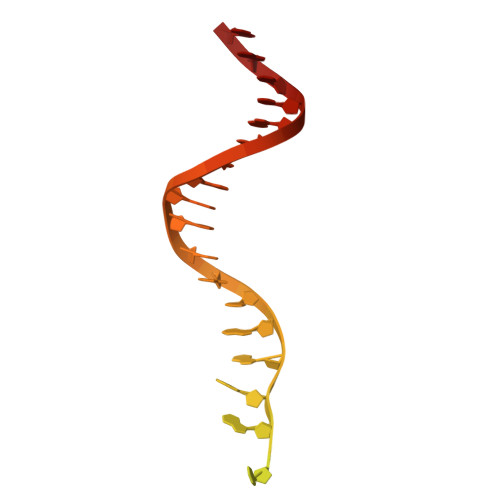
Target strand40synthetic construct
Sequence Annotations
Expand
  • Reference Sequence
Find similar nucleic acids by:  (by identity cutoff)  |  3D Structure
Entity ID: 4
MoleculeChains LengthOrganismImage
Non-target strand40synthetic construct
Sequence Annotations
Expand
  • Reference Sequence
Experimental Data & Validation

Experimental Data

  • Method: ELECTRON MICROSCOPY
  • Resolution: 3.10 Å
  • Aggregation State: PARTICLE 
  • Reconstruction Method: SINGLE PARTICLE 
EM Software:
TaskSoftware PackageVersion
MODEL REFINEMENTPHENIX1.21_5207
RECONSTRUCTIONcryoSPARC

Structure Validation

View Full Validation Report


Entry History & Funding Information

Deposition Data


Funding OrganizationLocationGrant Number
National Institutes of Health/National Institute of General Medical Sciences (NIH/NIGMS)United StatesGM097042
National Institutes of Health/National Institute of General Medical Sciences (NIH/NIGMS)United StatesF31GM143822

Revision History  (Full details and data files)

  • Version 1.0: 2024-12-04
    Type: Initial release
  • Version 1.1: 2024-12-25
    Changes: Data collection, Database references
  • Version 1.2: 2025-01-22
    Changes: Data collection, Database references