9BH0 | pdb_00009bh0

Ancestral uncoupled aspartate transporter in complex with L-aspartate


Experimental Data Snapshot

  • Method: ELECTRON MICROSCOPY
  • Resolution: 3.40 Å
  • Aggregation State: PARTICLE 
  • Reconstruction Method: SINGLE PARTICLE 

wwPDB Validation 3D Report Full Report

Validation slider image for 9BH0

This is version 1.0 of the entry. See complete history

Literature

Evolutionary analysis reveals the origin of sodium coupling in glutamate transporters.

Reddy, K.D.Rasool, B.Akher, F.B.Kutlesic, N.Pant, S.Boudker, O.

(2024) bioRxiv 

  • DOI: https://doi.org/10.1101/2023.12.03.569786
  • Primary Citation Related Structures: 
    9BGY, 9BGZ, 9BH0, 9BH1, 9BH2

  • PubMed Abstract: 

    Secondary active membrane transporters harness the energy of ion gradients to concentrate their substrates. Homologous transporters evolved to couple transport to different ions in response to changing environments and needs. The bases of such diversification, and thus principles of ion coupling, are unexplored. Employing phylogenetics and ancestral protein reconstruction, we investigated sodium-coupled transport in prokaryotic glutamate transporters, a mechanism ubiquitous across life domains and critical to neurotransmitter recycling in humans. We found that the evolutionary transition from sodium-dependent to independent substrate binding to the transporter preceded changes in the coupling mechanism. Structural and functional experiments suggest that the transition entailed allosteric mutations, making sodium binding dispensable without affecting ion-binding sites. Allosteric tuning of transporters' energy landscapes might be a widespread route of their functional diversification.


  • Organizational Affiliation
    • Dept. of Physiology & Biophysics, Weill Cornell Medical College, 1300 York Ave, New York, NY 10021, USA.

Macromolecule Content 

  • Total Structure Weight: 44.04 kDa 
  • Atom Count: 2,934 
  • Modeled Residue Count: 390 
  • Deposited Residue Count: 410 
  • Unique protein chains: 1

Macromolecules

Find similar proteins by:|  3D Structure
Entity ID: 1
MoleculeChains  Sequence LengthOrganismDetailsImage
Aspartate transporter410synthetic constructMutation(s): 0 

Small Molecules

Ligands 1 Unique
IDChains Name / Formula / InChI Key2D Diagram3D Interactions
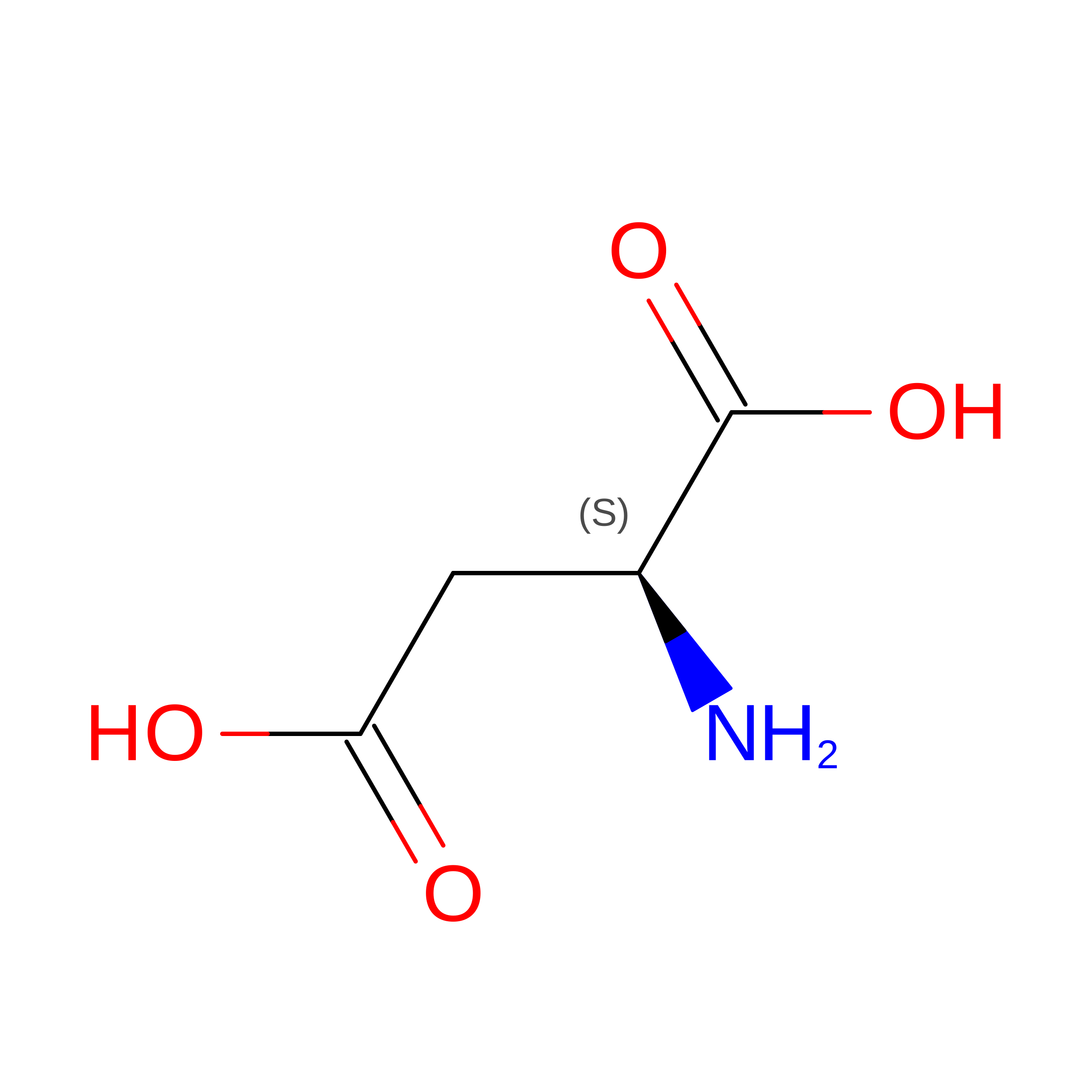
ASP
(Subject of Investigation/LOI)

Query on ASP


Download:Ideal Coordinates CCD File
B [auth A]ASPARTIC ACID
C4 H7 N O4
CKLJMWTZIZZHCS-REOHCLBHSA-N

Experimental Data & Validation

Experimental Data

  • Method: ELECTRON MICROSCOPY
  • Resolution: 3.40 Å
  • Aggregation State: PARTICLE 
  • Reconstruction Method: SINGLE PARTICLE 

Structure Validation

View Full Validation Report


Entry History 

& Funding Information

Deposition Data


Funding OrganizationLocationGrant Number
National Institutes of Health/National Institute of Neurological Disorders and Stroke (NIH/NINDS)United StatesR37NS134865
National Institutes of Health/National Institute of Neurological Disorders and Stroke (NIH/NINDS)United StatesF32NS102325

Revision History  (Full details and data files)

  • Version 1.0: 2025-03-12
    Type: Initial release