Download Mendeley
Structure of the CD33 Receptor and Implications for the Siglec Family.
Vu, H.N., Situ, A.J., Dai, X., Ulmer, T.S.(2025) Biochemistry 64: 1450-1462
- PubMed: 40067740 Search on PubMed
- DOI: https://doi.org/10.1021/acs.biochem.4c00864
- Primary Citation Related Structures:
9BET - PubMed Abstract:
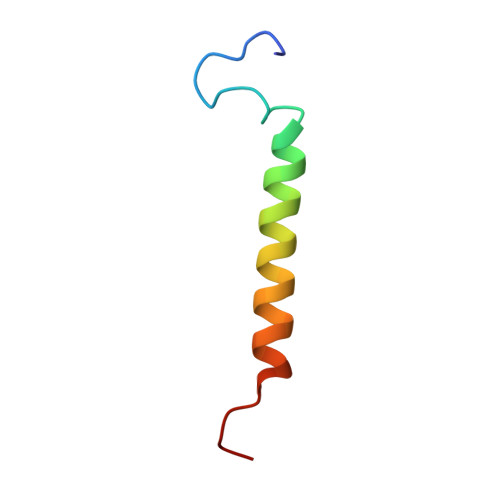
In the innate immune system, the CD33 receptor modulates microglial activity. Its downregulation promises to slow Alzheimer's disease, and it is already targeted in blood cancers. The mechanism underlying CD33 signaling is unresolved. Starting from the available crystal structure of its extracellular IgV-IgC1 domains, we have assembled a model of the human CD33 receptor by characterizing the oligomerization and structure of IgC1, transmembrane, and cytosolic domains in solution. IgC1 homodimerizes via intermolecular β-strand pairing and packing. In contrast, the 21-residue transmembrane helix of CD33 appears monomeric and straight, with a conserved thin neck and thick belly appearance followed by a positively charged cytosolic patch. The cytosolic domain is dynamically unstructured. Sequence alignment and AlphaFold models indicate that IgC domains in the family of human Siglecs, to which CD33 belongs, are surprisingly variable. Only Siglec-6 is identified to analogously dimerize via IgC1. Our CD33 structural model suggests that the receptor is not signaling via a monomer-dimer shift. Rather, we propose that, aided but also constrained by dimerization, multivalent ligands may concentrate the receptor transmembrane and cytosolic domains sufficiently to trigger colocalization with an activating kinase.
- Department of Physiology and Neuroscience, Zilkha Neurogenetic Institute, Keck School of Medicine, University of Southern California, Los Angeles, California 90033, United States.
Organizational Affiliation: