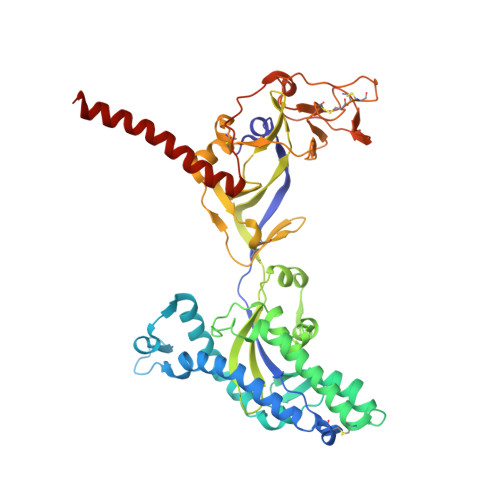
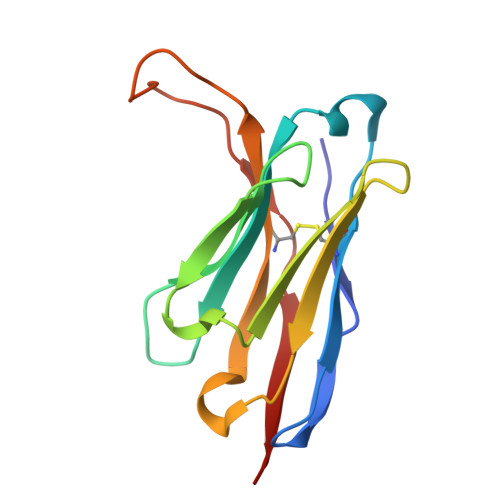
9B9E | pdb_00009b9e

Prefusion F glycoprotein ectodomain of Nipah virus ectodomain in complex with DS90 nanobody


Experimental Data Snapshot

  • Method: ELECTRON MICROSCOPY
  • Resolution: 3.66 Å
  • Aggregation State: PARTICLE 
  • Reconstruction Method: SINGLE PARTICLE 

wwPDB Validation   3D Report Full Report


This is version 1.2 of the entry. See complete history


Literature

A nanobody-based therapeutic targeting Nipah virus limits viral escape.

Isaacs, A.Nieto, G.V.Zhang, X.Modhiran, N.Barr, J.Thakur, N.Low, Y.S.Parry, R.H.Barnes, J.B.Jara, R.Himelreichs, J.Yao, Y.Deride, C.Barthou-Gatica, B.Salinas-Rebolledo, C.Ehrenfeld, P.Hen, J.J.Hayes, N.Paramitha, D.Morgan, M.S.McMillan, C.L.D.Jones, M.L.Munro, T.P.Khromykh, A.A.Reading, P.C.Young, P.R.Chappell, K.J.Shi, Y.Bailey, D.Marsh, G.A.Chiu, S.Rojas-Fernandez, A.Watterson, D.

(2025) Nat Struct Mol Biol 32: 1920-1931

  • DOI: https://doi.org/10.1038/s41594-025-01598-2
  • Primary Citation of Related Structures:  
    9B9E

  • PubMed Abstract: 

    Nipah virus (NiV) and Hendra virus (HeV) are highly pathogenic henipaviruses without approved human vaccines or therapies. Here, we report on a highly potent bispecific therapeutic that combines an anti-fusion glycoprotein nanobody with an anti-receptor-binding glycoprotein (RBP) antibody to deliver a dual-targeting biologic that is resistant to viral escape. We show that the nanobody, DS90, engages a unique, conserved site within the fusion glycoprotein of NiV and HeV and provides neutralization and complete protection from NiV disease. Bispecific engineering of DS90 with the anti-RBP monoclonal antibody m102.4 results in neutralization, elimination of viral escape and superior protection from NiV disease compared to leading monovalent approaches. These findings carry implications for the development of cross-neutralizing immunotherapies that limit the emergence of henipaviral escape mutants.


  • Organizational Affiliation
    • School of Chemistry and Molecular Biosciences, The University of Queensland, Brisbane, Queensland, Australia.

Macromolecules
Find similar proteins by:  (by identity cutoff)  |  3D Structure
Entity ID: 1
MoleculeChains Sequence LengthOrganismDetailsImage
Fusion glycoprotein F0
A, B, C
457Henipavirus nipahenseMutation(s): 0 
UniProt
Find proteins for Q9IH63 (Nipah virus)
Explore Q9IH63 
Go to UniProtKB:  Q9IH63
Entity Groups  
Sequence Clusters30% Identity50% Identity70% Identity90% Identity95% Identity100% Identity
UniProt GroupQ9IH63
Glycosylation
Glycosylation Sites: 4
Sequence Annotations
Expand
  • Reference Sequence
Find similar proteins by:  (by identity cutoff)  |  3D Structure
Entity ID: 2
MoleculeChains Sequence LengthOrganismDetailsImage
DS90 nanobody
D, E, F
124Vicugna pacosMutation(s): 0 
Entity Groups  
Sequence Clusters30% Identity50% Identity70% Identity90% Identity95% Identity100% Identity
Sequence Annotations
Expand
  • Reference Sequence
Small Molecules
Ligands 1 Unique
IDChains Name / Formula / InChI Key2D Diagram3D Interactions
NAG (Subject of Investigation/LOI)
Query on NAG

Download Ideal Coordinates CCD File 
G [auth A]
H [auth A]
I [auth A]
J [auth A]
K [auth B]
G [auth A],
H [auth A],
I [auth A],
J [auth A],
K [auth B],
L [auth B],
M [auth B],
N [auth B],
O [auth C],
P [auth C],
Q [auth C],
R [auth C]
2-acetamido-2-deoxy-beta-D-glucopyranose
C8 H15 N O6
OVRNDRQMDRJTHS-FMDGEEDCSA-N
Experimental Data & Validation

Experimental Data

  • Method: ELECTRON MICROSCOPY
  • Resolution: 3.66 Å
  • Aggregation State: PARTICLE 
  • Reconstruction Method: SINGLE PARTICLE 
EM Software:
TaskSoftware PackageVersion
RECONSTRUCTIONcryoSPARC3.3.1
MODEL REFINEMENTPHENIX1.20.1

Structure Validation

View Full Validation Report


Entry History & Funding Information

Deposition Data


Funding OrganizationLocationGrant Number
National Health and Medical Research Council (NHMRC, Australia)AustraliaAPP1144025

Revision History  (Full details and data files)

  • Version 1.0: 2025-06-04
    Type: Initial release
  • Version 1.1: 2025-12-17
    Changes: Data collection, Database references
  • Version 1.2: 2025-12-24
    Changes: Data collection, Database references