Download Mendeley
Chimeric Glycoprotein Nanoparticles Elicit Robust Neutralizing Antibodies Against Epstein-Barr Virus.
Sun, C., Xie, C., Fang, X.Y., Hong, D.C., Zhang, H., Wu, P.H., Liu, Y.N., Bu, G.L., Cao, D.H., Si-Tu, M.Y., Peng, Y.J., Wang, J., Feng, G.K., Zhong, Q., Liu, Z., Zeng, M.S.(2026) Adv Mater 38
- PubMed: 41045177 Search on PubMed
- DOI: https://doi.org/10.1002/adma.202507012
- Primary Citation Related Structures:
8YY6 - PubMed Abstract:
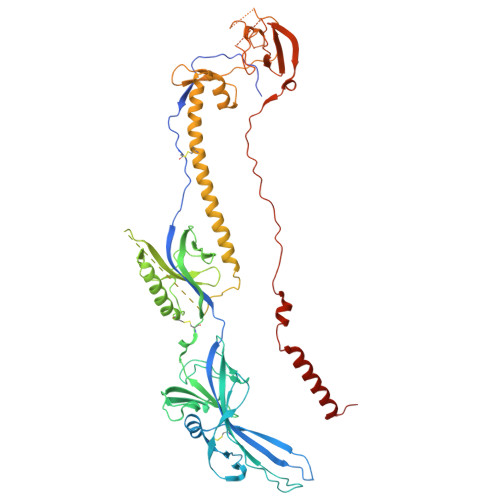
Epstein‒Barr virus (EBV) is a ubiquitous gammaherpesvirus linked to a broad spectrum of malignancies and autoimmune diseases with no approved therapeutic drugs or vaccines. EBV infection relies on the viral glycoproteins gB and gHgL, which, together, function as the fusion apparatus, mediating viral recognition and membrane fusion in both epithelial and B cells. Despite discovering potent neutralizing antibodies targeting gB and gHgL, the heterogeneous antigen structures and distribution of multiple glycoproteins in the virion hinder rational vaccine design targeting this apparatus complex. In this study, Chimeric nanoparticles (Chimeric-NPs) are designed that co-display EBV fusion apparatus and induce significantly more neutralizing antibodies in mice and nonhuman primates than the cocktail counterparts. It is further demonstrated that the Chimeric-NPs elicited neutralizing antibodies predominantly targeting gB, closely mimicking the antibody induction pattern by the whole EBV virion. Additionally, single-BCR sequencing is used to analyze the B cell response to Chimeric-NP, and a novel gB neutralizing antibody Fab5 targeting a new vulnerable site EBV gB is identified. These findings provide novel candidates and vaccine design strategies for EBV and reveal the underlying mechanisms of antibody induction and immune response regulation by chimera vaccines, with potential implications for all multi-antigen-harbored pathogens.
- State Key Laboratory of Oncology in South China, Guangdong Key Laboratory of Nasopharyngeal Carcinoma Diagnosis and Therapy, Guangdong Provincial Clinical Research Center for Cancer, Sun Yat-sen University Cancer Center, Guangdong, 510060, China.
Organizational Affiliation: