Download Mendeley
Structural insights into the activation mechanism of the human zinc-activated channel.
Lu, X., Li, D., Wang, Y., Zhang, G., Wen, T., Lu, Y., Jia, N., Wang, X., Chang, S., Zhang, X., Lin, J., Chen, Y.H., Yang, X., Shen, Y.(2025) Nat Commun 16: 442-442
- PubMed: 39774710 Search on PubMedSearch on PubMed Central
- DOI: https://doi.org/10.1038/s41467-024-55807-5
- Primary Citation Related Structures:
8YX6, 8YX7, 8YX8 - PubMed Abstract:
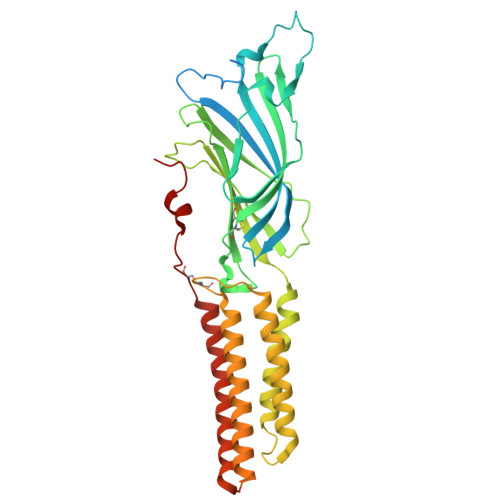
The zinc-activated channel (ZAC) is an atypical mammalian cys-loop receptor (CLR) that is activated by zinc ions and protons, allowing cations to pass through. The molecular mechanism that ligands use to activate ZAC remains elusive. Here, we present three cryo-electron microscopy reconstructions of human ZAC (hZAC) under different conditions. These three hZAC structures display highly similar conformations to one another, forming symmetrical homo-pentamers with a central ion-conduction pore. The hZAC protomer comprises an extracellular domain (ECD) and a transmembrane domain (TMD), sharing more structural similarity with anion-permeable CLRs, such as glycine receptors and type A γ-aminobutyric acid receptors. Notably, hZAC possesses a distinctive C-tail that establishes a disulfide bond with the loop M2-M3 in the TMD and occupies what is typically the canonical neurotransmitter orthosteric site in other mammalian CLRs. Moreover, the tip of the cys-loop creates an unprecedented orthosteric site in hZAC. The binding of Zn 2+ triggers a conformational shift in the cys-loop, which presumably prompts the loop M2-M3 to move and open the channel gate. This study sheds light on the assembly of the channel, its structural features, and the process of signal transduction in hZAC.
- State Key Laboratory of Medicinal Chemical Biology and Frontiers Science Center for Cell Responses, College of Life Sciences, Nankai University, Tianjin, 300350, China.
Organizational Affiliation: