8YL6 | pdb_00008yl6

EDS1-SAG101-NRG1A L134E heterotrimer


Experimental Data Snapshot

  • Method: ELECTRON MICROSCOPY
  • Resolution: 3.10 Å
  • Aggregation State: PARTICLE 
  • Reconstruction Method: SINGLE PARTICLE 

wwPDB Validation 3D Report Full Report

Validation slider image for 8YL6

This is version 1.2 of the entry. See complete history

Literature

Activation and inhibition mechanisms of a plant helper NLR.

Xiao, Y.Wu, X.Wang, Z.Ji, K.Zhao, Y.Zhang, Y.Wan, L.

(2025) Nature 639: 438-446

  • DOI: https://doi.org/10.1038/s41586-024-08517-3
  • Primary Citation Related Structures: 
    8YL6, 8YL7

  • PubMed Abstract: 

    Plant nucleotide-binding leucine-rich repeat (NLR) receptors sense pathogen effectors and form resistosomes to confer immunity 1 . Some sensor NLR resistosomes produce small molecules to induce formation of a heterotrimer complex with two lipase-like proteins, EDS1 and SAG101, and a helper NLR called NRG1 (refs. 2,3 ). Activation of sensor NLR resistosomes also triggers NRG1 oligomerization and resistosome formation at the plasma membrane 4,5 . We demonstrate that the Arabidopsis AtEDS1-AtSAG101-AtNRG1A heterotrimer formation is stabilized by the AtNRG1A loss-of-oligomerization mutant L134E 5,6 . We report structures of AtEDS1-AtSAG101-AtNRG1A L134E and AtEDS1-AtSAG101-AtNRG1C heterotrimers with similar assembly mechanisms. AtNRG1A signalling is activated by the interaction with the AtEDS1-AtSAG101 heterodimer in complex with their small-molecule ligand. The truncated AtNRG1C maintains core interacting domains of AtNRG1A but develops further interactions with AtEDS1-AtSAG101 to outcompete AtNRG1A. Moreover, AtNRG1C lacks an N-terminal signalling domain and shows nucleocytoplasmic localization, facilitating its sequestration of AtEDS1-AtSAG101, which is also nucleocytoplasmic. Our study shows the activation and inhibition mechanisms of a plant helper NLR.


  • Organizational Affiliation
    • State Key Laboratory of Plant Trait Design, CAS Center for Excellence in Molecular Plant Sciences, Shanghai Institute of Plant Physiology and Ecology, Chinese Academy of Sciences, Shanghai, China.

Macromolecule Content 

  • Total Structure Weight: 227.35 kDa 
  • Atom Count: 10,632 
  • Modeled Residue Count: 1,439 
  • Deposited Residue Count: 1,969 
  • Unique protein chains: 3

Macromolecules

Find similar proteins by:|  3D Structure
Entity ID: 1
MoleculeChains  Sequence LengthOrganismDetailsImage
Protein EDS1623Arabidopsis thalianaMutation(s): 0 
Gene Names: EDS1EDS1-90EDS1AAt3g48090T17F15.40
UniProt
Find proteins for Q9SU72 (Arabidopsis thaliana)
Explore Q9SU72 
Go to UniProtKB:  Q9SU72
Entity Groups
Sequence Clusters30% Identity50% Identity70% Identity90% Identity95% Identity100% Identity
UniProt GroupQ9SU72
Sequence Annotations
Expand
Reference Sequence
Find similar proteins by:|  3D Structure
Entity ID: 2
MoleculeChains  Sequence LengthOrganismDetailsImage
Senescence-associated carboxylesterase 101537Arabidopsis thalianaMutation(s): 0 
Gene Names: SAG101At5g14930F2G14.50
EC: 3.1.1.1
UniProt
Find proteins for Q4F883 (Arabidopsis thaliana)
Explore Q4F883 
Go to UniProtKB:  Q4F883
Entity Groups
Sequence Clusters30% Identity50% Identity70% Identity90% Identity95% Identity100% Identity
UniProt GroupQ4F883
Sequence Annotations
Expand
Reference Sequence
Find similar proteins by:|  3D Structure
Entity ID: 3
MoleculeChains  Sequence LengthOrganismDetailsImage
Probable disease resistance protein At5g66900809Arabidopsis thalianaMutation(s): 1 
Gene Names: At5g66900MUD21.16
UniProt
Find proteins for Q9FKZ1 (Arabidopsis thaliana)
Explore Q9FKZ1 
Go to UniProtKB:  Q9FKZ1
Entity Groups
Sequence Clusters30% Identity50% Identity70% Identity90% Identity95% Identity100% Identity
UniProt GroupQ9FKZ1
Sequence Annotations
Expand
Reference Sequence

Small Molecules

Ligands 1 Unique
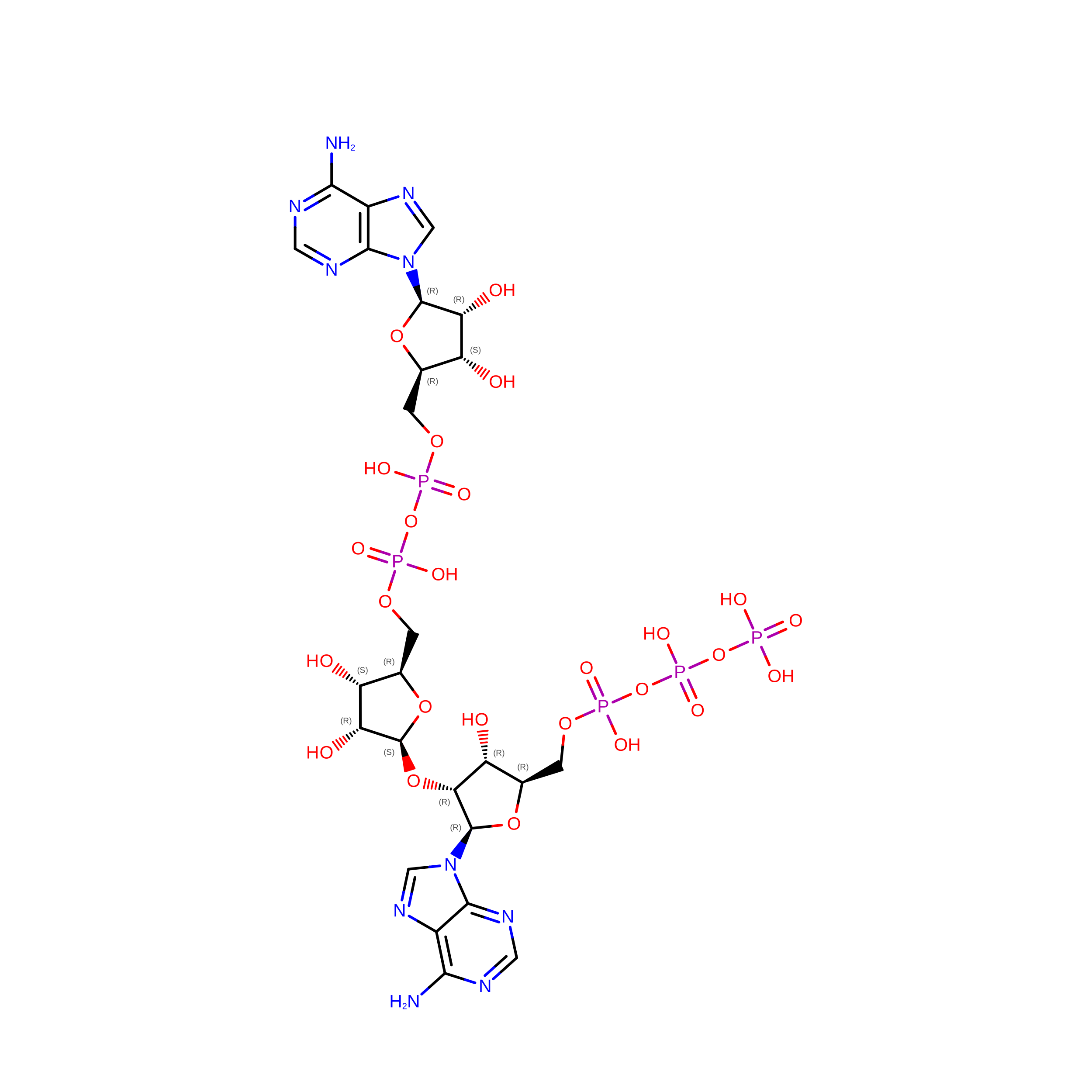
IDChains Name / Formula / InChI Key2D Diagram3D Interactions
A1L15

Query on A1L15


Download:Ideal Coordinates CCD File
D [auth A][[(2~{R},3~{R},4~{R},5~{R})-5-(6-aminopurin-9-yl)-4-[(2~{S},3~{R},4~{S},5~{R})-5-[[[[(2~{R},3~{S},4~{R},5~{R})-5-(6-aminopurin-9-yl)-3,4-bis(oxidanyl)oxolan-2-yl]methoxy-oxidanyl-phosphoryl]oxy-oxidanyl-phosphoryl]oxymethyl]-3,4-bis(oxidanyl)oxolan-2-yl]oxy-3-oxidanyl-oxolan-2-yl]methoxy-oxidanyl-phosphoryl] phosphono hydrogen phosphate
C25 H37 N10 O26 P5
BLHBPWIRUPJXKW-VIUUMBSUSA-N

Experimental Data & Validation

Experimental Data

  • Method: ELECTRON MICROSCOPY
  • Resolution: 3.10 Å
  • Aggregation State: PARTICLE 
  • Reconstruction Method: SINGLE PARTICLE 

Structure Validation

View Full Validation Report


Entry History 

& Funding Information

Deposition Data


Funding OrganizationLocationGrant Number
National Natural Science Foundation of China (NSFC)China32270304
Chinese Academy of SciencesChinaXDB27040214

Revision History  (Full details and data files)

  • Version 1.0: 2025-01-29
    Type: Initial release
  • Version 1.1: 2025-02-26
    Changes: Data collection, Database references
  • Version 1.2: 2025-03-26
    Changes: Data collection, Database references