Download Mendeley
Intra-channel bi-epitopic crosslinking unleashes ultrapotent antibodies targeting Na V 1.7 for pain alleviation.
Zhang, Y., Ding, Y., Zeng, Z., Zhu, R., Zheng, P., Fan, S., Cao, Q., Chen, H., Ren, W., Wu, M., Wang, L., Du, J.(2024) Cell Rep Med 5: 101800-101800
- PubMed: 39461335 Search on PubMed
- DOI: https://doi.org/10.1016/j.xcrm.2024.101800
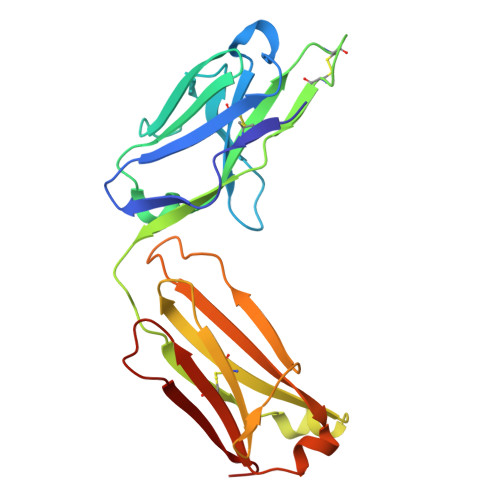
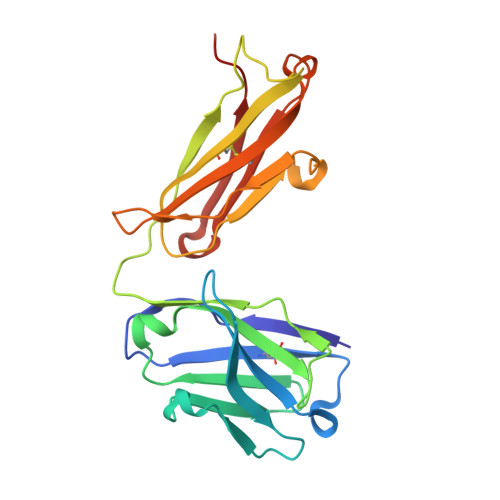
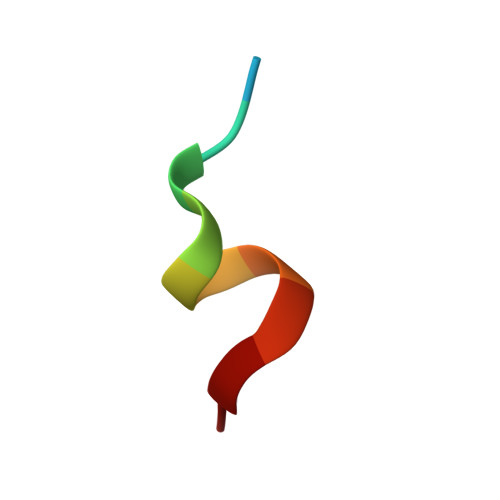
- Primary Citation Related Structures:
8YHZ - PubMed Abstract:
Crucial for cell activities, ion channels are key drug discovery targets. Although small-molecule and peptide modulators dominate ion channel drug discovery, antibodies are emerging as an alternative modality. However, challenges persist in generating potent antibodies, especially for channels with limited extracellular epitopes. We herein present a bi-epitopic crosslinking strategy to overcome these challenges, focusing on Na V 1.7, a potential analgesic target. Aiming to crosslink two non-overlapping epitopes on voltage-sensing domains II and IV, we construct bispecific antibodies and ligand-antibody conjugates. Enhanced affinity and potency are observed in comparison to the monospecific controls. Among them, a ligand-antibody conjugate (1080-PEG 7 -ACDTB) displays a two-orders-of-magnitude improvement in potency (IC 50 of 0.06 ± 0.01 nM) and over 1,000-fold selectivity for Na V 1.7. Additionally, this conjugate demonstrates robust analgesic effects in mouse pain models. Our study introduces an approach to developing effective antibodies against Na V 1.7, thereby initiating a promising direction for the advancement of pain therapeutics.
- School of Pharmaceutical Sciences, MOE Key Laboratory of Bioorganic Phosphorus Chemistry & Chemical Biology, Tsinghua University, Beijing 100084, China; Peking University-Tsinghua University-National Institute Biological Sciences (PTN) Joint Graduate Program, School of Life Sciences, Tsinghua University, Beijing 100084, China.
Organizational Affiliation: