Download Mendeley
Diatom pyrenoids are encased in a protein shell that enables efficient CO 2 fixation.
Shimakawa, G., Demulder, M., Flori, S., Kawamoto, A., Tsuji, Y., Nawaly, H., Tanaka, A., Tohda, R., Ota, T., Matsui, H., Morishima, N., Okubo, R., Wietrzynski, W., Lamm, L., Righetto, R.D., Uwizeye, C., Gallet, B., Jouneau, P.H., Gerle, C., Kurisu, G., Finazzi, G., Engel, B.D., Matsuda, Y.(2024) Cell 187: 5919
- PubMed: 39357521 Search on PubMed
- DOI: https://doi.org/10.1016/j.cell.2024.09.013
- Primary Citation Related Structures:
8WQP - PubMed Abstract:
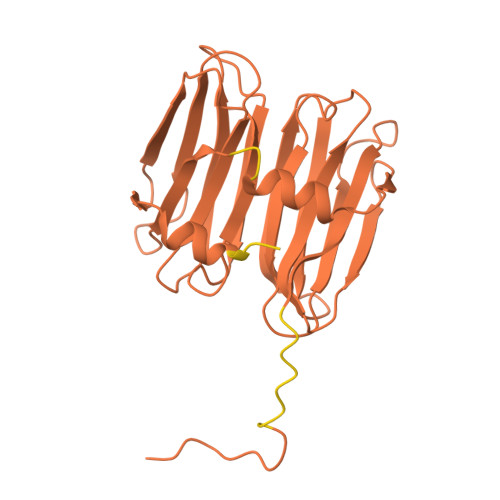
Pyrenoids are subcompartments of algal chloroplasts that increase the efficiency of Rubisco-driven CO 2 fixation. Diatoms fix up to 20% of global CO 2 , but their pyrenoids remain poorly characterized. Here, we used in vivo photo-crosslinking to identify pyrenoid shell (PyShell) proteins, which we localized to the pyrenoid periphery of model pennate and centric diatoms, Phaeodactylum tricornutum and Thalassiosira pseudonana. In situ cryo-electron tomography revealed that pyrenoids of both diatom species are encased in a lattice-like protein sheath. Single-particle cryo-EM yielded a 2.4-Å-resolution structure of an in vitro TpPyShell1 lattice, which showed how protein subunits interlock. T. pseudonana TpPyShell1/2 knockout mutants had no PyShell sheath, altered pyrenoid morphology, and a high-CO 2 requiring phenotype, with reduced photosynthetic efficiency and impaired growth under standard atmospheric conditions. The structure and function of the diatom PyShell provide a molecular view of how CO 2 is assimilated in the ocean, a critical ecosystem undergoing rapid change.
- Department of Bioscience, School of Biological and Environmental Sciences, Kwansei Gakuin University, 1 Gakuen-Uegahara, Sanda, Hyogo 669-1330, Japan.
Organizational Affiliation: