8V3D | pdb_00008v3d

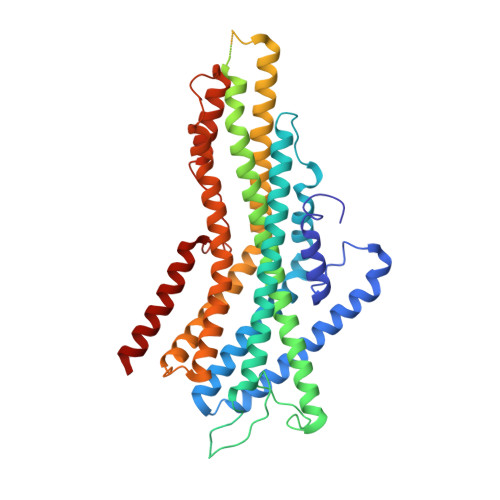
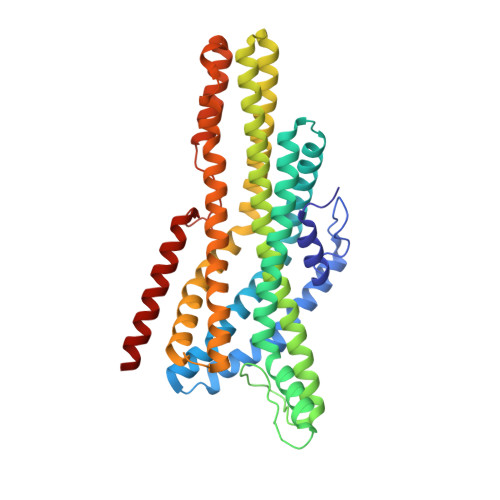
AgamOR28 structure bound to 2,4,5-trimethylthiazole


Experimental Data Snapshot

  • Method: ELECTRON MICROSCOPY
  • Resolution: 2.95 Å
  • Aggregation State: PARTICLE 
  • Reconstruction Method: SINGLE PARTICLE 

wwPDB Validation 3D Report Full Report

Validation slider image for 8V3D

This is version 1.2 of the entry. See complete history

Literature

Structural basis of odor sensing by insect heteromeric odorant receptors.

Zhao, J.Chen, A.Q.Ryu, J.Del Marmol, J.

(2024) Science 384: 1460-1467

  • DOI: https://doi.org/10.1126/science.adn6384
  • Primary Citation Related Structures: 
    8V00, 8V02, 8V3C, 8V3D

  • PubMed Abstract: 

    Most insects, including human-targeting mosquitoes, detect odors through odorant-activated ion channel complexes consisting of a divergent odorant-binding subunit (OR) and a conserved co-receptor subunit (Orco). As a basis for understanding how odorants activate these heteromeric receptors, we report here cryo-electron microscopy (cryo-EM) structures of two different heteromeric odorant receptor complexes containing ORs from disease-vector mosquitos Aedes aegypti or Anopheles gambiae . These structures reveal an unexpected stoichiometry of 1 OR to 3 Orco subunits. Comparison of structures in odorant-bound and unbound states indicates that odorant binding to the sole OR subunit is sufficient to open the channel pore, suggesting a mechanism of OR activation and a conceptual framework for understanding evolution of insect odorant receptor sensitivity.


  • Organizational Affiliation
    • Department of Biological Chemistry and Molecular Pharmacology, Harvard Medical School, Boston, MA 02115, USA.

Macromolecule Content 

  • Total Structure Weight: 205.57 kDa 
  • Atom Count: 12,636 
  • Modeled Residue Count: 1,578 
  • Deposited Residue Count: 1,820 
  • Unique protein chains: 2

Macromolecules

Find similar proteins by:|  3D Structure
Entity ID: 1
MoleculeChains  Sequence LengthOrganismDetailsImage
Odorant receptor Orco
A, B, C
474Apocrypta bakeriMutation(s): 0 
Gene Names: Or2
Membrane Entity: Yes 
UniProt
Find proteins for B0FAQ4 (Apocrypta bakeri)
Explore B0FAQ4 
Go to UniProtKB:  B0FAQ4
Entity Groups
Sequence Clusters30% Identity50% Identity70% Identity90% Identity95% Identity100% Identity
UniProt GroupB0FAQ4
Sequence Annotations
Expand
Reference Sequence
Find similar proteins by:|  3D Structure
Entity ID: 2
MoleculeChains  Sequence LengthOrganismDetailsImage
OR28398Anopheles gambiaeMutation(s): 0 
Membrane Entity: Yes 
UniProt
Find proteins for A0A1S4GFY3 (Anopheles gambiae)
Explore A0A1S4GFY3 
Go to UniProtKB:  A0A1S4GFY3
Entity Groups
Sequence Clusters30% Identity50% Identity70% Identity90% Identity95% Identity100% Identity
UniProt GroupA0A1S4GFY3
Sequence Annotations
Expand
Reference Sequence

Small Molecules

Ligands 1 Unique
IDChains Name / Formula / InChI Key2D Diagram3D Interactions
A1AFC
(Subject of Investigation/LOI)

Query on A1AFC


Download:Ideal Coordinates CCD File
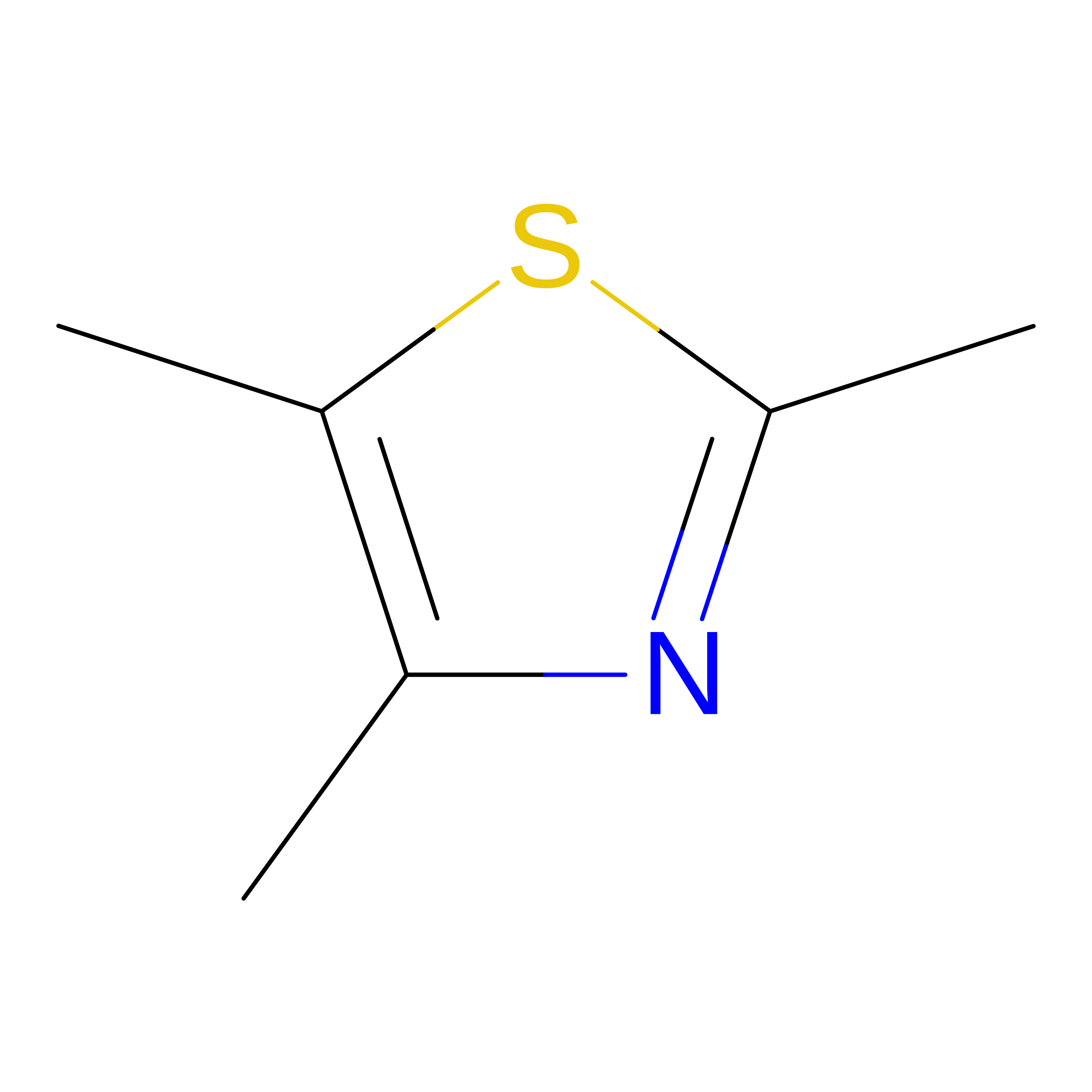
E [auth D]2,4,5-trimethyl-1,3-thiazole
C6 H9 N S
BAMPVSWRQZNDQC-UHFFFAOYSA-N

Experimental Data & Validation

Experimental Data

  • Method: ELECTRON MICROSCOPY
  • Resolution: 2.95 Å
  • Aggregation State: PARTICLE 
  • Reconstruction Method: SINGLE PARTICLE 
EM Software:
TaskSoftware PackageVersion
MODEL REFINEMENTPHENIX1.21_5207

Structure Validation

View Full Validation Report


Entry History 

& Funding Information

Deposition Data


Funding OrganizationLocationGrant Number
National Institutes of Health/National Institute on Deafness and Other Communication Disorders (NIH/NIDCD)United States5R00DC019401
Howard Hughes Medical Institute (HHMI)United States--

Revision History  (Full details and data files)

  • Version 1.0: 2024-06-19
    Type: Initial release
  • Version 1.1: 2024-06-26
    Changes: Data collection, Database references
  • Version 1.2: 2024-07-10
    Changes: Data collection, Database references