Download Mendeley
Stabilization of a Cu-binding site by a highly conserved tryptophan residue.
de Oliveira Silva, Y.R., Zheng, D., Peters, S.C., Fisher, O.S.(2024) J Inorg Biochem 253: 112501-112501
- PubMed: 38342077 Search on PubMed
- DOI: https://doi.org/10.1016/j.jinorgbio.2024.112501
- Primary Citation Related Structures:
8UM6 - PubMed Abstract:
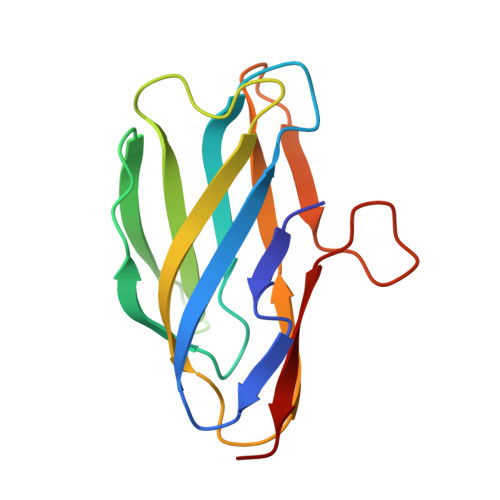
Copper serves as an essential cofactor for nearly all living organisms. There are still many gaps remaining in our knowledge of how Gram-positive bacteria import copper and maintain homeostasis. To obtain a better understanding of how these processes work, here we focus on the ycnKJI operon responsible for regulating copper levels in the Gram-positive bacterium Bacillus subtilis. This operon encodes three Cu-related proteins: a copper-dependent transcriptional repressor (YcnK), a putative copper importer (YcnJ), and a copper-binding protein of unknown function (YcnI). We previously found that YcnI's extracellular Domain of Unknown Function 1775 (DUF1775) houses a monohistidine brace motif that coordinates a single Cu(II) ion. The Cu(II) binding site includes a highly conserved tryptophan residue. Here, we investigate the role of that tryptophan and the ability of the protein to interact with other oxidation states of Cu. We find that YcnI exhibits strong preference for binding Cu in the oxidized Cu(II) state, and that the conserved tryptophan residue is not essential for the interaction. We determine the structure of a tryptophan variant to 1.95 Å resolution that indicates that the tryptophan is needed to stabilize the metal binding interaction, and find that this variant has weaker affinity for Cu(II) than the wild-type protein. Together, these data provide further insights into the DUF1775 domain family and reveal the role of the conserved tryptophan residue.
- Department of Chemistry, Lehigh University, 6 E Packer Ave, Bethlehem, PA 18015, USA.
Organizational Affiliation: