8THS | pdb_00008ths

Crystal Structure of a reconstructed Kaede-type Red Fluorescent Protein, LEA A69T


Experimental Data Snapshot

  • Method: X-RAY DIFFRACTION
  • Resolution: 1.50 Å
  • R-Value Free: 
    0.188 (Depositor), 0.170 (DCC) 
  • R-Value Work: 
    0.162 (Depositor), 0.172 (DCC) 
  • R-Value Observed: 
    0.164 (Depositor) 

wwPDB Validation 3D Report Full Report

Validation slider image for 8THS

This is version 2.0 of the entry. See complete history

Literature

Capturing excited-state structural snapshots of evolutionary green-to-red photochromic fluorescent proteins.

Krueger, T.D.Henderson, J.N.Breen, I.L.Zhu, L.Wachter, R.M.Mills, J.H.Fang, C.

(2023) Front Chem 11: 1328081-1328081

  • DOI: https://doi.org/10.3389/fchem.2023.1328081
  • Primary Citation Related Structures: 
    8THS, 8UB6

  • PubMed Abstract: 

    Photochromic fluorescent proteins (FPs) have proved to be indispensable luminous probes for sophisticated and advanced bioimaging techniques. Among them, an interplay between photoswitching and photoconversion has only been observed in a limited subset of Kaede-like FPs that show potential for discovering the key mechanistic steps during green-to-red photoconversion. Various spectroscopic techniques including femtosecond stimulated Raman spectroscopy (FSRS), X-ray crystallography, and femtosecond transient absorption were employed on a set of five related FPs with varying photoconversion and photoswitching efficiencies. A 3-methyl-histidine chromophore derivative, incorporated through amber suppression using orthogonal aminoacyl tRNA synthetase/tRNA pairs, displays more dynamic photoswitching but greatly reduced photoconversion versus the least-evolved ancestor (LEA). Excitation-dependent measurements of the green anionic chromophore reveal that the varying photoswitching efficiencies arise from both the initial transient dynamics of the bright cis state and the final trans -like photoswitched off state, with an exocyclic bridge H-rocking motion playing an active role during the excited-state energy dissipation. This investigation establishes a close-knit feedback loop between spectroscopic characterization and protein engineering, which may be especially beneficial to develop more versatile FPs with targeted mutations and enhanced functionalities, such as photoconvertible FPs that also feature photoswitching properties.


  • Organizational Affiliation
    • Department of Chemistry, Oregon State University, Corvallis, OR, United States.

Macromolecule Content 

  • Total Structure Weight: 106.59 kDa 
  • Atom Count: 8,156 
  • Modeled Residue Count: 873 
  • Deposited Residue Count: 912 
  • Unique protein chains: 1

Macromolecules

Find similar proteins by:|  3D Structure
Entity ID: 1
MoleculeChains  Sequence LengthOrganismDetailsImage
KAEDE-TYPE RED FLUORESCENT PROTEIN, LEA A69T
A, B, C, D
228synthetic constructMutation(s): 0 

Small Molecules

Ligands 2 Unique
IDChains Name / Formula / InChI Key2D Diagram3D Interactions
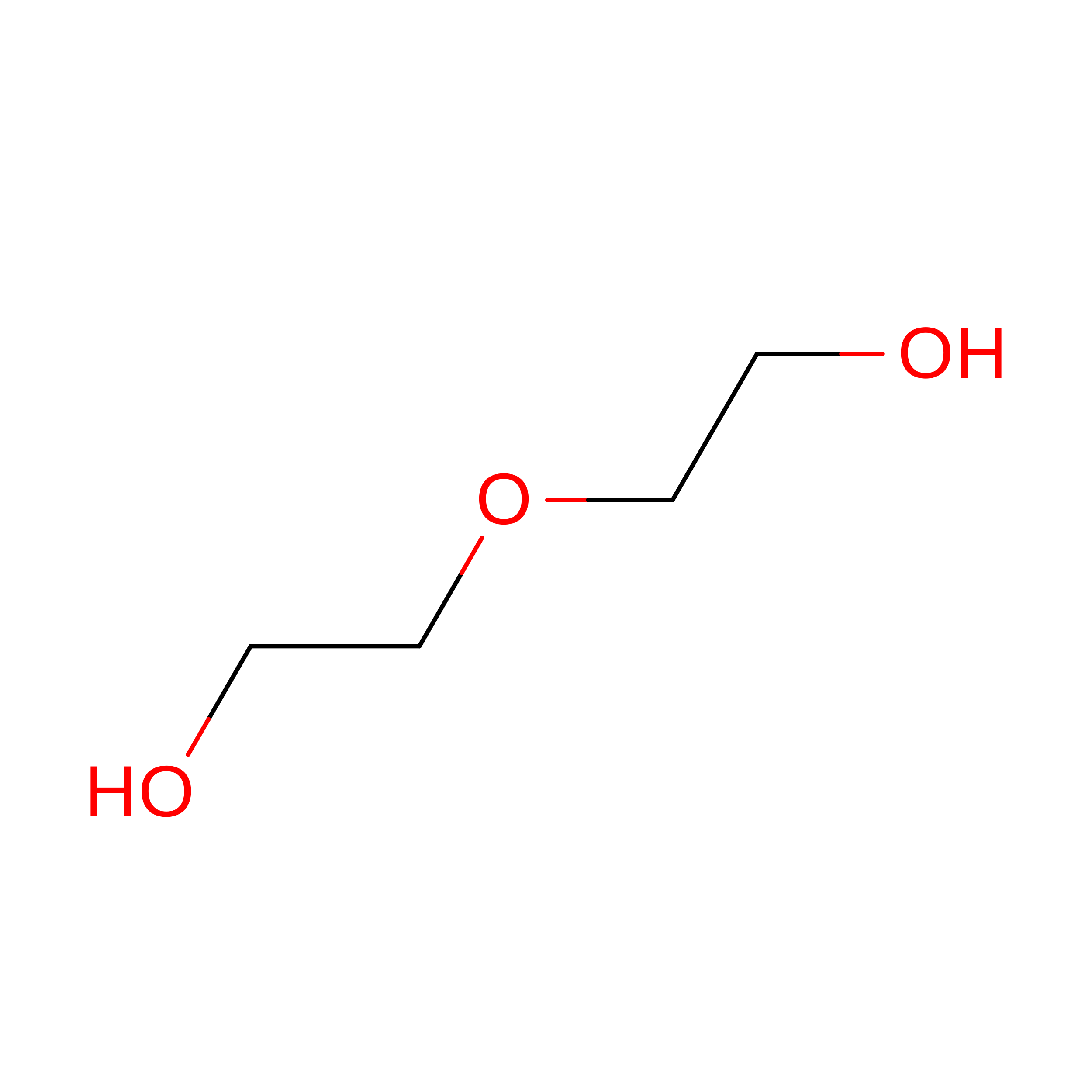
PEG

Query on PEG


Download:Ideal Coordinates CCD File
F [auth A],
G [auth B],
J [auth B],
L [auth C]
DI(HYDROXYETHYL)ETHER
C4 H10 O3
MTHSVFCYNBDYFN-UHFFFAOYSA-N
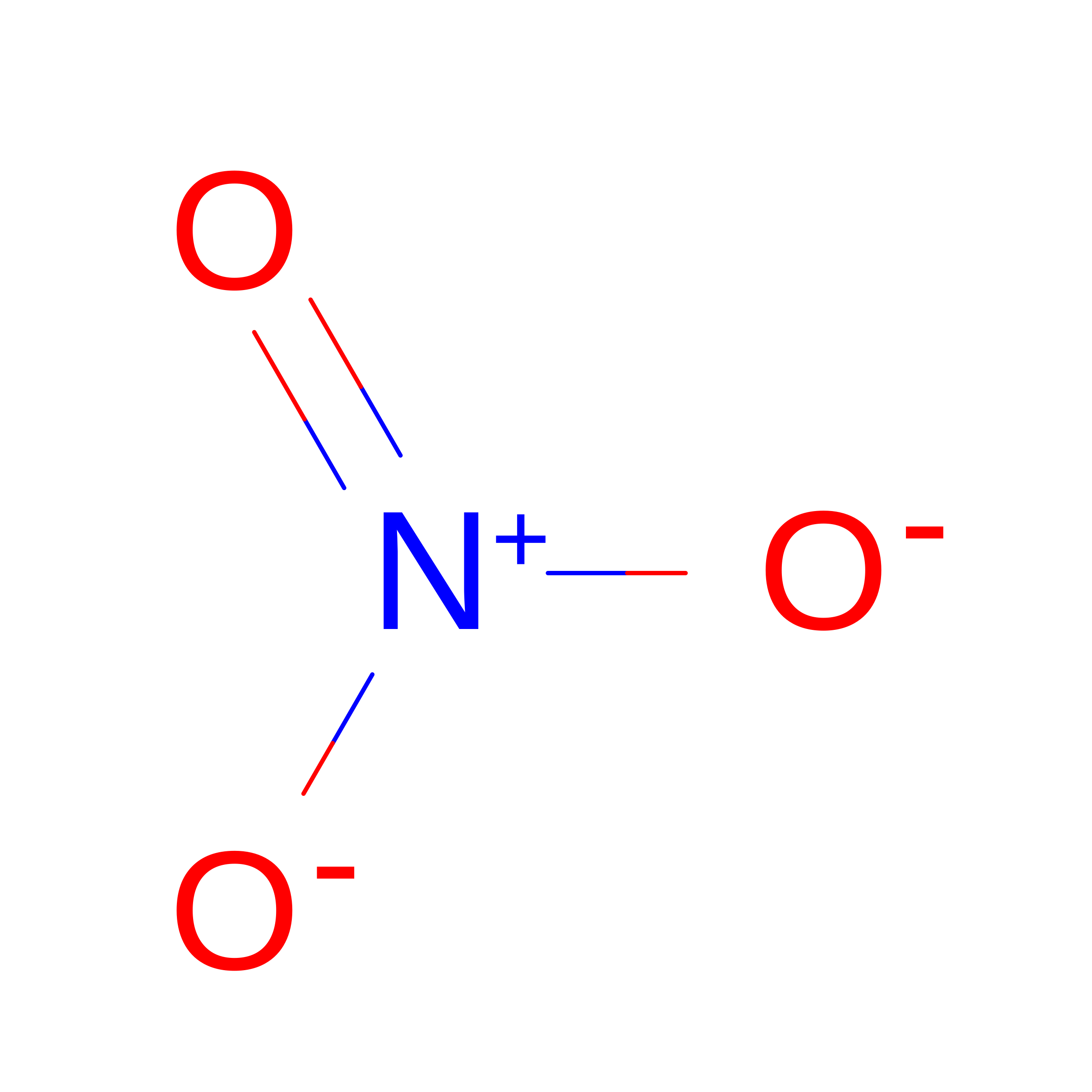
NO3

Query on NO3


Download:Ideal Coordinates CCD File
E [auth A],
H [auth B],
I [auth B],
K [auth C],
M [auth D]
NITRATE ION
N O3
NHNBFGGVMKEFGY-UHFFFAOYSA-N
Modified Residues  1 Unique
IDChains TypeFormula2D DiagramParent
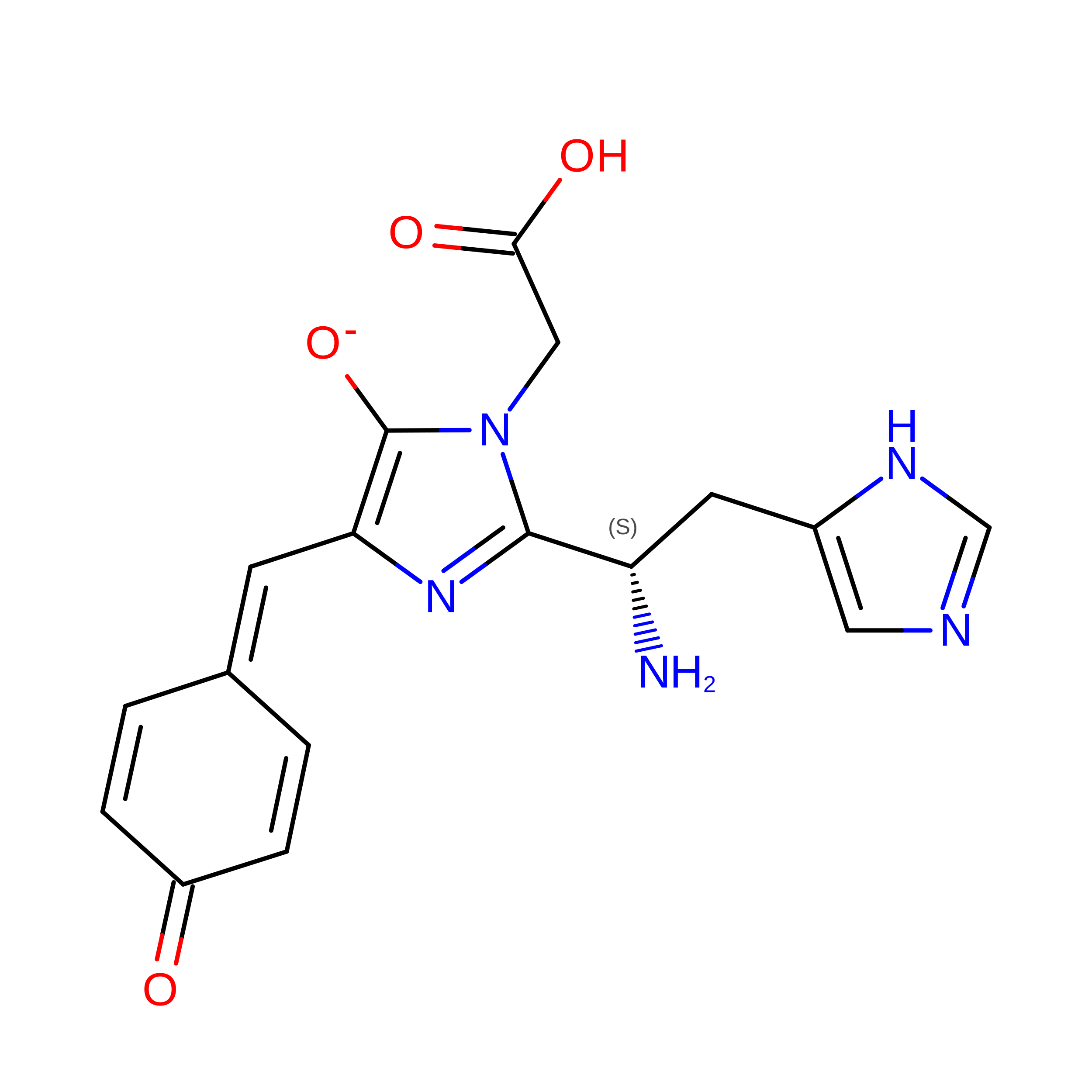
CR8
Query on CR8
A, B, C, D
L-PEPTIDE LINKINGC17 H16 N5 O4HIS, TYR, GLY

Experimental Data & Validation

Experimental Data

  • Method: X-RAY DIFFRACTION
  • Resolution: 1.50 Å
  • R-Value Free:  0.188 (Depositor), 0.170 (DCC) 
  • R-Value Work:  0.162 (Depositor), 0.172 (DCC) 
  • R-Value Observed: 0.164 (Depositor) 
Space Group: P 21 21 21
Unit Cell:
Length ( Å )Angle ( ˚ )
a = 72.447α = 90
b = 106.084β = 90
c = 123.471γ = 90
Software Package:
Software NamePurpose
REFMACrefinement
Aimlessdata scaling
XDSdata reduction
PHASERphasing

Structure Validation

View Full Validation Report


Entry History 

& Funding Information

Deposition Data


Funding OrganizationLocationGrant Number
National Science Foundation (NSF, United States)United StatesMCB-1817947

Revision History  (Full details and data files)

  • Version 1.0: 2023-11-29
    Type: Initial release
  • Version 1.1: 2023-12-13
    Changes: Database references
  • Version 1.2: 2024-01-10
    Changes: Database references
  • Version 1.3: 2024-01-24
    Changes: Database references
  • Version 1.4: 2024-10-09
    Changes: Structure summary
  • Version 2.0: 2026-03-18
    Changes: Polymer sequence