8QZU | pdb_00008qzu

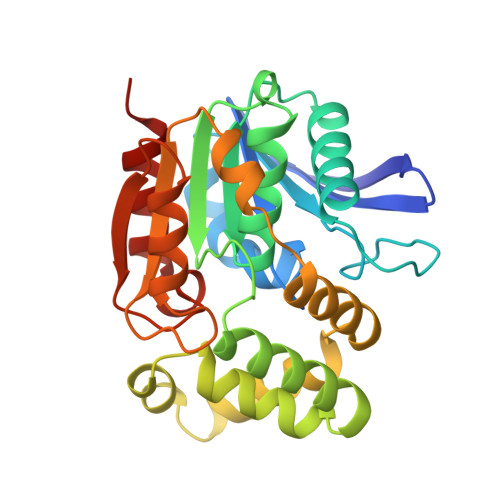
XhpG hydrolase mutant S98A of Xenorhabdus hominickii


Experimental Data Snapshot

  • Method: X-RAY DIFFRACTION
  • Resolution: 1.18 Å
  • R-Value Free: 
    0.196 (Depositor) 
  • R-Value Work: 
    0.166 (Depositor) 
  • R-Value Observed: 
    0.168 (Depositor) 

Starting Model: in silico
View more details

wwPDB Validation 3D Report Full Report

Currently 8QZU does not have a validation slider image.


This is version 2.0 of the entry. See complete history

Literature

Pyrrolizwilline, a Unique Bacterial Alkaloid Assembled by a Nonribosomal Peptide Synthetase and non-Enzymatic Dimerization.

Effert, J.Westphalen, M.Calderari, A.Shi, Y.M.Elamri, I.Najah, S.Grun, P.Li, Y.Gruez, A.Weissman, K.J.Bode, H.B.

(2024) Angew Chem Int Ed Engl 63: e202411258-e202411258

  • DOI: https://doi.org/10.1002/anie.202411258
  • Primary Citation Related Structures: 
    8QZU

  • PubMed Abstract: 

    Pyrrolizidine alkaloids (PAs) are a structurally diverse group of heterocyclic specialized metabolites characterized by a core structure comprising a hexahydro-1H-pyrrolizine. PAs are synthesized through two main pathways. In plants, assembly occurs via a homospermidine synthase, and in bacteria, through combined action of a nonribosomal peptide synthetase and a Baeyer-Villiger monooxygenase. While the toxic properties of plant-derived PAs and their prevalence in animal and human foods have been extensively studied, the biological roles and biosynthesis of more complex bacterial PAs are not well understood. Here, we report the identification and characterization of a bacterial biosynthetic gene cluster from Xenorhabdus hominickii, xhpA-G, which is responsible for producing the PA pseudo-dimer pyrrolizwilline. Analysis of X. hominickii promoter exchange mutants together with heterologous expression of xhpA-G in E. coli, revealed a set of pathway intermediates, two of which were chemically synthesized, as well as multiple derivatives. This information was leveraged to propose a detailed biosynthetic pathway to pyrrolizwilline. Furthermore, we have characterized the hydrolase XhpG, the key enzyme in the conversion of the pathway intermediate pyrrolizixenamide to pyrrolizwilline, using X-ray crystallography and small-angle X-ray scattering (SAXS).


  • Organizational Affiliation
    • Max Planck Institute for Terrestrial Microbiology, Natural Products, GERMANY.

Macromolecule Content 

  • Total Structure Weight: 29.42 kDa 
  • Atom Count: 2,282 
  • Modeled Residue Count: 265 
  • Deposited Residue Count: 270 
  • Unique protein chains: 1

Macromolecules

Find similar proteins by:|  3D Structure
Entity ID: 1
MoleculeChains  Sequence LengthOrganismDetailsImage
Carboxylesterase270Xenorhabdus hominickiiMutation(s): 1 
Gene Names: Xhom_00310
EC: 3.5.1
UniProt
Find proteins for A0A2G0QDP0 (Xenorhabdus hominickii)
Explore A0A2G0QDP0 
Go to UniProtKB:  A0A2G0QDP0
Entity Groups
Sequence Clusters30% Identity50% Identity70% Identity90% Identity95% Identity100% Identity
UniProt GroupA0A2G0QDP0
Sequence Annotations
Expand
Reference Sequence

Small Molecules

Ligands 1 Unique
IDChains Name / Formula / InChI Key2D Diagram3D Interactions
ACT
(Subject of Investigation/LOI)

Query on ACT


Download:Ideal Coordinates CCD File
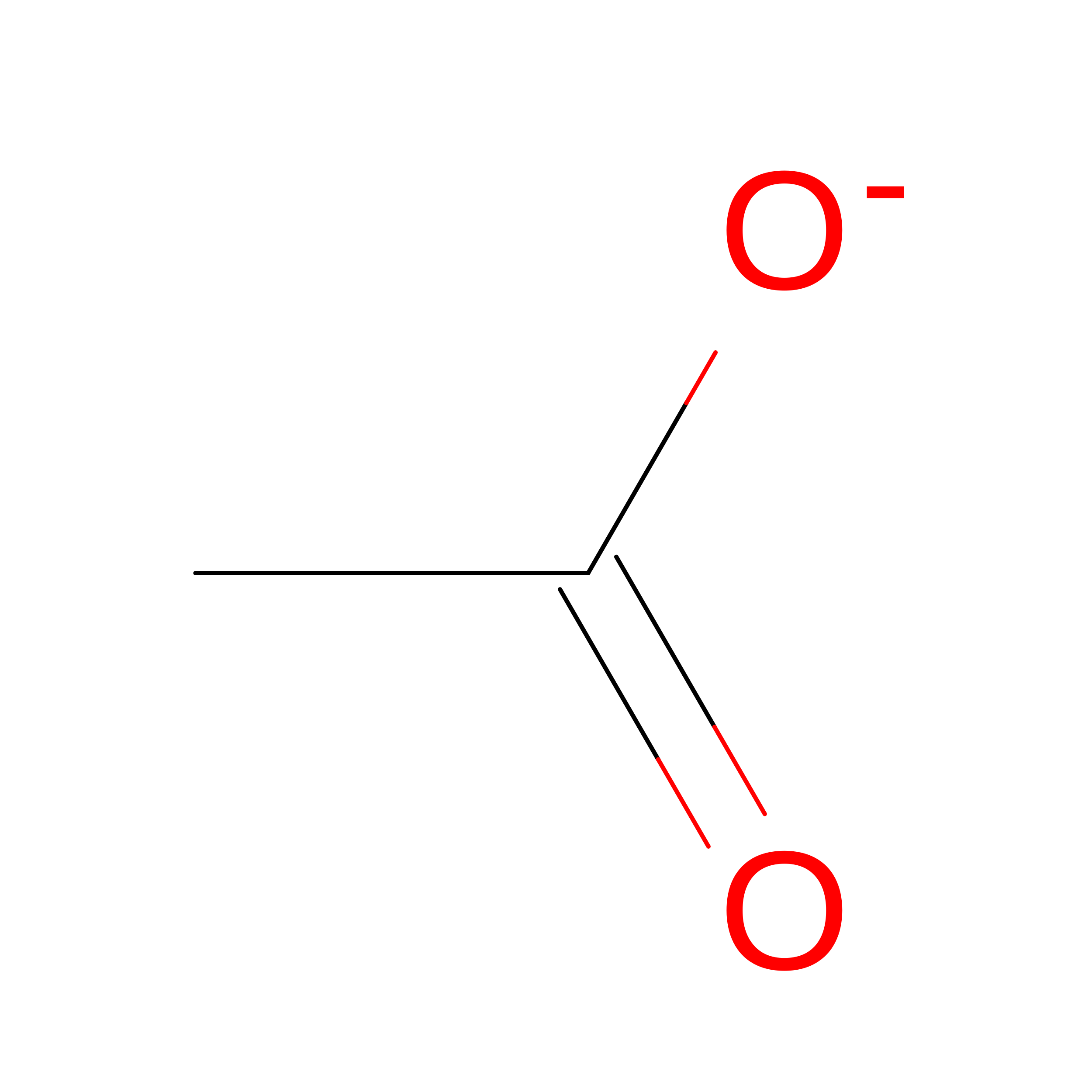
B [auth A]ACETATE ION
C2 H3 O2
QTBSBXVTEAMEQO-UHFFFAOYSA-M

Experimental Data & Validation

Experimental Data

  • Method: X-RAY DIFFRACTION
  • Resolution: 1.18 Å
  • R-Value Free:  0.196 (Depositor) 
  • R-Value Work:  0.166 (Depositor) 
  • R-Value Observed: 0.168 (Depositor) 
Space Group: C 1 2 1
Unit Cell:
Length ( Å )Angle ( ˚ )
a = 48.83α = 90
b = 68.54β = 98.11
c = 75.48γ = 90
Software Package:
Software NamePurpose
REFMACrefinement
Aimlessdata scaling
XDSdata reduction
MOLREPphasing

Structure Validation

View Full Validation Report

Currently 8QZU does not have a validation slider image.


Entry History 

& Funding Information

Deposition Data


Funding OrganizationLocationGrant Number
Agence Nationale de la Recherche (ANR)FranceANR-20-CE92-0038

Revision History  (Full details and data files)

  • Version 1.0: 2024-11-06
    Type: Initial release
  • Version 2.0: 2024-12-18
    Changes: Database references, Polymer sequence