8QP6 | pdb_00008qp6

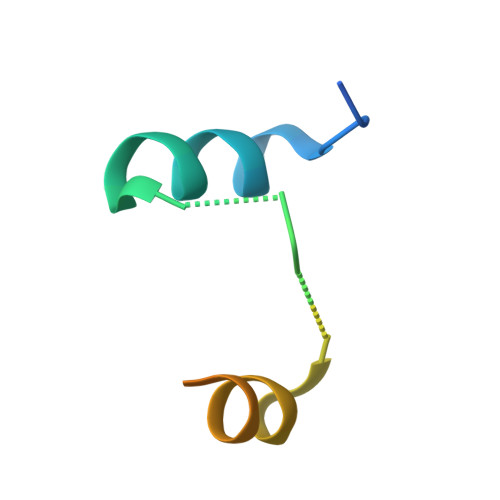
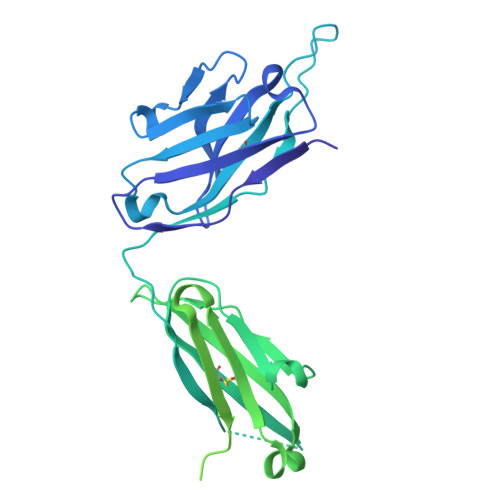
Crystal structure of Hepatitis C Virus E1 glycoprotein epitope 314-324 scaffold design 1W4K_08 in complex with neutralizing antibody F(ab) fragment IGH526


Experimental Data Snapshot

  • Method: X-RAY DIFFRACTION
  • Resolution: 2.59 Å
  • R-Value Free: 
    0.273 (Depositor), 0.275 (DCC) 
  • R-Value Work: 
    0.232 (Depositor), 0.237 (DCC) 
  • R-Value Observed: 
    0.234 (Depositor) 

Starting Model: experimental
View more details

wwPDB Validation 3D Report Full Report

Validation slider image for 8QP6

This is version 1.1 of the entry. See complete history

Literature

Epitope-focused immunogens targeting the hepatitis C virus glycoproteins induce broadly neutralizing antibodies.

Nagarathinam, K.Scheck, A.Labuhn, M.Stroh, L.J.Herold, E.Veselkova, B.Tune, S.Cramer, J.T.Rosset, S.Vollers, S.S.Bankwitz, D.Ballmaier, M.Boning, H.Roth, E.Khera, T.Ahsendorf-Abidi, H.P.Dittrich-Breiholz, O.Obleser, J.Nassal, M.Jack, H.M.Pietschmann, T.Correia, B.E.Krey, T.

(2024) Sci Adv 10: eado2600-eado2600

  • DOI: https://doi.org/10.1126/sciadv.ado2600
  • Primary Citation Related Structures: 
    8QP6, 8QP7

  • PubMed Abstract: 

    Hepatitis C virus (HCV) infection causes ~290,000 annual human deaths despite the highly effective antiviral treatment available. Several viral immune evasion mechanisms have hampered the development of an effective vaccine against HCV, among them the remarkable conformational flexibility within neutralization epitopes in the HCV antigens. Here, we report the design of epitope-focused immunogens displaying two distinct HCV cross-neutralization epitopes. We show that these immunogens induce a pronounced, broadly neutralizing antibody response in laboratory and transgenic human antibody mice. Monoclonal human antibodies isolated from immunized human antibody mice specifically recognized the grafted epitopes and neutralized four diverse HCV strains. Our results highlight a promising strategy for developing HCV immunogens and provide an encouraging paradigm for targeting structurally flexible epitopes to improve the induction of neutralizing antibodies.


  • Organizational Affiliation
    • Institute of Biochemistry, Center of Structural and Cell Biology in Medicine, University of Lübeck, 23562 Lübeck, Germany.

Macromolecule Content 

  • Total Structure Weight: 435.33 kDa 
  • Atom Count: 13,211 
  • Modeled Residue Count: 1,822 
  • Deposited Residue Count: 4,128 
  • Unique protein chains: 2

Macromolecules

Find similar proteins by:|  3D Structure
Entity ID: 1
MoleculeChains  Sequence LengthOrganismDetailsImage
1W4K_08A,
C [auth G],
E [auth D],
J
60Pyrobaculum aerophilumMutation(s): 0 
Find similar proteins by:|  3D Structure
Entity ID: 2
MoleculeChains  Sequence LengthOrganismDetailsImage
F(ab) IGH526486Homo sapiensMutation(s): 0 

Experimental Data & Validation

Experimental Data

  • Method: X-RAY DIFFRACTION
  • Resolution: 2.59 Å
  • R-Value Free:  0.273 (Depositor), 0.275 (DCC) 
  • R-Value Work:  0.232 (Depositor), 0.237 (DCC) 
  • R-Value Observed: 0.234 (Depositor) 
Space Group: P 21 21 21
Unit Cell:
Length ( Å )Angle ( ˚ )
a = 72.32α = 90
b = 121.76β = 90
c = 234.1γ = 90
Software Package:
Software NamePurpose
PHENIXrefinement
Cootmodel building
XDSdata reduction
XSCALEdata scaling
PHENIXphasing

Structure Validation

View Full Validation Report


Entry History 

& Funding Information

Deposition Data


Funding OrganizationLocationGrant Number
German Research Foundation (DFG)GermanyKR 2880 / 3-1

Revision History  (Full details and data files)

  • Version 1.0: 2024-10-09
    Type: Initial release
  • Version 1.1: 2025-04-30
    Changes: Database references