8PJ9 | pdb_00008pj9

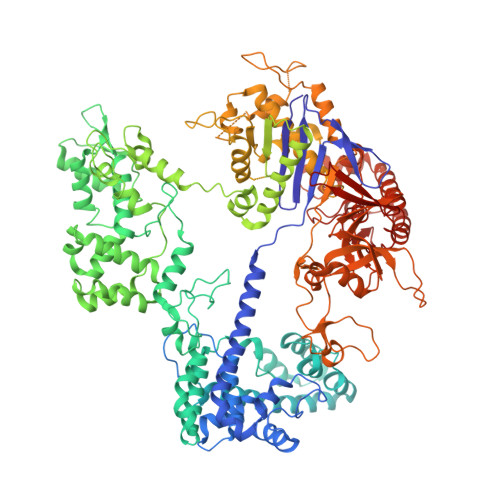
Cas9 bound to cognate DNA, Streptococcus thermophilus DGCC 7710 CRISPR3 system


Experimental Data Snapshot

  • Method: ELECTRON MICROSCOPY
  • Resolution: 3.24 Å
  • Aggregation State: PARTICLE 
  • Reconstruction Method: SINGLE PARTICLE 

Starting Model: in silico
View more details

wwPDB Validation   3D Report Full Report


This is version 1.1 of the entry. See complete history


Literature

Structural insights into Cas9-mediated prespacer selection in CRISPR-Cas adaptation.

Gaizauskaite, U.Tamulaitiene, G.Silanskas, A.Gasiunas, G.Siksnys, V.Sasnauskas, G.

(2026) Mol Cell 

  • DOI: https://doi.org/10.1016/j.molcel.2026.01.022
  • Primary Citation of Related Structures:  
    8PJ9, 9H1H, 9H1V, 9H21, 9H2G, 9H2M, 9H6T, 9H72, 9HP8, 9HP9, 9Q85

  • PubMed Abstract: 

    During CRISPR-Cas adaptation, prokaryotic cells become immunized by the insertion of foreign DNA fragments, termed spacers, into the host genome to serve as templates for RNA-guided immunity. Spacer acquisition relies on the Cas1-Cas2 integrase and accessory proteins, which select DNA sequences flanked by the protospacer adjacent motif (PAM) and insert them into the CRISPR array. It has been shown that in type II-A systems, selection of PAM-proximal prespacers is mediated by the effector nuclease Cas9, which forms a "supercomplex" with the Cas1-Cas2 integrase and the Csn2 protein. Here, we present cryo-electron microscopy structures of the Streptococcus thermophilus type II-A prespacer selection supercomplex in the DNA-scanning and two distinct PAM-bound configurations, providing insights into the mechanism of Cas9-mediated prespacer selection in type II-A CRISPR-Cas systems. Repurposing Cas9 by the CRISPR adaptation machinery for prespacer selection, as characterized here, demonstrates Cas9 plasticity and expands our knowledge of Cas9 biology.


  • Organizational Affiliation
    • Institute of Biotechnology, Life Sciences Center, Vilnius University, Saulėtekio av. 7, 10257 Vilnius, Lithuania.

Macromolecules

Find similar proteins by:  (by identity cutoff)  |  3D Structure
Entity ID: 1
MoleculeChains Sequence LengthOrganismDetailsImage
CRISPR-associated endonuclease Cas91,397Streptococcus thermophilus DGCC 7710Mutation(s): 0 
Gene Names: cas9csn1
EC: 3.1
UniProt
Find proteins for G3ECR1 (Streptococcus thermophilus)
Explore G3ECR1 
Go to UniProtKB:  G3ECR1
Entity Groups  
Sequence Clusters30% Identity50% Identity70% Identity90% Identity95% Identity100% Identity
UniProt GroupG3ECR1
Sequence Annotations
Expand
  • Reference Sequence
Find similar nucleic acids by:  (by identity cutoff) 
Entity ID: 2
MoleculeChains LengthOrganismImage
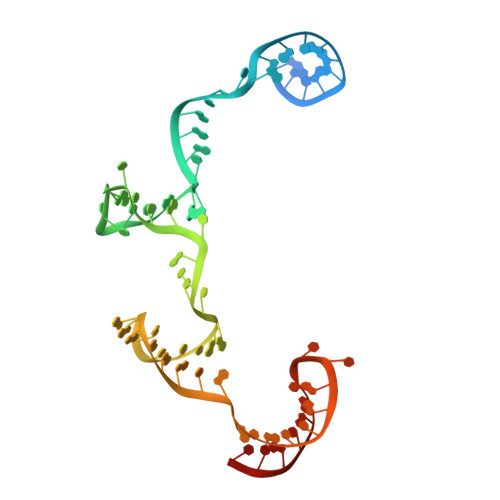
crRNA, chain B42Streptococcus thermophilus DGCC 7710
Sequence Annotations
Expand
  • Reference Sequence
Find similar nucleic acids by:  (by identity cutoff) 
Entity ID: 3
MoleculeChains LengthOrganismImage
tracrRNA, chain C75Streptococcus thermophilus DGCC 7710
Sequence Annotations
Expand
  • Reference Sequence
Find similar nucleic acids by:  (by identity cutoff) 
Entity ID: 4
MoleculeChains LengthOrganismImage
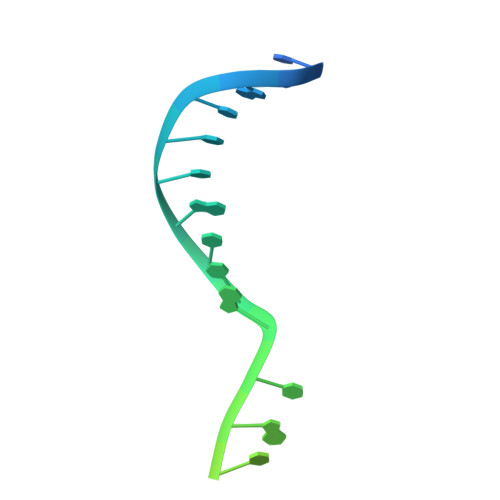
DNA oligoduplex, target strand, chains D,E
D, E
32synthetic construct
Sequence Annotations
Expand
  • Reference Sequence

Find similar nucleic acids by:  Sequence  

Entity ID: 5
MoleculeChains LengthOrganismImage
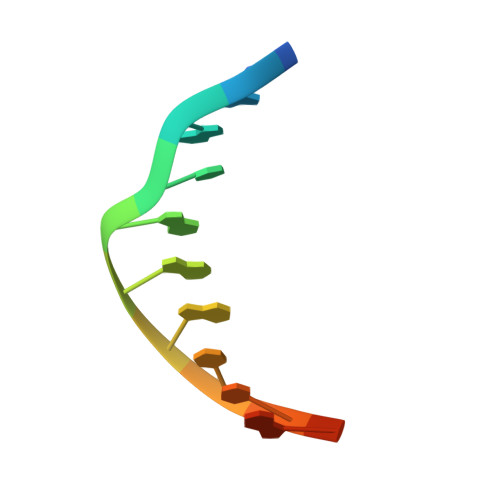
DNA oligoduplex, non-target strand, chain F12synthetic construct
Sequence Annotations
Expand
  • Reference Sequence
Small Molecules
Ligands 1 Unique
IDChains Name / Formula / InChI Key2D Diagram3D Interactions
MG
Query on MG

Download Ideal Coordinates CCD File 
G [auth C]MAGNESIUM ION
Mg
JLVVSXFLKOJNIY-UHFFFAOYSA-N
Experimental Data & Validation

Experimental Data

  • Method: ELECTRON MICROSCOPY
  • Resolution: 3.24 Å
  • Aggregation State: PARTICLE 
  • Reconstruction Method: SINGLE PARTICLE 
EM Software:
TaskSoftware PackageVersion
RECONSTRUCTIONcryoSPARC4.1.1
MODEL REFINEMENTPHENIX1.21rc1_4903

Structure Validation

View Full Validation Report


Entry History & Funding Information

Deposition Data


Funding OrganizationLocationGrant Number
Research Council of LithuaniaLithuaniaS-MIP-19-32

Revision History  (Full details and data files)

  • Version 1.0: 2024-07-10
    Type: Initial release
  • Version 1.1: 2026-03-04
    Changes: Data collection, Database references, Structure summary