8P3D | pdb_00008p3d

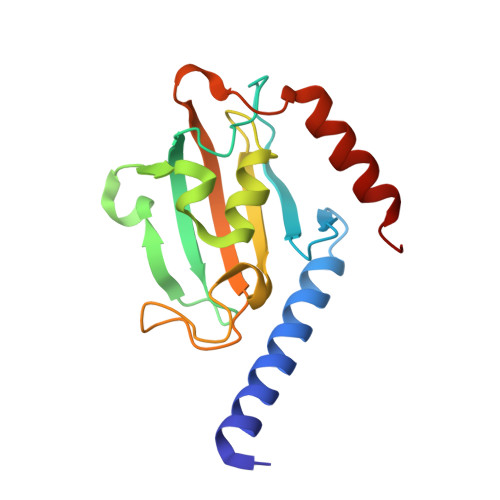
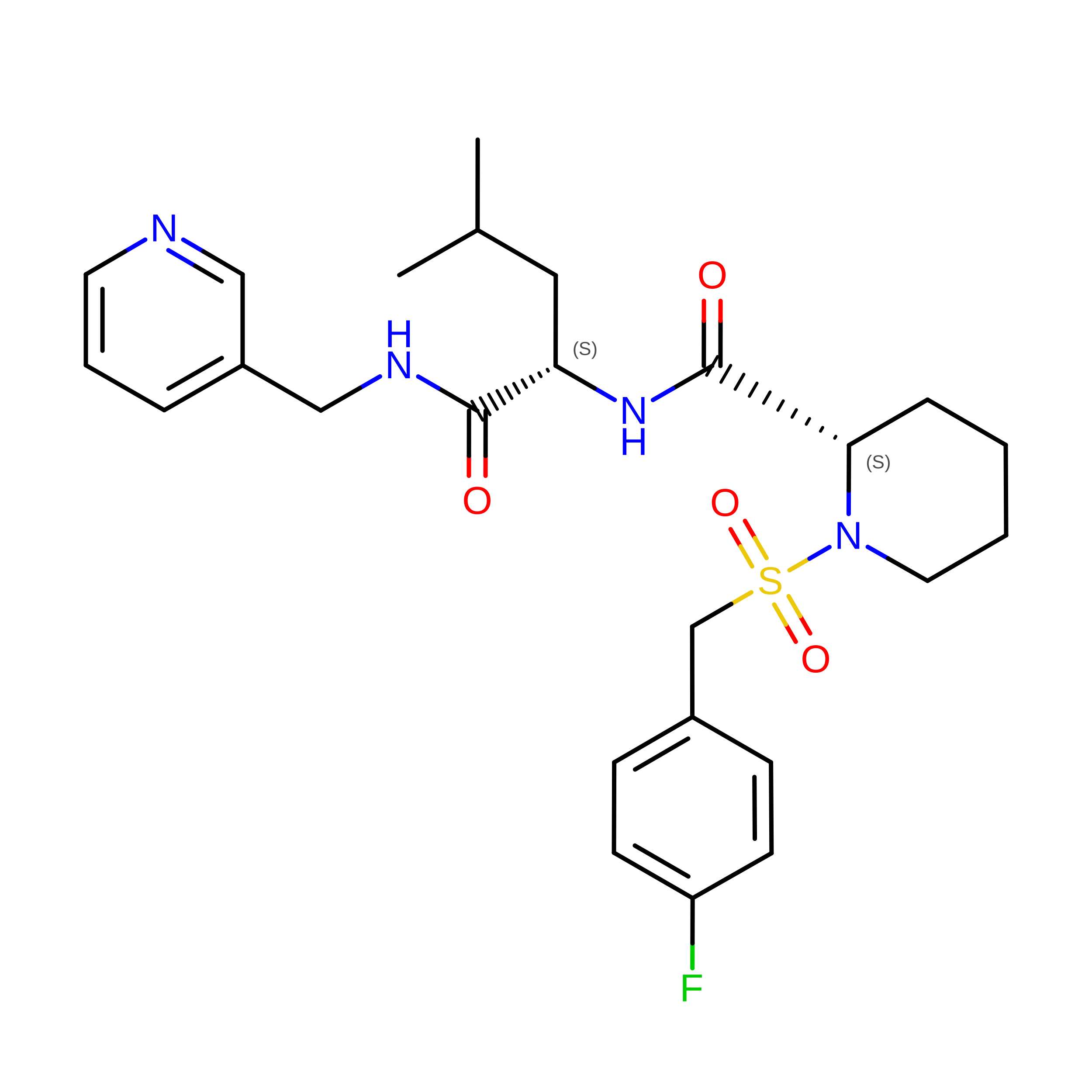
Full length structure of TcMIP with bound inhibitor NJS224.


Experimental Data Snapshot

  • Method: X-RAY DIFFRACTION
  • Resolution: 1.71 Å
  • R-Value Free: 
    0.217 (Depositor), 0.221 (DCC) 
  • R-Value Work: 
    0.182 (Depositor), 0.183 (DCC) 
  • R-Value Observed: 
    0.183 (Depositor) 

Starting Model: experimental
View more details

wwPDB Validation 3D Report Full Report

Validation slider image for 8P3D

Ligand Structure Quality Assessment 


This is version 1.2 of the entry. See complete history

Literature

Structure and Dynamics of Macrophage Infectivity Potentiator Proteins from Pathogenic Bacteria and Protozoans Bound to Fluorinated Pipecolic Acid Inhibitors.

Perez Carrillo, V.H.Whittaker, J.J.Wiedemann, C.Harder, J.M.Lohr, T.Jamithireddy, A.K.Dajka, M.Goretzki, B.Joseph, B.Guskov, A.Harmer, N.J.Holzgrabe, U.Hellmich, U.A.

(2025) J Med Chem 68: 5926-5941

  • DOI: https://doi.org/10.1021/acs.jmedchem.5c00134
  • Primary Citation Related Structures: 
    8P3C, 8P3D, 8P42

  • PubMed Abstract: 

    Macrophage infectivity potentiator (MIP) proteins, found in pro- and eukaryotic pathogens, influence microbial virulence, host cell infection, pathogen replication, and dissemination. MIPs share an FKBP (FK506 binding protein)-like prolyl- cis/trans -isomerase domain, making them attractive targets for inhibitor development. We determined high-resolution crystal structures of Burkholderia pseudomallei and Trypanosoma cruzi MIPs in complex with fluorinated pipecolic acid inhibitors. The inhibitor binding profiles in solution were compared across B. pseudomallei , T. cruzi , and Legionella pneumophila MIPs using 1 H, 15 N, and 19 F NMR spectroscopy. Demonstrating the versatility of fluorinated ligands for characterizing inhibitor complexes, 19 F NMR spectroscopy identified differences in ligand binding dynamics across MIPs. EPR spectroscopy and SAXS further revealed inhibitor-induced global structural changes in homodimeric L. pneumophila MIP. This study demonstrates the importance of integrating diverse methods to probe protein dynamics and provides a foundation for optimizing MIP-targeted inhibitors in this structurally conserved yet dynamically variable protein family.


  • Organizational Affiliation
    • Faculty of Chemistry and Earth Sciences, Institute of Organic Chemistry and Macromolecular Chemistry, Friedrich Schiller University Jena, 07743 Jena, Germany.

Macromolecule Content 

  • Total Structure Weight: 19 kDa 
  • Atom Count: 1,499 
  • Modeled Residue Count: 162 
  • Deposited Residue Count: 162 
  • Unique protein chains: 1

Macromolecules

Find similar proteins by:|  3D Structure
Entity ID: 1
MoleculeChains  Sequence LengthOrganismDetailsImage
peptidylprolyl isomerase162Trypanosoma cruziMutation(s): 0 
Gene Names: Tc00.1047053508897.110
EC: 5.2.1.8
UniProt
Find proteins for Q09734 (Trypanosoma cruzi)
Explore Q09734 
Go to UniProtKB:  Q09734
Entity Groups
Sequence Clusters30% Identity50% Identity70% Identity90% Identity95% Identity100% Identity
UniProt GroupQ09734
Sequence Annotations
Expand
Reference Sequence

Experimental Data & Validation

Experimental Data

  • Method: X-RAY DIFFRACTION
  • Resolution: 1.71 Å
  • R-Value Free:  0.217 (Depositor), 0.221 (DCC) 
  • R-Value Work:  0.182 (Depositor), 0.183 (DCC) 
  • R-Value Observed: 0.183 (Depositor) 
Space Group: P 1 21 1
Unit Cell:
Length ( Å )Angle ( ˚ )
a = 46.858α = 90
b = 34.696β = 93.53
c = 53.081γ = 90
Software Package:
Software NamePurpose
PHENIXrefinement
XDSdata scaling
XDSdata reduction
PHASERphasing

Structure Validation

View Full Validation Report


Ligand Structure Quality Assessment 


Entry History 

& Funding Information

Deposition Data


Funding OrganizationLocationGrant Number
German Research Foundation (DFG)Germany390713860

Revision History  (Full details and data files)

  • Version 1.0: 2024-06-12
    Type: Initial release
  • Version 1.1: 2025-03-05
    Changes: Database references, Structure summary
  • Version 1.2: 2025-03-26
    Changes: Database references