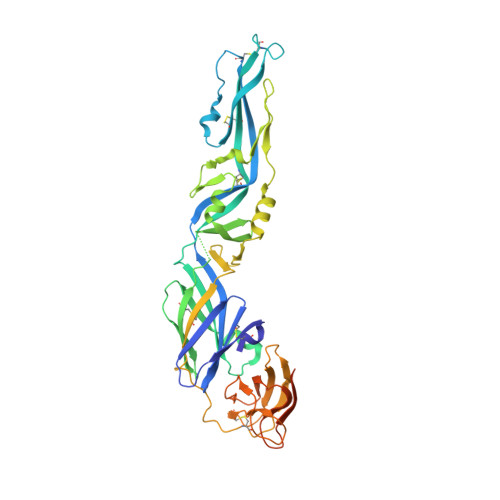
8OFN | pdb_00008ofn

Structure of the yellow fever virus (Asibi strain) dimeric envelope protein


Experimental Data Snapshot

  • Method: X-RAY DIFFRACTION
  • Resolution: 3.48 Å
  • R-Value Free: 
    0.273 (Depositor), 0.288 (DCC) 
  • R-Value Work: 
    0.255 (Depositor), 0.274 (DCC) 
  • R-Value Observed: 
    0.256 (Depositor) 

Starting Model: experimental
View more details

wwPDB Validation 3D Report Full Report

Validation slider image for 8OFN

Ligand Structure Quality Assessment 


This is version 1.4 of the entry. See complete history

Literature

New insight into flavivirus maturation from structure/function studies of the yellow fever virus envelope protein complex.

Crampon, E.Covernton, E.Vaney, M.C.Dellarole, M.Sommer, S.Sharma, A.Haouz, A.England, P.Lepault, J.Duquerroy, S.Rey, F.A.Barba-Spaeth, G.

(2023) mBio 14: e0070623-e0070623

  • DOI: https://doi.org/10.1128/mbio.00706-23
  • Primary Citation Related Structures: 
    8OFN

  • PubMed Abstract: 

    All enveloped viruses enter cells by fusing their envelope with a target cell membrane while avoiding premature fusion with membranes of the producer cell-the latter being particularly important for viruses that bud at internal membranes. Flaviviruses bud in the endoplasmic reticulum, are transported through the TGN to reach the external milieu, and enter other cells via receptor-mediated endocytosis. The trigger for membrane fusion is the acidic environment of early endosomes, which has a similar pH to the TGN of the producer cell. The viral particles therefore become activated to react to mildly acidic pH only after their release into the neutral pH extracellular environment. Our study shows that for yellow fever virus (YFV), the mechanism of activation involves actively knocking out the fusion brake (protein pr) through a localized conformational change of the envelope protein upon exposure to the neutral pH external environment. Our study has important implications for understanding the molecular mechanism of flavivirus fusion activation in general and points to an alternative way of interfering with this process as an antiviral treatment.


  • Organizational Affiliation
    • Institut Pasteur, Université Paris Cité, CNRS UMR 3569, Unité de Virologie Structurale , Paris, France.

Macromolecule Content 

  • Total Structure Weight: 93.35 kDa 
  • Atom Count: 5,964 
  • Modeled Residue Count: 778 
  • Deposited Residue Count: 856 
  • Unique protein chains: 1

Macromolecules

Find similar proteins by:|  3D Structure
Entity ID: 1
MoleculeChains  Sequence LengthOrganismDetailsImage
Envelope glycoprotein
A, B
428Yellow fever virusMutation(s): 0 
UniProt
Find proteins for Q6DV88 (Yellow fever virus (strain Ghana/Asibi/1927))
Explore Q6DV88 
Go to UniProtKB:  Q6DV88
Entity Groups
Sequence Clusters30% Identity50% Identity70% Identity90% Identity95% Identity100% Identity
UniProt GroupQ6DV88
Sequence Annotations
Expand
Reference Sequence

Experimental Data & Validation

Experimental Data

  • Method: X-RAY DIFFRACTION
  • Resolution: 3.48 Å
  • R-Value Free:  0.273 (Depositor), 0.288 (DCC) 
  • R-Value Work:  0.255 (Depositor), 0.274 (DCC) 
  • R-Value Observed: 0.256 (Depositor) 
Space Group: P 43 21 2
Unit Cell:
Length ( Å )Angle ( ˚ )
a = 92.54α = 90
b = 92.54β = 90
c = 308.4γ = 90
Software Package:
Software NamePurpose
BUSTERrefinement
XDSdata reduction
STARANISOdata scaling
PHASERphasing

Structure Validation

View Full Validation Report


Ligand Structure Quality Assessment 


Entry History 

& Funding Information

Deposition Data


Funding OrganizationLocationGrant Number
Pasteur InstituteFrance--

Revision History  (Full details and data files)

  • Version 1.0: 2023-08-09
    Type: Initial release
  • Version 1.1: 2023-09-06
    Changes: Data collection, Database references
  • Version 1.2: 2023-09-13
    Changes: Database references
  • Version 1.3: 2023-11-29
    Changes: Database references
  • Version 1.4: 2024-10-16
    Changes: Structure summary