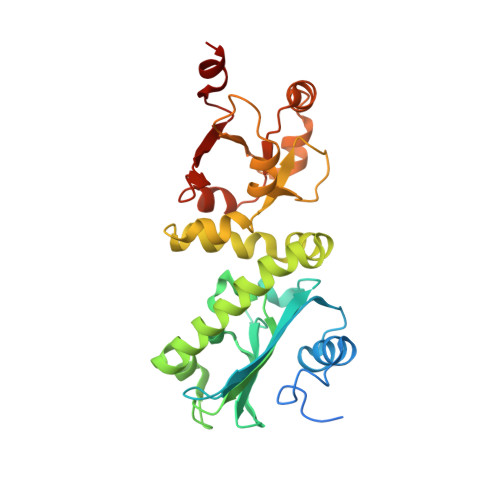
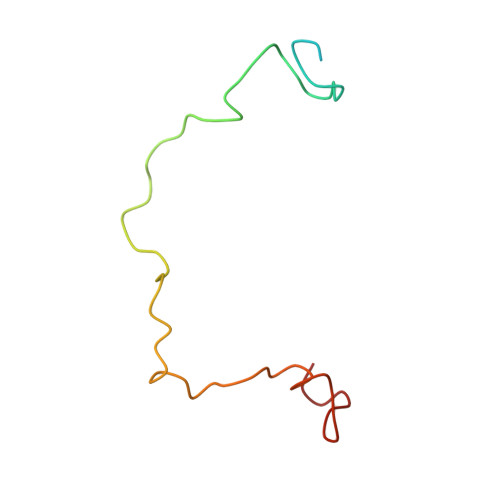
Primary Citation Related Structures: 8K2R, 8K2S, 8K2T
PubMed Abstract:
Molecular chaperone heat shock protein 90 (Hsp90) is a ubiquitous regulator that fine-tunes and remodels diverse client proteins, exerting profound effects on normal biology and diseases. Unraveling the mechanistic details of Hsp90's function requires atomic-level insights into its client interactions throughout the adenosine triphosphate-coupled functional cycle. However, the structural details of the initial encounter complex in the chaperone cycle, wherein Hsp90 adopts an open conformation while engaging with the client, remain elusive. Here, using nuclear magnetic resonance spectroscopy, we determined the solution structure of Hsp90 in its open state, bound to a disordered client. Our findings reveal that Hsp90 uses two distinct binding sites, collaborating synergistically to capture discrete hydrophobic segments within client proteins. This bipartite interaction generates a versatile complex that facilitates rapid conformational sampling. Moreover, our investigations spanning various clients and Hsp90 orthologs demonstrate a pervasive mechanism used by Hsp90 orthologs to accommodate the vast array of client proteins. Collectively, our work contributes to establish a unified conceptual and mechanistic framework, elucidating the intricate interplay between Hsp90 and its clients.
Organizational Affiliation:
Ministry of Education Key Laboratory for Membraneless Organelles and Cellular Dynamics, University of Science and Technology of China, Hefei, China.
Center for Advanced Interdisciplinary Science and Biomedicine of IHM, Hefei, China.
Hefei National Laboratory for Physical Sciences at the Microscale, Division of Life Sciences and Medicine, University of Science and Technology of China, Hefei, China.
Division of Life Sciences and Medicine, University of Science and Technology of China, University of Science and Technology of China, Hefei, China.
High Magnetic Field Laboratory, CAS Key Laboratory of High Magnetic Field and Ion Beam Physical Biology, Hefei Institutes of Physical Science, Chinese Academy of Sciences, Hefei, China.
Department of Structural Biology, St. Jude Children's Research Hospital, Memphis, TN, USA.
Biomedical Sciences and Health Laboratory of Anhui Province, University of Science and Technology of China, Hefei, China.
Ministry of Education Key Laboratory for Membraneless Organelles and Cellular Dynamics, University of Science and Technology of China, Hefei, China. xuweiya@ustc.edu.cn.
Center for Advanced Interdisciplinary Science and Biomedicine of IHM, Hefei, China. xuweiya@ustc.edu.cn.
Hefei National Laboratory for Physical Sciences at the Microscale, Division of Life Sciences and Medicine, University of Science and Technology of China, Hefei, China. xuweiya@ustc.edu.cn.
Division of Life Sciences and Medicine, University of Science and Technology of China, University of Science and Technology of China, Hefei, China. xuweiya@ustc.edu.cn.
Biomedical Sciences and Health Laboratory of Anhui Province, University of Science and Technology of China, Hefei, China. xuweiya@ustc.edu.cn.
Ministry of Education Key Laboratory for Membraneless Organelles and Cellular Dynamics, University of Science and Technology of China, Hefei, China. huangcd@ustc.edu.cn.
Center for Advanced Interdisciplinary Science and Biomedicine of IHM, Hefei, China. huangcd@ustc.edu.cn.
Hefei National Laboratory for Physical Sciences at the Microscale, Division of Life Sciences and Medicine, University of Science and Technology of China, Hefei, China. huangcd@ustc.edu.cn.
Division of Life Sciences and Medicine, University of Science and Technology of China, University of Science and Technology of China, Hefei, China. huangcd@ustc.edu.cn.
Biomedical Sciences and Health Laboratory of Anhui Province, University of Science and Technology of China, Hefei, China. huangcd@ustc.edu.cn.








 Download Mendeley