Download Mendeley
Flipping of a Non-productive Substrate Binding Conformation Facilitates Hydroxynitrile Lyase Catalyzed Hydrocyanation.
Zheng, Y.C., Mao, Y., Geng, Q., Li, F.L., Kong, X.D., Qi, Y.K., Zhang, L., Chen, Q., Zhang, Z.J., Hong, R., Zhao, Y.L., Yu, H.L., Xu, J.H.(2025) Angew Chem Int Ed Engl 64: e202515778-e202515778
- PubMed: 41137404 Search on PubMed
- DOI: https://doi.org/10.1002/anie.202515778
- Primary Citation Related Structures:
8JM0, 8JM1, 8JM2, 8JM3, 8JM4, 8JM5, 8JM6, 8JM7, 8JM8 - PubMed Abstract:
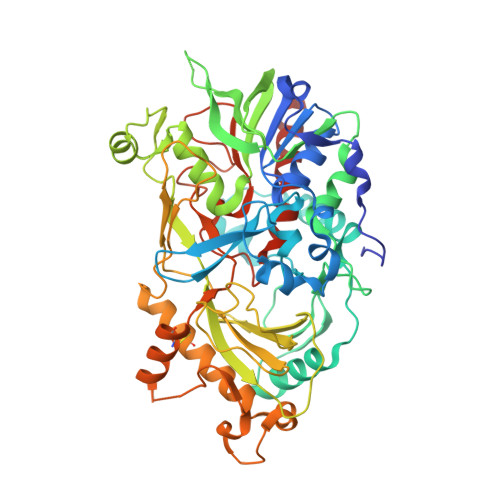
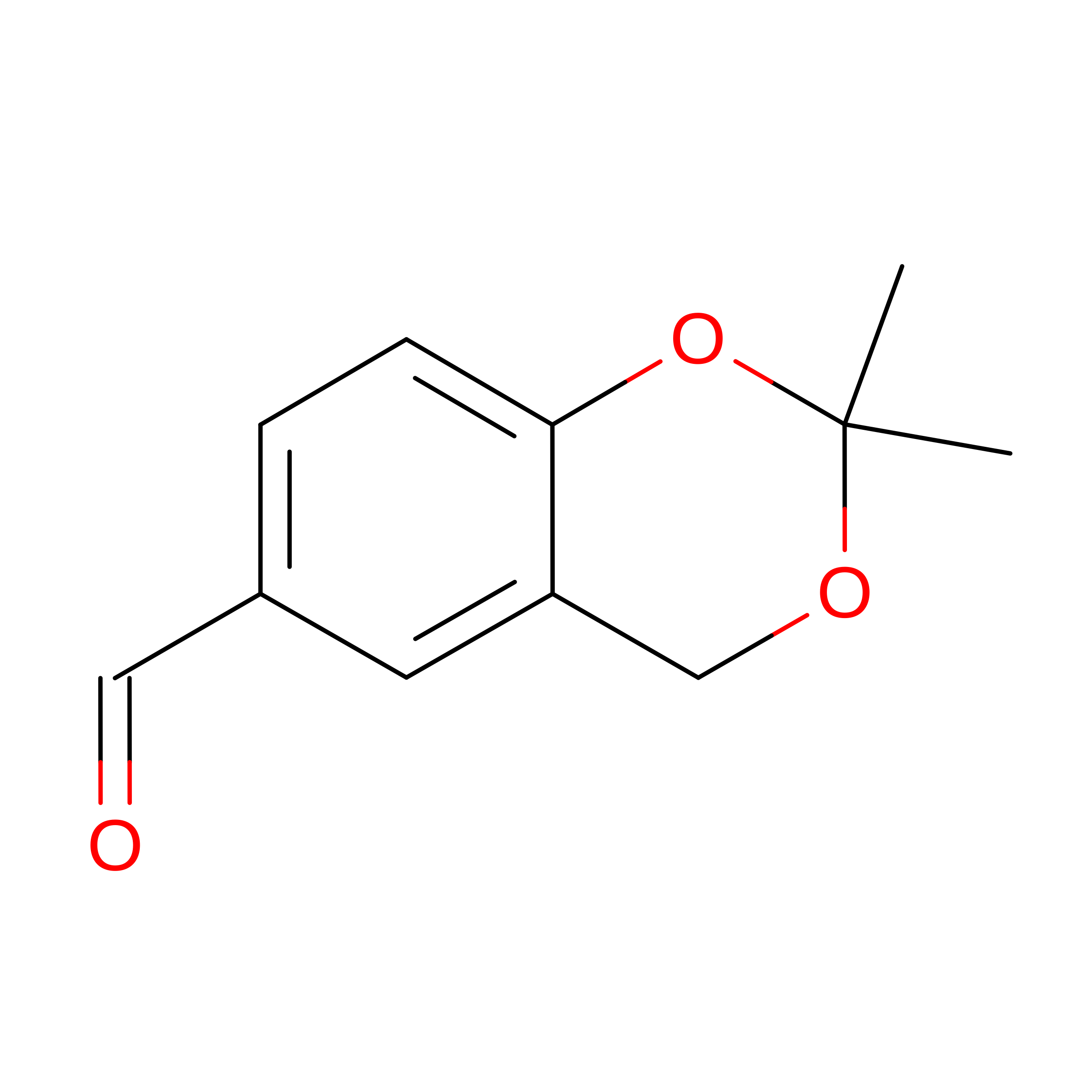
Understanding enzyme-substrate conformational transformations is crucial to the design and engineering of biocatalysts. However, the mechanisms by which substrates undergo dynamic transformations that regulate the function of an enzyme remain poorly understood. Hydroxynitrile lyase from Prunus communis (PcHNL5) catalyzes the cleavage of cyanohydrins. Its reverse reaction holds significant synthetic potential for the preparation of pharmaceutical precursors. Using a combination of crystallography and computational experiments, a novel flipped substrate binding state is identified within the substrate tunnel of the PcHNL5 L331A mutant. This binding state is non-productive and undergoes a conformational change before the catalytic cycle can proceed. Site-saturation mutagenesis led to the discovery of a triple mutant, PcHNL5 L331A/S333V/P340L , that destabilizes the non-productive substrate binding state thereby facilitating its transition to the catalytically productive conformation and significantly enhancing catalytic efficiency. Crystallographic studies provide a structural description of the factors that stabilize versus destabilize the different binding conformers in the different enzyme variants and thus the differing catalytic efficiencies. These findings demonstrate that destabilizing unfavorable substrate binding conformations within an enzyme active site can improve functionality and provide a promising strategy for designing efficient biocatalysts.
- State Key Laboratory of Bioreactor Engineering, Shanghai Collaborative Innovation Centre for Biomanufacturing, East China University of Science and Technology, Shanghai, 200237, P.R. China.
Organizational Affiliation: