8IJC | pdb_00008ijc

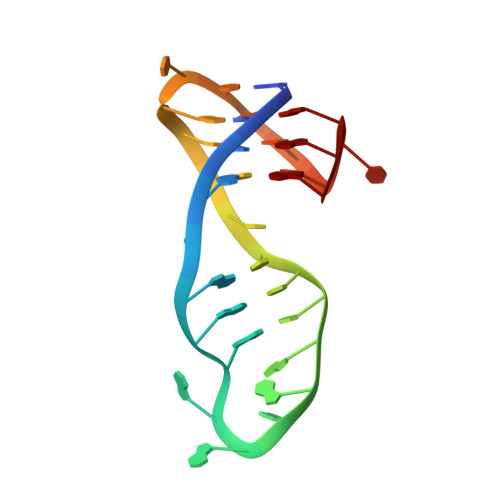
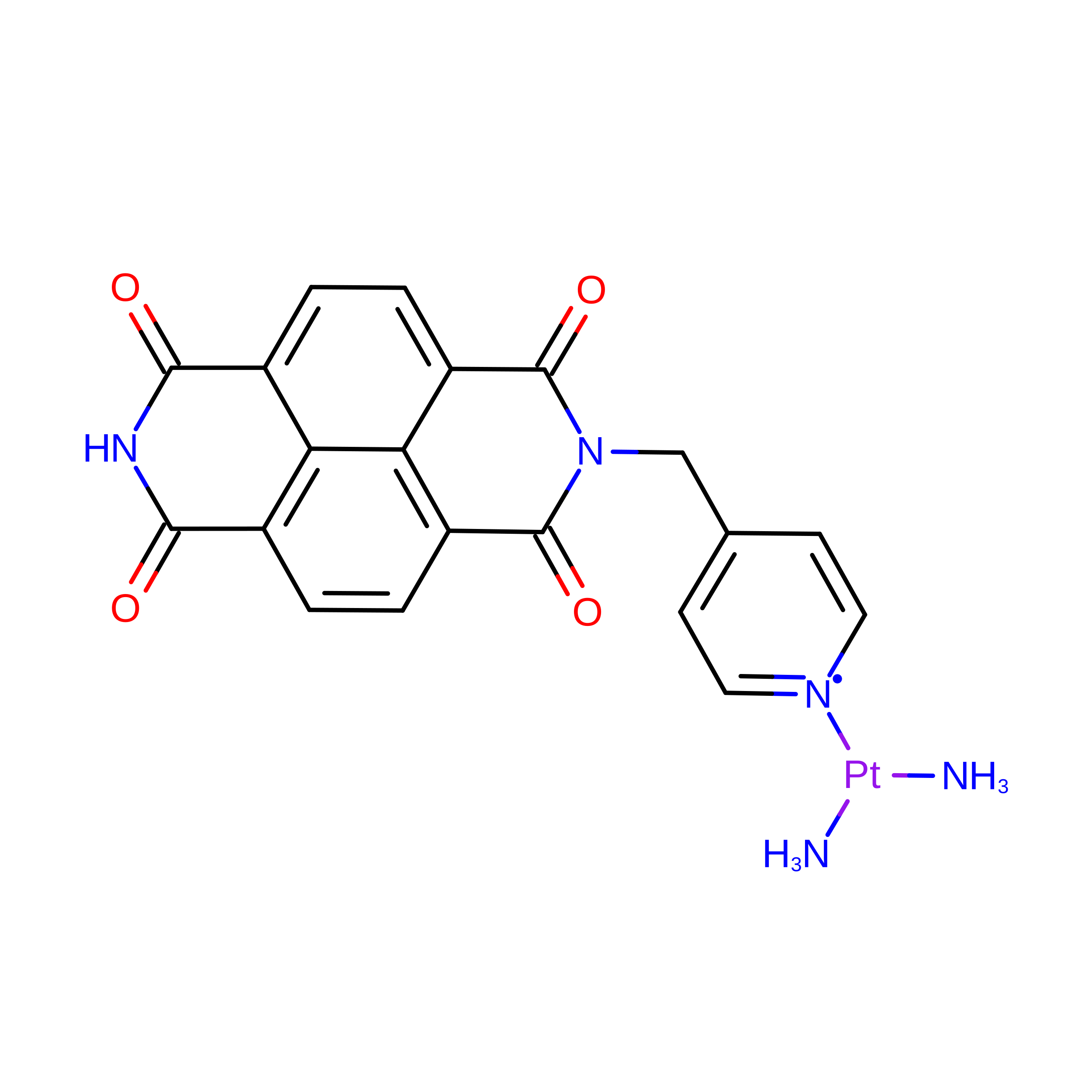
NMR solution structure of the 1:1 complex of a platinum(II) ligand L1-transpt covalently bound to a G-quadruplex MYT1L

  • Classification: DNA
  • Organism(s): Homo sapiens
  • Mutation(s): No 

  • Deposited: 2023-02-27 Released: 2023-06-28 
  • Deposition Author(s): Liu, L.-Y., Mao, Z.-W.
  • Funding Organization(s): National Science Foundation (NSF, China)

Experimental Data Snapshot

  • Method: SOLUTION NMR
  • Conformers Calculated: 100 
  • Conformers Submitted: 15 
  • Selection Criteria: structures with the lowest energy 

wwPDB Validation 3D Report Full Report

Validation slider image for 8IJC

This is version 1.2 of the entry. See complete history

Literature

Organic-Platinum Hybrids for Covalent Binding of G-Quadruplexes: Structural Basis and Application to Cancer Immunotherapy.

Liu, L.Y.Ma, T.Z.Zeng, Y.L.Liu, W.Zhang, H.Mao, Z.W.

(2023) Angew Chem Int Ed Engl 62: e202305645-e202305645

  • DOI: https://doi.org/10.1002/anie.202305645
  • Primary Citation Related Structures: 
    8IJC

  • PubMed Abstract: 

    G-quadruplexes (G4s) have been revived as promising therapeutic targets with the development of immunotherapy, but the G4-mediated immune response remains unclear. We designed a novel class of G4-binding organic-platinum hybrids, L 1 -cispt and L 1 -transpt, with spatial matching for G4 binding and G4 DNA reactivity for binding site locking. The solution structure of L 1 -transpt-MYT1L G4 demonstrated the effectiveness of the covalent binding and revealed the covalent binding-guided dynamic balance, accompanied by the destruction of the A5-T17 base pairs to achieve the covalent binding of the platinum unit to N7 of the G6 residue. Furthermore, L 1 -cispt- and L 1 -transpt-mediated genomic dysfunction could activate the retinoic acid-induced gene I (RIG-I) pathway and induce immunogenic cell death (ICD). The use of L 1 -cispt/L 1 -transpt-treated dying cells as therapeutic vaccines stimulated a robust immune response and effectively inhibited tumor growth in vivo. Our findings highlight the importance of the rational combination of specific spatial recognition and covalent locking in G4-trageting drug design and their potential in immunotherapy.


  • Organizational Affiliation
    • MOE Key Laboratory of Bioinorganic and Synthetic Chemistry, School of Chemistry, IGCME, Sun Yat-Sen University, Guangzhou, 510275, P. R. China.

Macromolecule Content 

  • Total Structure Weight: 9.8 kDa 
  • Atom Count: 644 
  • Modeled Residue Count: 29 
  • Deposited Residue Count: 29 
  • Unique nucleic acid chains: 1

Macromolecules

Find similar nucleic acids by:  (by identity cutoff) 
Entity ID: 1
MoleculeChains LengthOrganismImage
G-quadruplex DNA MYT1L29Homo sapiens
Sequence Annotations
Expand
Reference Sequence

Small Molecules

Ligands 1 Unique
IDChains Name / Formula / InChI Key2D Diagram3D Interactions
Q3Z
(Subject of Investigation/LOI)

Query on Q3Z


Download:Ideal Coordinates CCD File
B [auth A]Pt(NH3)2(2-(pyridin-4-ylmethyl)benzo-[lmn][3,8]phenanthroline-1,3,6,8(2H,7H)-tetraone)
C20 H17 N5 O4 Pt
KUFSUTVUWNDAOZ-UHFFFAOYSA-N

Experimental Data & Validation

Experimental Data

  • Method: SOLUTION NMR
  • Conformers Calculated: 100 
  • Conformers Submitted: 15 
  • Selection Criteria: structures with the lowest energy 

Structure Validation

View Full Validation Report


Entry History 

& Funding Information

Deposition Data


Funding OrganizationLocationGrant Number
National Science Foundation (NSF, China)China--

Revision History  (Full details and data files)

  • Version 1.0: 2023-06-28
    Type: Initial release
  • Version 1.1: 2024-01-10
    Changes: Data collection, Database references
  • Version 1.2: 2024-05-15
    Changes: Database references