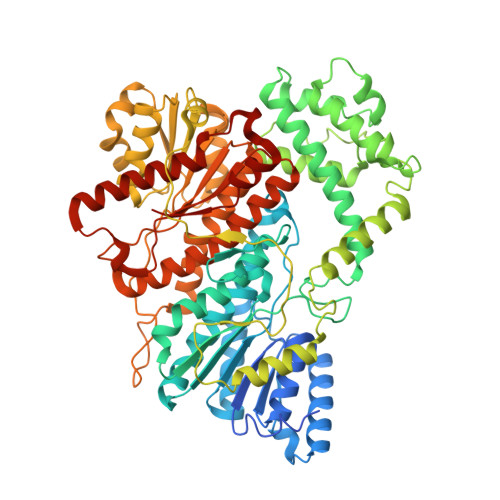
8I70 | pdb_00008i70

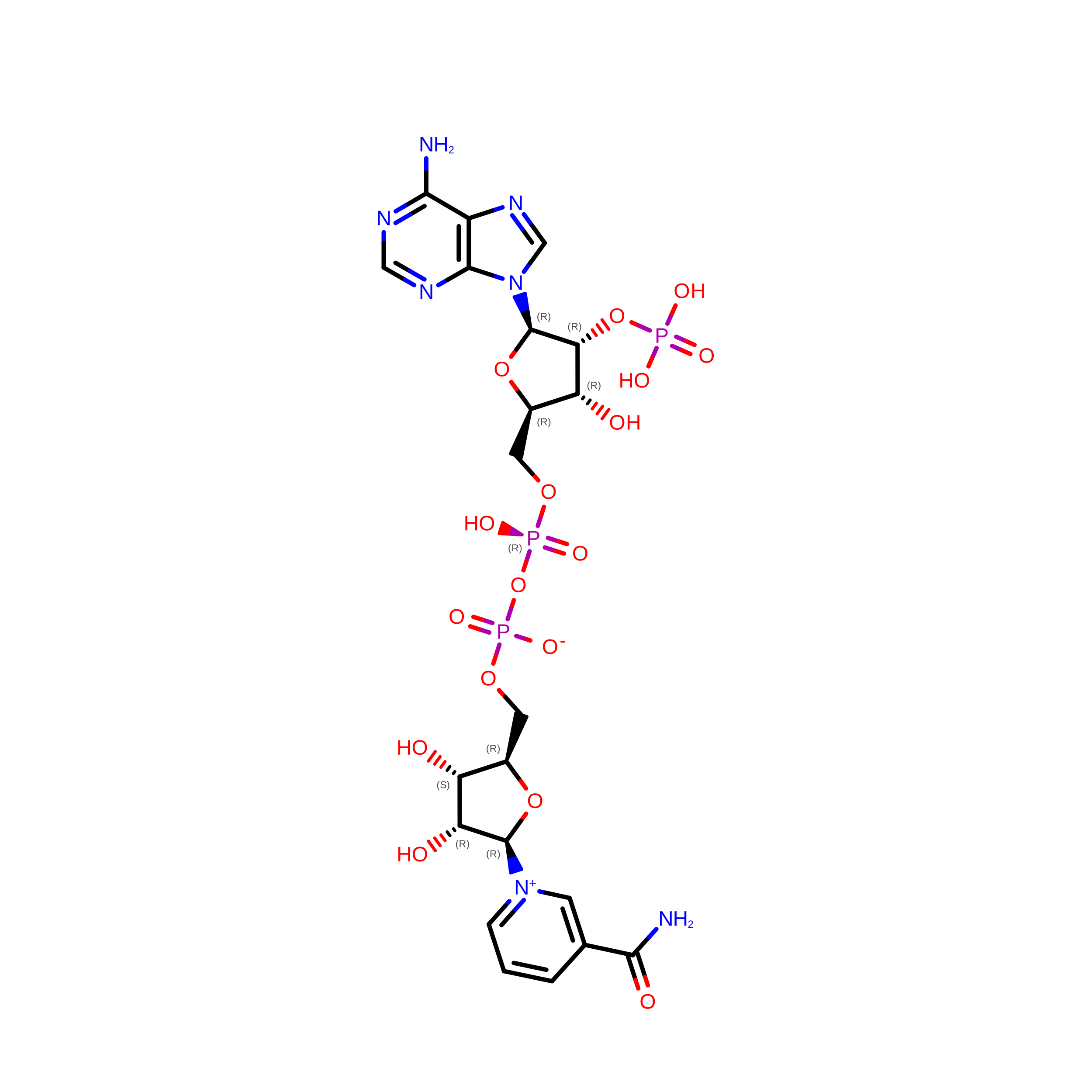
Crystal structure of NADP-binding form of malonyl-CoA reductase C-domain from Chloroflexus aurantiacus


Experimental Data Snapshot

  • Method: X-RAY DIFFRACTION
  • Resolution: 1.90 Å
  • R-Value Free: 
    0.191 (Depositor), 0.197 (DCC) 
  • R-Value Work: 
    0.152 (Depositor), 0.166 (DCC) 
  • R-Value Observed: 
    0.154 (Depositor) 

Starting Model: experimental
View more details

wwPDB Validation 3D Report Full Report

Validation slider image for 8I70

Ligand Structure Quality Assessment 


This is version 1.1 of the entry. See complete history

Literature

Cryo-EM structure of bifunctional malonyl-CoA reductase from Chloroflexus aurantiacus reveals a dynamic domain movement for high enzymatic activity.

Ahn, J.W.Kim, S.Hong, J.Kim, K.J.

(2023) Int J Biol Macromol 242: 124676-124676

  • DOI: https://doi.org/10.1016/j.ijbiomac.2023.124676
  • Primary Citation Related Structures: 
    8HJW, 8I6Z, 8I70

  • PubMed Abstract: 

    The platform chemical 3-hydroxypropionic acid is used to synthesize various valuable materials, including bioplastics. Bifunctional malonyl-CoA reductase is a key enzyme in 3-hydroxypropionic acid biosynthesis as it catalyzes the two-step reduction of malonyl-CoA to malonate semialdehyde to 3-hydroxypropionic acid. Here, we report the cryo-EM structure of a full-length malonyl-CoA reductase protein from Chloroflexus aurantiacus (CaMCR Full ). The EM model of CaMCR Full reveals a tandem helix architecture comprising an N-terminal (CaMCR ND ) and a C-terminal (CaMCR CD ) domain. The CaMCR Full model also revealed that the enzyme undergoes a dynamic domain movement between CaMCR ND and CaMCR CD due to the presence of a flexible linker between these two domains. Increasing the flexibility and extension of the linker resulted in a twofold increase in enzyme activity, indicating that for CaMCR, domain movement is crucial for high enzyme activity. We also describe the structural features of CaMCR ND and CaMCR CD . This study reveals the protein structures underlying the molecular mechanism of CaMCR Full and thereby provides valuable information for future enzyme engineering to improve the productivity of 3-hydroxypropionic acid.


  • Organizational Affiliation
    • Postech Biotech Center, Pohang University of Science and Technology, 77 Cheongam-ro, Nam-gu, Pohang, Gyeongbuk 37673, Republic of Korea; Center for Biomolecular Capture Technology, Bio Open Innovation Center, Pohang University of Science and Technology, 47 Cheongam-ro, Nam-gu, Pohang, Gyeongbuk 37673, Republic of Korea.

Macromolecule Content 

  • Total Structure Weight: 76.64 kDa 
  • Atom Count: 5,644 
  • Modeled Residue Count: 658 
  • Deposited Residue Count: 689 
  • Unique protein chains: 1

Macromolecules

Find similar proteins by:|  3D Structure
Entity ID: 1
MoleculeChains  Sequence LengthOrganismDetailsImage
Short-chain dehydrogenase/reductase SDR689Chloroflexus aurantiacusMutation(s): 0 
Gene Names: Caur_2614
EC: 1.2.1.75
UniProt
Find proteins for A9WIU3 (Chloroflexus aurantiacus (strain ATCC 29366 / DSM 635 / J-10-fl))
Explore A9WIU3 
Go to UniProtKB:  A9WIU3
Entity Groups
Sequence Clusters30% Identity50% Identity70% Identity90% Identity95% Identity100% Identity
UniProt GroupA9WIU3
Sequence Annotations
Expand
Reference Sequence

Experimental Data & Validation

Experimental Data

  • Method: X-RAY DIFFRACTION
  • Resolution: 1.90 Å
  • R-Value Free:  0.191 (Depositor), 0.197 (DCC) 
  • R-Value Work:  0.152 (Depositor), 0.166 (DCC) 
  • R-Value Observed: 0.154 (Depositor) 
Space Group: C 1 2 1
Unit Cell:
Length ( Å )Angle ( ˚ )
a = 85.675α = 90
b = 139.644β = 97.71
c = 73.565γ = 90
Software Package:
Software NamePurpose
REFMACrefinement
HKL-2000data scaling
HKL-2000data reduction
MOLREPphasing

Structure Validation

View Full Validation Report


Ligand Structure Quality Assessment 


Entry History 

& Funding Information

Deposition Data


Funding OrganizationLocationGrant Number
Not funded--

Revision History  (Full details and data files)

  • Version 1.0: 2023-06-14
    Type: Initial release
  • Version 1.1: 2024-05-29
    Changes: Data collection