8G7D | pdb_00008g7d

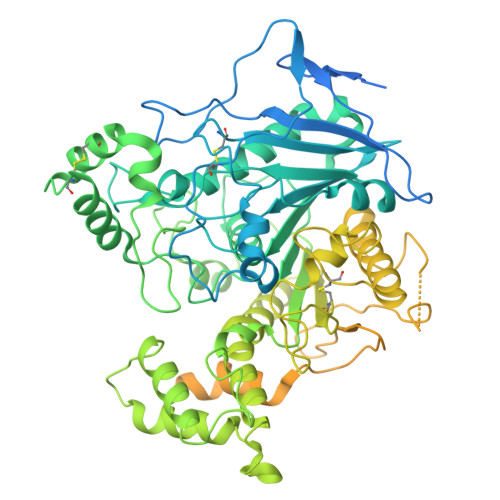
Cryo-EM structure of full length Neuroligin-2 from Mouse

  • Classification: MEMBRANE PROTEIN
  • Organism(s): Mus musculus
  • Expression System: Homo sapiens
  • Mutation(s): No 

  • Deposited: 2023-02-16 Released: 2025-05-14 
  • Deposition Author(s): Boyd, R., Wang, W.
  • Funding Organization(s): National Institutes of Health/National Cancer Institute (NIH/NCI), McKnight Foundation

Experimental Data Snapshot

  • Method: ELECTRON MICROSCOPY
  • Resolution: 3.28 Å
  • Aggregation State: PARTICLE 
  • Reconstruction Method: SINGLE PARTICLE 

Starting Model: experimental
View more details

wwPDB Validation 3D Report Full Report

Validation slider image for 8G7D

This is version 1.1 of the entry. See complete history

Literature

Weaker neuroligin 2-neurexin beta 1 interaction tethers membranes and recruits gephyrin at membrane junctions through clustering.

Boyd, R.Jaqaman, K.Wang, W.

(2026) Sci Adv 12: eads9732-eads9732

  • DOI: https://doi.org/10.1126/sciadv.ads9732
  • Primary Citation Related Structures: 
    8G7D

  • PubMed Abstract: 

    Single-pass transmembrane proteins neuroligin (NL) and neurexin (NRX) constitute a pair of synaptic adhesion molecules that are essential for the formation of functional synapses. Binding affinities vary by ~1000-fold between combinations of NL and NRX subtypes, which contribute to chemical and spatial specificities. Among major NL-NRX subtypes, NL2 and NRXβ1 have the lowest affinity. Here, we report structures of NL2 in complex with NRXβ1 in several conformations, along with NL2 alone. We identify mechanisms underlying the modulation of NL-NRX affinities and how the weaker NL2-NRXβ1 interaction alone is capable of tethering lipid membranes. We further show that NL2 and NRXβ1 cluster at intercellular junctions and recruit the master postsynaptic scaffolding protein gephyrin, which further clusters neurotransmitter receptors. These findings suggest a dual role of the NL2-NRXβ1 interaction-both as mechanical tether and as signaling receptor-to ensure correct spatial and chemical coordination between two cells to generate functional synapses.


  • Organizational Affiliation
    • Department of Biophysics, University of Texas Southwestern Medical Center, Dallas, TX, USA.

Macromolecule Content 

  • Total Structure Weight: 191.34 kDa 
  • Atom Count: 8,346 
  • Modeled Residue Count: 1,076 
  • Deposited Residue Count: 1,740 
  • Unique protein chains: 1

Macromolecules

Find similar proteins by:|  3D Structure
Entity ID: 1
MoleculeChains  Sequence LengthOrganismDetailsImage
Neuroligin-1,Neuroligin-2
A, B
870Mus musculusMutation(s): 0 
Gene Names: Nlgn1Kiaa1070Nlgn2Kiaa1366
UniProt
Find proteins for Q69ZK9 (Mus musculus)
Explore Q69ZK9 
Go to UniProtKB:  Q69ZK9
Find proteins for Q99K10 (Mus musculus)
Explore Q99K10 
Go to UniProtKB:  Q99K10
Entity Groups
Sequence Clusters30% Identity50% Identity70% Identity90% Identity95% Identity100% Identity
UniProt GroupsQ99K10Q69ZK9
Glycosylation
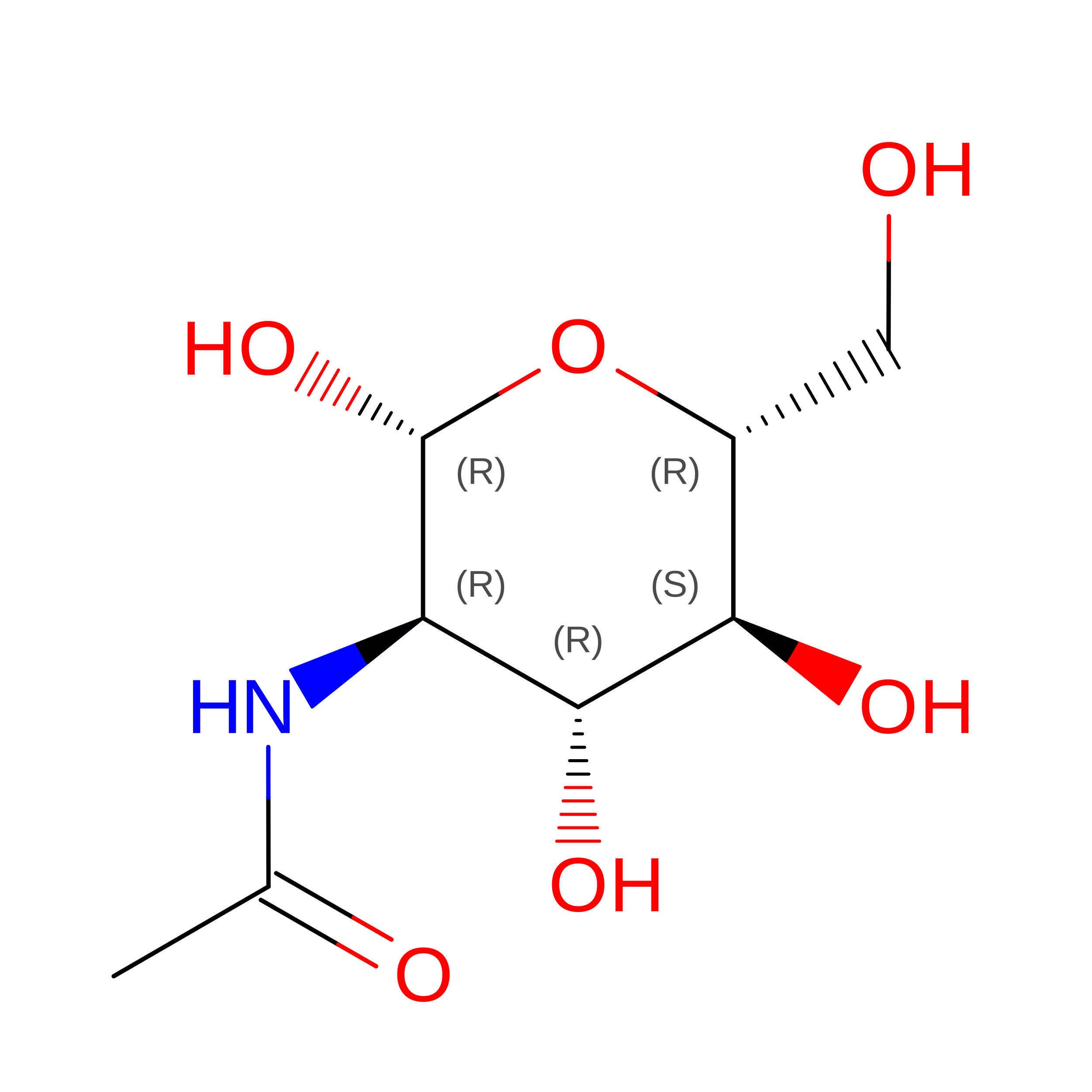
Glycosylation Sites: 2Go to GlyGen: Q99K10-1Q69ZK9-1
Sequence Annotations
Expand
Reference Sequence

Experimental Data & Validation

Experimental Data

  • Method: ELECTRON MICROSCOPY
  • Resolution: 3.28 Å
  • Aggregation State: PARTICLE 
  • Reconstruction Method: SINGLE PARTICLE 
EM Software:
TaskSoftware PackageVersion
RECONSTRUCTIONcryoSPARC3
MODEL REFINEMENTPHENIX1

Structure Validation

View Full Validation Report


Entry History 

& Funding Information

Deposition Data


Funding OrganizationLocationGrant Number
National Institutes of Health/National Cancer Institute (NIH/NCI)United States1R25Gm146860
McKnight FoundationUnited States2022 Scholar Award

Revision History  (Full details and data files)

  • Version 1.0: 2025-05-14
    Type: Initial release
  • Version 1.1: 2026-04-08
    Changes: Data collection, Database references