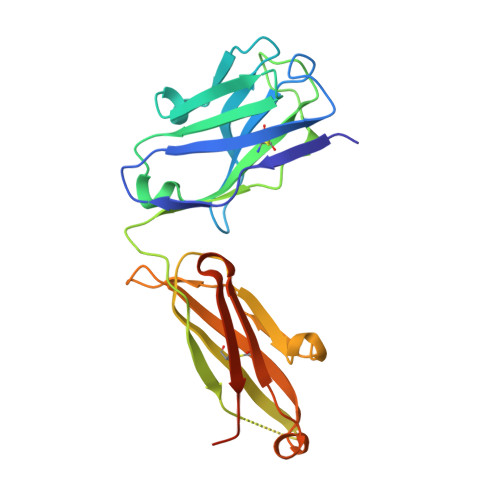
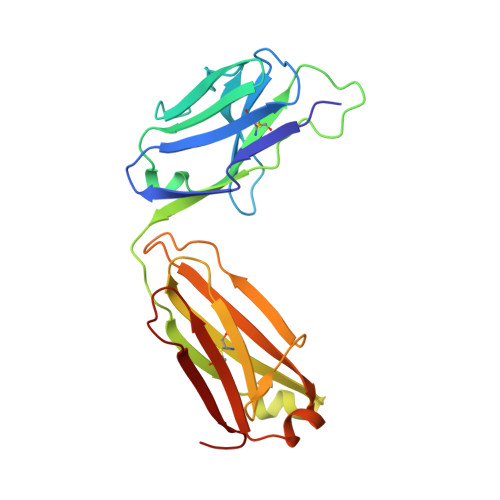
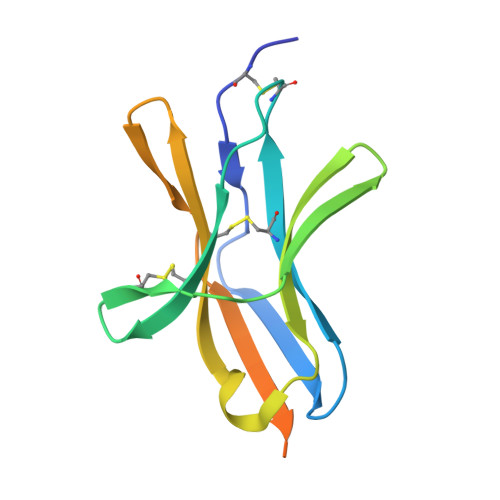
8F6L | pdb_00008f6l

anti-BTLA monoclonal antibody h25F7 in complex with BTLA


Experimental Data Snapshot

  • Method: X-RAY DIFFRACTION
  • Resolution: 1.85 Å
  • R-Value Free: 
    0.240 (Depositor), 0.240 (DCC) 
  • R-Value Work: 
    0.198 (Depositor), 0.199 (DCC) 
  • R-Value Observed: 
    0.200 (Depositor) 

Starting Model: experimental
View more details

wwPDB Validation 3D Report Full Report

Validation slider image for 8F6L

This is version 1.4 of the entry. See complete history

Literature

Epitope topography of agonist antibodies to the checkpoint inhibitory receptor BTLA.

Cheung, T.C.Atwell, S.Bafetti, L.Cuenca, P.D.Froning, K.Hendle, J.Hickey, M.Ho, C.Huang, J.Lieu, R.Lim, S.Lippner, D.Obungu, V.Ward-Kavanagh, L.Weichert, K.Ware, C.F.Vendel, A.C.

(2023) Structure 31: 958

  • DOI: https://doi.org/10.1016/j.str.2023.05.011
  • Primary Citation Related Structures: 
    8F60, 8F6L, 8F6O

  • PubMed Abstract: 

    B and T lymphocyte attenuator (BTLA) is an attractive target for a new class of therapeutics that attempt to rebalance the immune system by agonizing checkpoint inhibitory receptors (CIRs). Herpesvirus entry mediator (HVEM) binds BTLA in both trans- and cis-orientations. We report here the development and structural characterization of three humanized BTLA agonist antibodies, 22B3, 25F7, and 23C8. We determined the crystal structures of the antibody-BTLA complexes, showing that these antibodies bind distinct and non-overlapping epitopes of BTLA. While all three antibodies activate BTLA, 22B3 mimics HVEM binding to BTLA and shows the strongest agonistic activity in functional cell assays and in an imiquimod-induced mouse model of psoriasis. 22B3 is also capable of modulating HVEM signaling through the BTLA-HVEM cis-interaction. The data obtained from crystal structures, biochemical assays, and functional studies provide a mechanistic model of HVEM and BTLA organization on the cell surface and informed the discovery of a highly active BTLA agonist.


  • Organizational Affiliation
    • Infectious and Inflammatory Diseases Center, Sanford Burnham Prebys Medical Discovery Institute, La Jolla, CA 92037, USA.

Macromolecule Content 

  • Total Structure Weight: 63.69 kDa 
  • Atom Count: 4,537 
  • Modeled Residue Count: 537 
  • Deposited Residue Count: 582 
  • Unique protein chains: 3

Macromolecules

Find similar proteins by:|  3D Structure
Entity ID: 1
MoleculeChains  Sequence LengthOrganismDetailsImage
h25F7 Fab heavy chain235Homo sapiensMutation(s): 0 
Find similar proteins by:|  3D Structure
Entity ID: 2
MoleculeChains  Sequence LengthOrganismDetailsImage
h25F7 Fab light chain217Homo sapiensMutation(s): 0 
Find similar proteins by:|  3D Structure
Entity ID: 3
MoleculeChains  Sequence LengthOrganismDetailsImage
B- and T-lymphocyte attenuator130Homo sapiensMutation(s): 0 
Gene Names: BTLA
UniProt & NIH Common Fund Data Resources
Find proteins for Q7Z6A9 (Homo sapiens)
Explore Q7Z6A9 
Go to UniProtKB:  Q7Z6A9
PHAROS:  Q7Z6A9
GTEx:  ENSG00000186265 
Entity Groups
Sequence Clusters30% Identity50% Identity70% Identity90% Identity95% Identity100% Identity
UniProt GroupQ7Z6A9
Sequence Annotations
Expand
Reference Sequence

Experimental Data & Validation

Experimental Data

  • Method: X-RAY DIFFRACTION
  • Resolution: 1.85 Å
  • R-Value Free:  0.240 (Depositor), 0.240 (DCC) 
  • R-Value Work:  0.198 (Depositor), 0.199 (DCC) 
  • R-Value Observed: 0.200 (Depositor) 
Space Group: P 21 21 21
Unit Cell:
Length ( Å )Angle ( ˚ )
a = 48.961α = 90
b = 68.6β = 90
c = 187.321γ = 90
Software Package:
Software NamePurpose
REFMACrefinement
MOSFLMdata reduction
SCALAdata scaling
PHASERphasing

Structure Validation

View Full Validation Report


Entry History 

& Funding Information

Deposition Data


Funding OrganizationLocationGrant Number
Not funded--

Revision History  (Full details and data files)

  • Version 1.0: 2023-05-24
    Type: Initial release
  • Version 1.1: 2023-07-05
    Changes: Database references
  • Version 1.2: 2023-08-16
    Changes: Data collection, Database references
  • Version 1.3: 2023-10-25
    Changes: Refinement description
  • Version 1.4: 2024-10-16
    Changes: Structure summary