Download Mendeley
Ea22 Proteins from Lambda and Shiga Toxin-Producing Bacteriophages Balance Structural Diversity with Functional Similarity.
Tong, J., Nejman-Faleeczyk, B., Bloch, S., Wegrzyn, A., Wegrzyn, G., Donaldson, L.W.(2020) ACS Omega 5: 12236-12244
- PubMed: 32548406 Search on PubMedSearch on PubMed Central
- DOI: https://doi.org/10.1021/acsomega.0c00894
- Primary Citation Related Structures:
8DSX - PubMed Abstract:
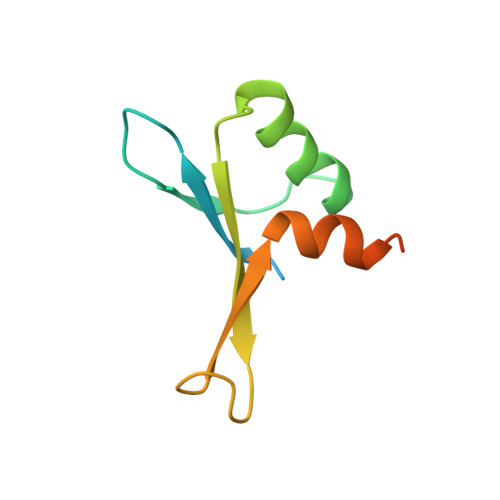
Enterohemorrhagic Escherichia coli (EHEC) outbreaks are commonly associated with contaminated food sources. Unlike normal intestinal bacteria, EHEC are lysogens of lambdoid bacteriophages that also carry a gene for Shiga toxin. Oxidative attack by the immune system or other stressors on the bacterial host can activate the lytic pathway of the latent phage genome to produce phage progeny and the release of Shiga toxin into the surrounding tissues. Within the genomes of bacteriophage λ and Shiga toxin-expressing (Stx + ) phages such as φ24 B and φP27, there is a conserved set of open reading frames that is located between the exo and xis genes that influences the lysogenic-lytic decision. In this report, we have focused on the largest exo - xis region open reading frame termed ea22 that has been shown previously to have prolysogenic properties. Using a variety of biophysical and bioinformatic methods, we demonstrate that λ and φP27 Ea22 proteins are tetrameric in solution and can be considered in terms of an amino-terminal region, a central coiled-coil region, and a carboxy-terminal region. The carboxy-terminal regions of λ and φ24 B Ea22, expressed on their own, form dimers with exceptional thermostability. Limited proteolysis of φP27 Ea22 also identified a C-terminal region along the predicted boundaries. While the three Ea22 proteins all appear to have the hallmarks of a domain in their respective C-terminal regions, each sequence is remarkably dissimilar. To reconcile this difference among Ea22 proteins from λ and Stx + phages alike, we speculate that each Ea22 may achieve the same function by targeting different components of the same regulatory process in the host.
- Department of Biology, York University, 4700 Keele Street, Toronto, ON, Canada M3J 1P3.
Organizational Affiliation: