Download Mendeley
Structural insights into a plant-conserved DHFR-TS reveal a selective herbicide target.
Haywood, J., Breese, K.J., McDougal, D.P., Verdonk, C., Partridge, A., Lo, A.F., Zhang, J., Yang, W.C., Bruning, J.B., Saliba, K.J., Bond, C.S., Stubbs, K.A., Mylne, J.S.(2025) Mol Plant 18: 1294-1309
- PubMed: 40598768 Search on PubMed
- DOI: https://doi.org/10.1016/j.molp.2025.06.016
- Primary Citation Related Structures:
8DAE - PubMed Abstract:
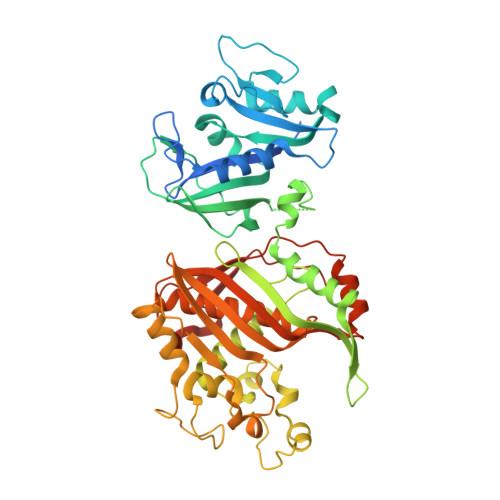
Modern agricultural practices rely on herbicides to reduce yield losses. Herbicide-resistant weeds threaten herbicide utility and, hence, food security. New herbicide modes of action and integrated pest-management practices are vital to mitigate this threat. As the antimalarials that target the bifunctional enzyme dihydrofolate reductase-thymidylate synthase (DHFR-TS) have been shown to be herbicidal, DHFR-TS might represent a mode-of-action target for the development of herbicides. Here, we present the crystal structure of a DHFR-TS (AtDHFR-TS1) from the model dicot Arabidopsis thaliana. It shows a divergent DHFR active site and a linker domain that challenges previous classifications of bifunctional DHFR-TS proteins. This plant-conserved architecture enabled us to develop highly selective herbicidal inhibitors of AtDHFR-TS1 over human DHFR and identify inhibitors with unique scaffolds via a large-library virtual screen. These results suggest that DHFR-TS is a viable herbicide target.
- School of Molecular Sciences, The University of Western Australia, 35 Stirling Highway, Crawley, Perth, WA 6009, Australia; Centre for Crop and Disease Management, School of Molecular and Life Sciences, Curtin University, Kent Street, Bentley, Perth, WA 6102, Australia. Electronic address: joel.haywood@curtin.edu.au.
Organizational Affiliation: