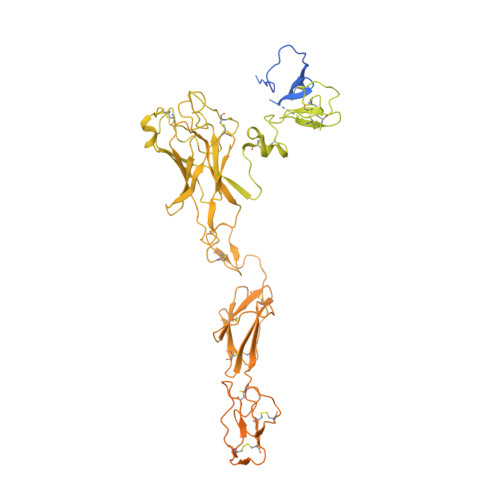
8D8O | pdb_00008d8o

Cryo-EM structure of substrate unbound PAPP-A


Experimental Data Snapshot

  • Method: ELECTRON MICROSCOPY
  • Resolution: 3.35 Å
  • Aggregation State: PARTICLE 
  • Reconstruction Method: SINGLE PARTICLE 

wwPDB Validation 3D Report Full Report

Validation slider image for 8D8O

This is version 1.2 of the entry. See complete history. 

Re-refinement Note

This entry reflects an alternative modeling of the original data in: 7UFG

Literature

Structure of the PAPP-ABP5 complex reveals mechanism of substrate recognition

Judge, R.A., Sridar, J., Tunyasunvunakool, K., Jain, R., Wang, J.C.K., Ouch, C., Xu, J., Mafi, A., Nile, A.H., Remarcik, C., Smith, C.L., Ghosh, C., Xu, C., Stoll, V., Jumper, J., Singh, A.H., Eaton, D., Hao, Q.

(2022) Nat Commun 13: 5500

  • DOI: https://doi.org/10.1038/s41467-022-33175-2
  • Primary Citation Related Structures: 
    7UFG, 8D8O

  • PubMed Abstract: 

    Insulin-like growth factor (IGF) signaling is highly conserved and tightly regulated by proteases including Pregnancy-Associated Plasma Protein A (PAPP-A). PAPP-A and its paralog PAPP-A2 are metalloproteases that mediate IGF bioavailability through cleavage of IGF binding proteins (IGFBPs). Here, we present single-particle cryo-EM structures of the catalytically inactive mutant PAPP-A (E483A) in complex with a peptide from its substrate IGFBP5 (PAPP-A BP5 ) and also in its substrate-free form, by leveraging the power of AlphaFold to generate a high quality predicted model as a starting template. We show that PAPP-A is a flexible trans-dimer that binds IGFBP5 via a 25-amino acid anchor peptide which extends into the metalloprotease active site. This unique IGFBP5 anchor peptide that mediates the specific PAPP-A-IGFBP5 interaction is not found in other PAPP-A substrates. Additionally, we illustrate the critical role of the PAPP-A central domain as it mediates both IGFBP5 recognition and trans-dimerization. We further demonstrate that PAPP-A trans-dimer formation and distal inter-domain interactions are both required for efficient proteolysis of IGFBP4, but dispensable for IGFBP5 cleavage. Together the structural and biochemical studies reveal the mechanism of PAPP-A substrate binding and selectivity.


  • Organizational Affiliation: 
    • AbbVie, 1 North Waukegan Road, North Chicago, IL, USA.

Macromolecule Content 

  • Total Structure Weight: 352.75 kDa 
  • Atom Count: 11,819 
  • Modeled Residue Count: 1,536 
  • Deposited Residue Count: 3,162 
  • Unique protein chains: 1

Macromolecules

Find similar proteins by:|  3D Structure
Entity ID: 1
MoleculeChains  Sequence LengthOrganismDetailsImage
Pappalysin-1
A, B
1,581Homo sapiensMutation(s): 2 
Gene Names: PAPPA
EC: 3.4.24.79
UniProt & NIH Common Fund Data Resources
Find proteins for Q13219 (Homo sapiens)
Explore Q13219 
Go to UniProtKB:  Q13219
PHAROS:  Q13219
GTEx:  ENSG00000182752 
Entity Groups
Sequence Clusters30% Identity50% Identity70% Identity90% Identity95% Identity100% Identity
UniProt GroupQ13219
Sequence Annotations
Expand
Reference Sequence

Small Molecules

Ligands 1 Unique
IDChains Name / Formula / InChI Key2D Diagram3D Interactions
ZN

Query on ZN


Download:Ideal Coordinates CCD File
C [auth B]ZINC ION
Zn
PTFCDOFLOPIGGS-UHFFFAOYSA-N

Experimental Data & Validation

Experimental Data

  • Method: ELECTRON MICROSCOPY
  • Resolution: 3.35 Å
  • Aggregation State: PARTICLE 
  • Reconstruction Method: SINGLE PARTICLE 
EM Software:
TaskSoftware PackageVersion
MODEL REFINEMENTPHENIX
RECONSTRUCTIONcryoSPARC3

Structure Validation

View Full Validation Report


Entry History 

& Funding Information

Deposition Data


Funding OrganizationLocationGrant Number
Not funded--

Revision History  (Full details and data files)

  • Version 1.0: 2022-09-28
    Type: Initial release
  • Version 1.1: 2024-11-20
    Changes: Data collection, Structure summary
  • Version 1.2: 2025-01-01
    Changes: Data collection, Data processing