8C79 | pdb_00008c79

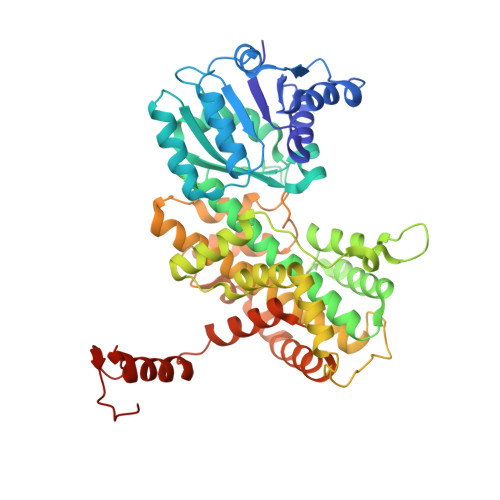
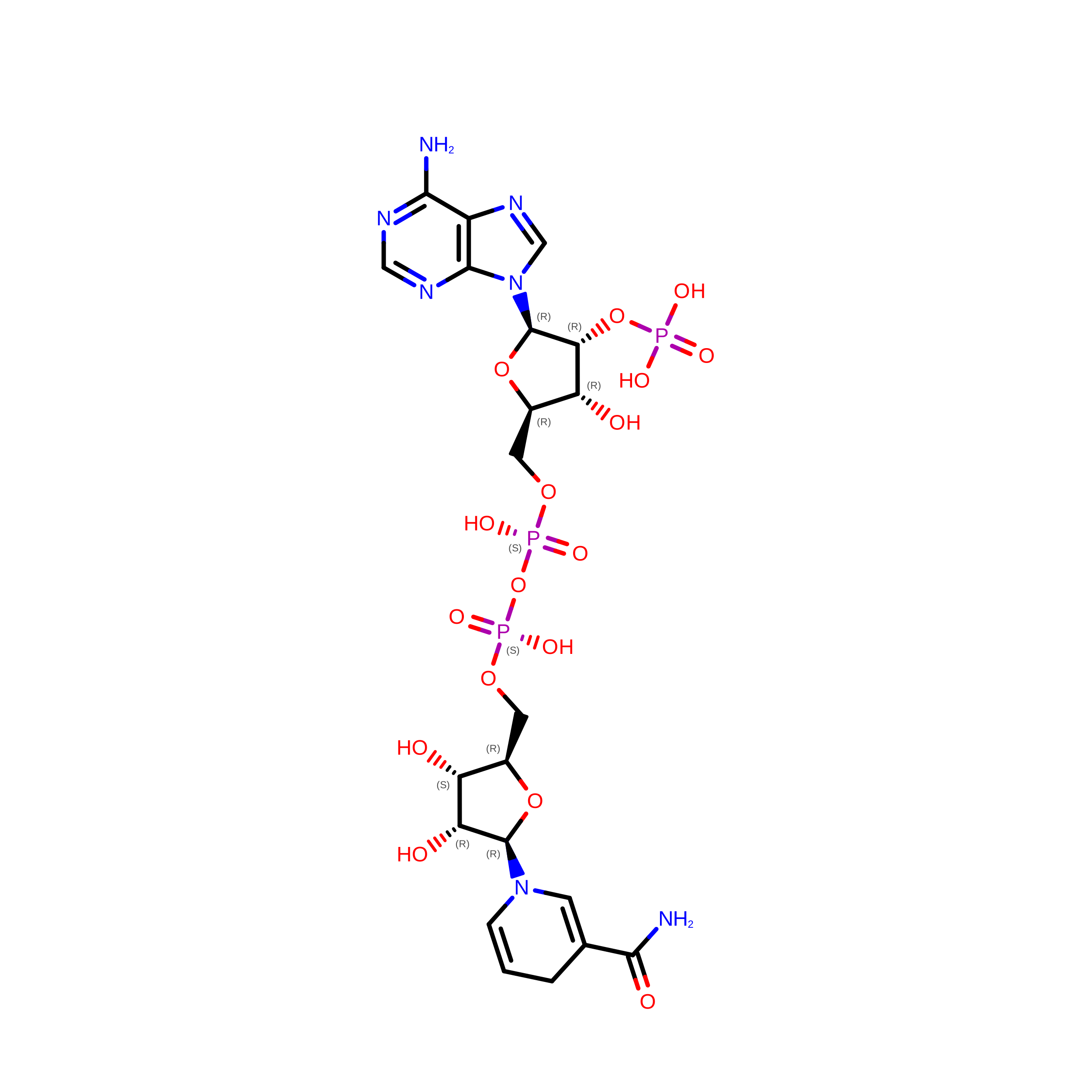
Crystal structure of Leishmania donovani 6-Phosphogluconate Dehydrogenase complexed with NADPH


Experimental Data Snapshot

  • Method: X-RAY DIFFRACTION
  • Resolution: 3.10 Å
  • R-Value Free: 
    0.317 (Depositor), 0.317 (DCC) 
  • R-Value Work: 
    0.262 (Depositor), 0.263 (DCC) 
  • R-Value Observed: 
    0.267 (Depositor) 

Starting Model: experimental
View more details

wwPDB Validation 3D Report Full Report

Validation slider image for 8C79

Ligand Structure Quality Assessment 


This is version 1.2 of the entry. See complete history

Literature

Structure of Leishmania donovani 6-Phosphogluconate Dehydrogenase and Inhibition by Phosphine Gold(I) Complexes: A Potential Approach to Leishmaniasis Treatment.

Berneburg, I.Stumpf, M.Velten, A.S.Rahlfs, S.Przyborski, J.Becker, K.Fritz-Wolf, K.

(2023) Int J Mol Sci 24

  • DOI: https://doi.org/10.3390/ijms24108615
  • Primary Citation Related Structures: 
    8C79

  • PubMed Abstract: 

    As unicellular parasites are highly dependent on NADPH as a source for reducing equivalents, the main NADPH-producing enzymes glucose 6-phosphate dehydrogenase (G6PD) and 6-phosphogluconate dehydrogenase (6PGD) of the pentose phosphate pathway are considered promising antitrypanosomatid drug targets. Here we present the biochemical characterization and crystal structure of Leishmania donovani 6PGD ( Ld 6PGD) in complex with NADP(H). Most interestingly, a previously unknown conformation of NADPH is visible in this structure. In addition, we identified auranofin and other gold(I)-containing compounds as efficient Ld 6PGD inhibitors, although it has so far been assumed that trypanothione reductase is the sole target of auranofin in Kinetoplastida . Interestingly, 6PGD from Plasmodium falciparum is also inhibited at lower micromolar concentrations, whereas human 6PGD is not. Mode-of-inhibition studies indicate that auranofin competes with 6PG for its binding site followed by a rapid irreversible inhibition. By analogy with other enzymes, this suggests that the gold moiety is responsible for the observed inhibition. Taken together, we identified gold(I)-containing compounds as an interesting class of inhibitors against 6PGDs from Leishmania and possibly from other protozoan parasites. Together with the three-dimensional crystal structure, this provides a valid basis for further drug discovery approaches.


  • Organizational Affiliation
    • Biochemistry and Molecular Biology, Interdisciplinary Research Center, Justus Liebig University, 35392 Giessen, Germany.

Macromolecule Content 

  • Total Structure Weight: 105.42 kDa 
  • Atom Count: 7,366 
  • Modeled Residue Count: 956 
  • Deposited Residue Count: 956 
  • Unique protein chains: 1

Macromolecules

Find similar proteins by:|  3D Structure
Entity ID: 1
MoleculeChains  Sequence LengthOrganismDetailsImage
6-phosphogluconate dehydrogenase, decarboxylating
A, B
478Leishmania donovaniMutation(s): 0 
Gene Names: gnd
EC: 1.1.1.44
UniProt
Find proteins for Q18L02 (Leishmania donovani)
Explore Q18L02 
Go to UniProtKB:  Q18L02
Entity Groups
Sequence Clusters30% Identity50% Identity70% Identity90% Identity95% Identity100% Identity
UniProt GroupQ18L02
Sequence Annotations
Expand
Reference Sequence

Experimental Data & Validation

Experimental Data

  • Method: X-RAY DIFFRACTION
  • Resolution: 3.10 Å
  • R-Value Free:  0.317 (Depositor), 0.317 (DCC) 
  • R-Value Work:  0.262 (Depositor), 0.263 (DCC) 
  • R-Value Observed: 0.267 (Depositor) 
Space Group: P 21 21 21
Unit Cell:
Length ( Å )Angle ( ˚ )
a = 65.87α = 90
b = 117.35β = 90
c = 128.91γ = 90
Software Package:
Software NamePurpose
PHENIXrefinement
PHENIXrefinement
XDSdata reduction
XSCALEdata scaling
PHENIXphasing

Structure Validation

View Full Validation Report


Ligand Structure Quality Assessment 


Entry History 

& Funding Information

Deposition Data


Funding OrganizationLocationGrant Number
LOEWE Center DRUIDGermanyB3/E3

Revision History  (Full details and data files)

  • Version 1.0: 2023-05-24
    Type: Initial release
  • Version 1.1: 2023-06-07
    Changes: Database references
  • Version 1.2: 2024-02-07
    Changes: Data collection, Refinement description