Download Mendeley
Emergence of fractal geometries in the evolution of a metabolic enzyme.
Sendker, F.L., Lo, Y.K., Heimerl, T., Bohn, S., Persson, L.J., Mais, C.N., Sadowska, W., Paczia, N., Nussbaum, E., Del Carmen Sanchez Olmos, M., Forchhammer, K., Schindler, D., Erb, T.J., Benesch, J.L.P., Marklund, E.G., Bange, G., Schuller, J.M., Hochberg, G.K.A.(2024) Nature 628: 894-900
- PubMed: 38600380 Search on PubMedSearch on PubMed Central
- DOI: https://doi.org/10.1038/s41586-024-07287-2
- Primary Citation Related Structures:
8AN1, 8BEI, 8BP7, 8RJK, 8RJL - PubMed Abstract:
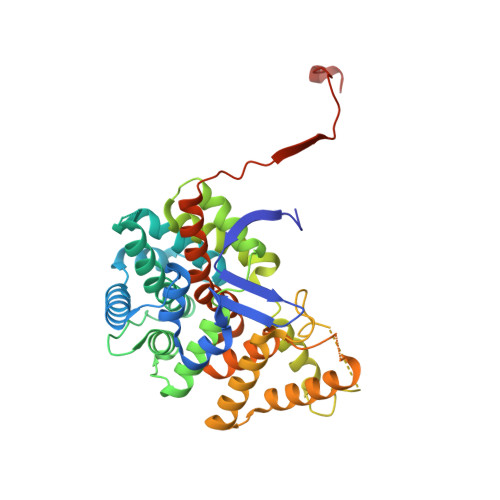
Fractals are patterns that are self-similar across multiple length-scales 1 . Macroscopic fractals are common in nature 2-4 ; however, so far, molecular assembly into fractals is restricted to synthetic systems 5-12 . Here we report the discovery of a natural protein, citrate synthase from the cyanobacterium Synechococcus elongatus, which self-assembles into Sierpiński triangles. Using cryo-electron microscopy, we reveal how the fractal assembles from a hexameric building block. Although different stimuli modulate the formation of fractal complexes and these complexes can regulate the enzymatic activity of citrate synthase in vitro, the fractal may not serve a physiological function in vivo. We use ancestral sequence reconstruction to retrace how the citrate synthase fractal evolved from non-fractal precursors, and the results suggest it may have emerged as a harmless evolutionary accident. Our findings expand the space of possible protein complexes and demonstrate that intricate and regulatable assemblies can evolve in a single substitution.
- Evolutionary Biochemistry Group, Max Planck Institute for Terrestrial Microbiology, Marburg, Germany.
Organizational Affiliation: