8AG8 | pdb_00008ag8

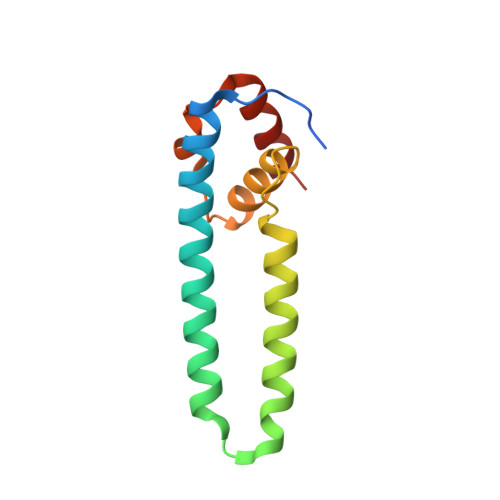
Structure of the Fluorescence Recovery-like protein FRPL from Pseudomonas borbori


Experimental Data Snapshot

  • Method: X-RAY DIFFRACTION
  • Resolution: 1.80 Å
  • R-Value Free: 
    0.232 (Depositor), 0.247 (DCC) 
  • R-Value Work: 
    0.227 (Depositor), 0.243 (DCC) 
  • R-Value Observed: 
    0.228 (Depositor) 

Starting Model: experimental
View more details

wwPDB Validation 3D Report Full Report

Validation slider image for 8AG8

This is version 1.3 of the entry. See complete history

Literature

Fortuitously compatible protein surfaces primed allosteric control in cyanobacterial photoprotection.

Steube, N.Moldenhauer, M.Weiland, P.Saman, D.Kilb, A.Ramirez Rojas, A.A.Garg, S.G.Schindler, D.Graumann, P.L.Benesch, J.L.P.Bange, G.Friedrich, T.Hochberg, G.K.A.

(2023) Nat Ecol Evol 7: 756-767

  • DOI: https://doi.org/10.1038/s41559-023-02018-8
  • Primary Citation Related Structures: 
    8AG8

  • PubMed Abstract: 

    Highly specific interactions between proteins are a fundamental prerequisite for life, but how they evolve remains an unsolved problem. In particular, interactions between initially unrelated proteins require that they evolve matching surfaces. It is unclear whether such surface compatibilities can only be built by selection in small incremental steps, or whether they can also emerge fortuitously. Here, we used molecular phylogenetics, ancestral sequence reconstruction and biophysical characterization of resurrected proteins to retrace the evolution of an allosteric interaction between two proteins that act in the cyanobacterial photoprotection system. We show that this interaction between the orange carotenoid protein (OCP) and its unrelated regulator, the fluorescence recovery protein (FRP), evolved when a precursor of FRP was horizontally acquired by cyanobacteria. FRP's precursors could already interact with and regulate OCP even before these proteins first encountered each other in an ancestral cyanobacterium. The OCP-FRP interaction exploits an ancient dimer interface in OCP, which also predates the recruitment of FRP into the photoprotection system. Together, our work shows how evolution can fashion complex regulatory systems easily out of pre-existing components.


  • Organizational Affiliation
    • Max Planck Institute for Terrestrial Microbiology, Marburg, Germany.

Macromolecule Content 

  • Total Structure Weight: 13.61 kDa 
  • Atom Count: 952 
  • Modeled Residue Count: 106 
  • Deposited Residue Count: 113 
  • Unique protein chains: 1

Macromolecules

Find similar proteins by:|  3D Structure
Entity ID: 1
MoleculeChains  Sequence LengthOrganismDetailsImage
Fluorescence Recovery-like protein113Pseudomonas borboriMutation(s): 0 
Gene Names: SAMN05216190_11792
UniProt
Find proteins for A0A1I5SVP7 (Pseudomonas borbori)
Explore A0A1I5SVP7 
Go to UniProtKB:  A0A1I5SVP7
Entity Groups
Sequence Clusters30% Identity50% Identity70% Identity90% Identity95% Identity100% Identity
UniProt GroupA0A1I5SVP7
Sequence Annotations
Expand
Reference Sequence

Small Molecules

Ligands 1 Unique
IDChains Name / Formula / InChI Key2D Diagram3D Interactions
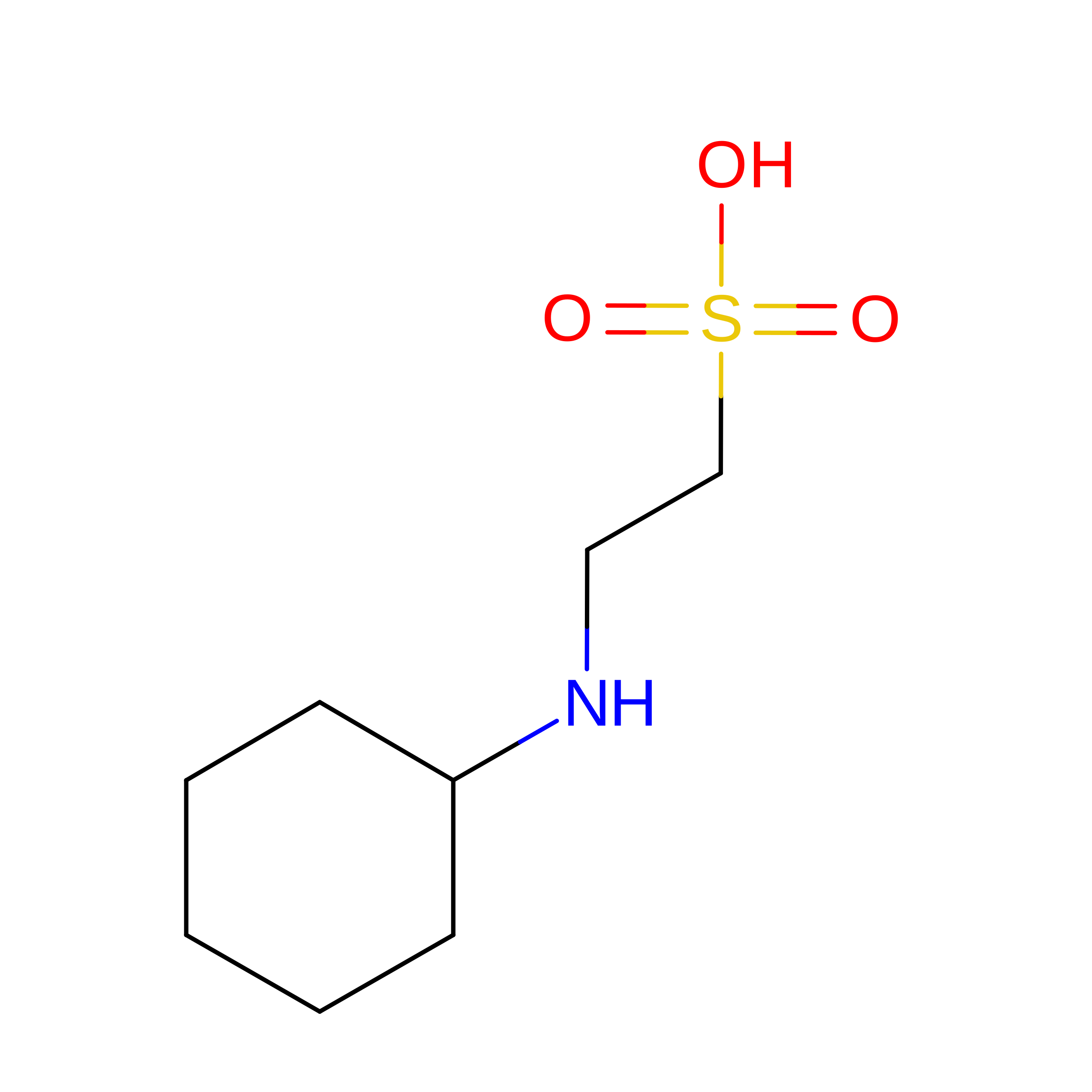
NHE

Query on NHE


Download:Ideal Coordinates CCD File
B [auth A]2-[N-CYCLOHEXYLAMINO]ETHANE SULFONIC ACID
C8 H17 N O3 S
MKWKNSIESPFAQN-UHFFFAOYSA-N

Experimental Data & Validation

Experimental Data

  • Method: X-RAY DIFFRACTION
  • Resolution: 1.80 Å
  • R-Value Free:  0.232 (Depositor), 0.247 (DCC) 
  • R-Value Work:  0.227 (Depositor), 0.243 (DCC) 
  • R-Value Observed: 0.228 (Depositor) 
Space Group: P 43 21 2
Unit Cell:
Length ( Å )Angle ( ˚ )
a = 53.46α = 90
b = 53.46β = 90
c = 92.67γ = 90
Software Package:
Software NamePurpose
PHENIXrefinement
XDSdata reduction
XSCALEdata scaling
PHASERphasing

Structure Validation

View Full Validation Report


Entry History 

& Funding Information

Deposition Data


Funding OrganizationLocationGrant Number
Not funded--

Revision History  (Full details and data files)

  • Version 1.0: 2023-04-05
    Type: Initial release
  • Version 1.1: 2023-04-12
    Changes: Database references
  • Version 1.2: 2023-05-24
    Changes: Database references
  • Version 1.3: 2024-02-07
    Changes: Data collection, Refinement description