Download Mendeley
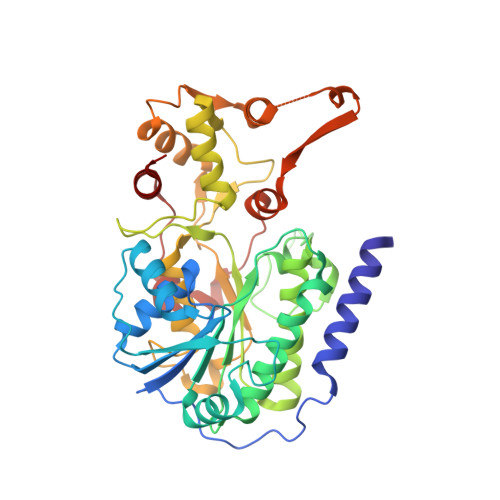
Structure of the Reductase Domain of a Fungal Carboxylic Acid Reductase and Its Substrate Scope in Thioester and Aldehyde Reduction.
Daniel, B., Hashem, C., Leithold, M., Sagmeister, T., Tripp, A., Stolterfoht-Stock, H., Messenlehner, J., Keegan, R., Winkler, C.K., Ling, J.G., Younes, S.H.H., Oberdorfer, G., Abu Bakar, F.D., Gruber, K., Pavkov-Keller, T., Winkler, M.(2022) ACS Catal 12: 15668-15674
- PubMed: 37180375 Search on PubMedSearch on PubMed Central
- DOI: https://doi.org/10.1021/acscatal.2c04426
- Primary Citation Related Structures:
8AEP - PubMed Abstract:
The synthesis of aldehydes from carboxylic acids has long been a challenge in chemistry. In contrast to the harsh chemically driven reduction, enzymes such as carboxylic acid reductases (CARs) are considered appealing biocatalysts for aldehyde production. Although structures of single- and didomains of microbial CARs have been reported, to date no full-length protein structure has been elucidated. In this study, we aimed to obtain structural and functional information regarding the reductase (R) domain of a CAR from the fungus Neurospora crassa ( Nc ). The Nc CAR R-domain revealed activity for N -acetylcysteamine thioester (S-(2-acetamidoethyl) benzothioate), which mimics the phosphopantetheinylacyl-intermediate and can be anticipated as the minimal substrate for thioester reduction by CARs. The determined crystal structure of the Nc CAR R-domain reveals a tunnel that putatively harbors the phosphopantetheinylacyl-intermediate, which is in good agreement with docking experiments performed with the minimal substrate. In vitro studies were performed with this highly purified R-domain and NADPH, demonstrating carbonyl reduction activity. The R-domain was able to accept not only a simple aromatic ketone but also benzaldehyde and octanal, which are typically considered to be the final product of carboxylic acid reduction by CAR. Also, the full-length Nc CAR reduced aldehydes to primary alcohols. In conclusion, aldehyde overreduction can no longer be attributed exclusively to the host background.
- acib - Austrian Center of Industrial Biotechnology, Krenngasse 37, 8010Graz, Austria.
Organizational Affiliation: