7XM0 | pdb_00007xm0

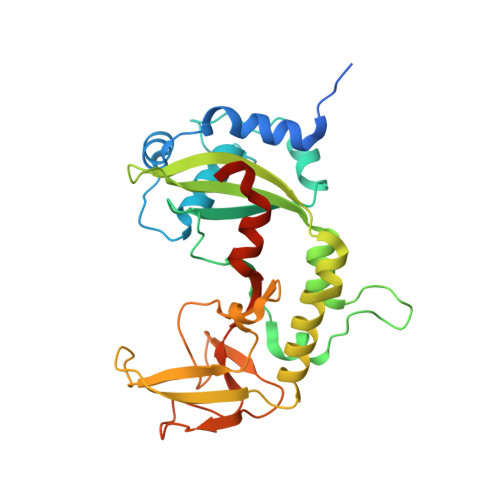
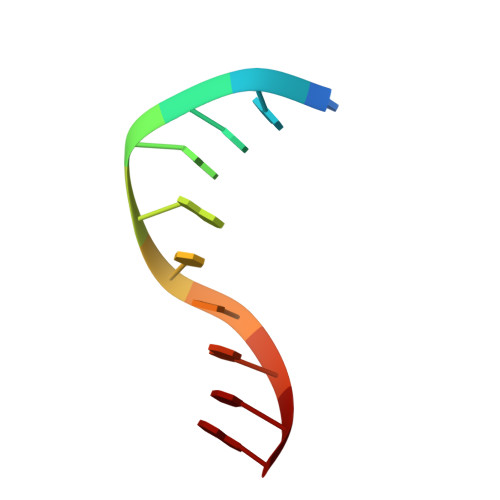
Crystal structure of Sau3AI-C and DNA substrate complex


Experimental Data Snapshot

  • Method: X-RAY DIFFRACTION
  • Resolution: 2.60 Å
  • R-Value Free: 
    0.240 (Depositor), 0.239 (DCC) 
  • R-Value Work: 
    0.193 (Depositor), 0.193 (DCC) 
  • R-Value Observed: 
    0.196 (Depositor) 

Starting Model: experimental
View more details

wwPDB Validation 3D Report Full Report

Validation slider image for 7XM0

This is version 2.2 of the entry. See complete history

Literature

The crystal structures of Sau3AI with and without bound DNA suggest a self-activation-based DNA cleavage mechanism.

Liu, Y.Xu, C.Zhou, H.Wang, W.Liu, B.Li, Y.Hu, X.Yu, F.He, J.

(2023) Structure 31: 1463-1472.e2

  • DOI: https://doi.org/10.1016/j.str.2023.08.005
  • Primary Citation Related Structures: 
    7XM0

  • PubMed Abstract: 

    The type II restriction endonuclease Sau3AI cleaves the sequence 5'-GATC-3' in double-strand DNA producing two sticky ends. Sau3AI cuts both DNA strands regardless of methylation status. Here, we report the crystal structures of the active site mutant Sau3AI-E64A and the C-terminal domain Sau3AI-C with a bound GATC substrate. Interestingly, the catalytic site of the N-terminal domain (Sau3AI-N) is spatially blocked by the C-terminal domain, suggesting a potential self-inhibition of the enzyme. Interruption of Sau3AI-C binding to substrate DNA disrupts Sau3AI function, suggesting a functional linkage between the N- and C-terminal domains. We propose that Sau3AI-C behaves as an allosteric effector binding one GATC substrate, which triggers a conformational change to open the N-terminal catalytic site, resulting in the subsequent GATC recognition by Sau3AI-N and cleavage of the second GATC site. Our data indicate that Sau3AI and UbaLAI might represent a new subclass of type IIE restriction enzymes.


  • Organizational Affiliation
    • Department of Pathogen Biology, School of Basic Medicine, Tongji Medical College, Huazhong University of Science and Technology, 13 Hangkong Road, Wuhan, Hubei 430030, China.

Macromolecule Content 

  • Total Structure Weight: 118.54 kDa 
  • Atom Count: 7,578 
  • Modeled Residue Count: 821 
  • Deposited Residue Count: 924 
  • Unique protein chains: 1
  • Unique nucleic acid chains: 1

Macromolecules


Find similar proteins by:|  3D Structure
Entity ID: 1
MoleculeChains  Sequence LengthOrganismDetailsImage
Type II restriction enzyme Sau3AI
A, B, C
288Staphylococcus aureusMutation(s): 0 
Gene Names: sau3AIR
EC: 3.1.21.4
UniProt
Find proteins for P16667 (Staphylococcus aureus)
Explore P16667 
Go to UniProtKB:  P16667
Entity Groups
Sequence Clusters30% Identity50% Identity70% Identity90% Identity95% Identity100% Identity
UniProt GroupP16667
Sequence Annotations
Expand
Reference Sequence
Find similar nucleic acids by:  Sequence
Entity ID: 2
MoleculeChains LengthOrganismImage
DNA (5'-D(*CP*AP*TP*GP*AP*TP*CP*AP*TP*G)-3')
D, E, F, G, H
D, E, F, G, H, I
10synthetic construct
Sequence Annotations
Expand
Reference Sequence

Experimental Data & Validation

Experimental Data

  • Method: X-RAY DIFFRACTION
  • Resolution: 2.60 Å
  • R-Value Free:  0.240 (Depositor), 0.239 (DCC) 
  • R-Value Work:  0.193 (Depositor), 0.193 (DCC) 
  • R-Value Observed: 0.196 (Depositor) 
Space Group: P 21 21 21
Unit Cell:
Length ( Å )Angle ( ˚ )
a = 62.943α = 90
b = 98.391β = 90
c = 209.455γ = 90
Software Package:
Software NamePurpose
PHENIXrefinement
PHENIXrefinement
HKL-2000data reduction
HKL-2000data scaling
PHENIXphasing

Structure Validation

View Full Validation Report


Entry History 

& Funding Information

Deposition Data


Funding OrganizationLocationGrant Number
Ministry of Science and Technology (MoST, China)China2021YFC2301405
National Natural Science Foundation of China (NSFC)China31971121
National Natural Science Foundation of China (NSFC)China81861138047
National Natural Science Foundation of China (NSFC)ChinaU1932130

Revision History  (Full details and data files)

  • Version 1.0: 2023-04-26
    Type: Initial release
  • Version 2.0: 2023-07-19
    Type: Coordinate replacement
    Reason: Ligand identity
    Changes: Advisory, Atomic model, Author supporting evidence, Data collection, Derived calculations, Refinement description, Structure summary
  • Version 2.1: 2023-11-29
    Changes: Data collection, Refinement description
  • Version 2.2: 2024-11-06
    Changes: Database references, Structure summary