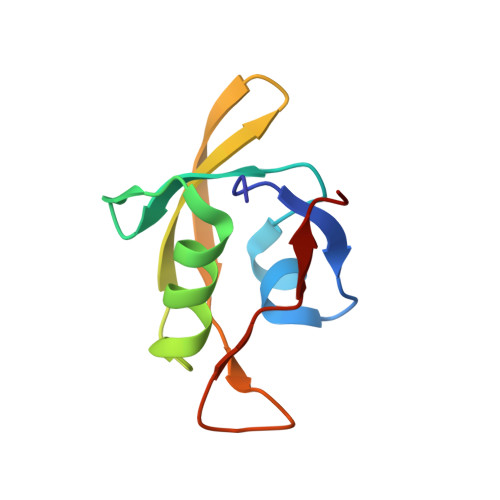
7W70 | pdb_00007w70

Crystal structure of the PDZ-C domain fragment of Kangiella koreensis RseP orthologue


Experimental Data Snapshot

  • Method: X-RAY DIFFRACTION
  • Resolution: 1.15 Å
  • R-Value Free: 
    0.206 (Depositor), 0.207 (DCC) 
  • R-Value Work: 
    0.196 (Depositor), 0.199 (DCC) 
  • R-Value Observed: 
    0.197 (Depositor) 

Starting Model: experimental
View more details

wwPDB Validation 3D Report Full Report

Validation slider image for 7W70

This is version 1.1 of the entry. See complete history

Literature

Mechanistic insights into intramembrane proteolysis by E. coli site-2 protease homolog RseP.

Imaizumi, Y.Takanuki, K.Miyake, T.Takemoto, M.Hirata, K.Hirose, M.Oi, R.Kobayashi, T.Miyoshi, K.Aruga, R.Yokoyama, T.Katagiri, S.Matsuura, H.Iwasaki, K.Kato, T.Kaneko, M.K.Kato, Y.Tajiri, M.Akashi, S.Nureki, O.Hizukuri, Y.Akiyama, Y.Nogi, T.

(2022) Sci Adv 8: eabp9011-eabp9011

  • DOI: https://doi.org/10.1126/sciadv.abp9011
  • Primary Citation Related Structures: 
    7W6X, 7W6Y, 7W6Z, 7W70, 7W71

  • PubMed Abstract: 

    Site-2 proteases are a conserved family of intramembrane proteases that cleave transmembrane substrates to regulate signal transduction and maintain proteostasis. Here, we elucidated crystal structures of inhibitor-bound forms of bacterial site-2 proteases including Escherichia coli RseP. Structure-based chemical modification and cross-linking experiments indicated that the RseP domains surrounding the active center undergo conformational changes to expose the substrate-binding site, suggesting that RseP has a gating mechanism to regulate substrate entry. Furthermore, mutational analysis suggests that a conserved electrostatic linkage between the transmembrane and peripheral membrane-associated domains mediates the conformational changes. In vivo cleavage assays also support that the substrate transmembrane helix is unwound by strand addition to the intramembrane β sheet of RseP and is clamped by a conserved asparagine residue at the active center for efficient cleavage. This mechanism underlying the substrate binding, i.e., unwinding and clamping, appears common across distinct families of intramembrane proteases that cleave transmembrane segments.


  • Organizational Affiliation
    • Graduate School of Medical Life Science, Yokohama City University, 1-7-29 Suehiro-cho, Tsurumi-ku, Yokohama 230-0045, Japan.

Macromolecule Content 

  • Total Structure Weight: 18.53 kDa 
  • Atom Count: 1,582 
  • Modeled Residue Count: 174 
  • Deposited Residue Count: 174 
  • Unique protein chains: 1

Macromolecules

Find similar proteins by:|  3D Structure
Entity ID: 1
MoleculeChains  Sequence LengthOrganismDetailsImage
Zinc metalloprotease
A, B
87Kangiella koreensis DSM 16069Mutation(s): 0 
Gene Names: Kkor_1905
EC: 3.4.24
UniProt
Find proteins for C7R5Z1 (Kangiella koreensis (strain DSM 16069 / JCM 12317 / KCTC 12182 / SW-125))
Explore C7R5Z1 
Go to UniProtKB:  C7R5Z1
Entity Groups
Sequence Clusters30% Identity50% Identity70% Identity90% Identity95% Identity100% Identity
UniProt GroupC7R5Z1
Sequence Annotations
Expand
Reference Sequence

Experimental Data & Validation

Experimental Data

  • Method: X-RAY DIFFRACTION
  • Resolution: 1.15 Å
  • R-Value Free:  0.206 (Depositor), 0.207 (DCC) 
  • R-Value Work:  0.196 (Depositor), 0.199 (DCC) 
  • R-Value Observed: 0.197 (Depositor) 
Space Group: P 21 21 21
Unit Cell:
Length ( Å )Angle ( ˚ )
a = 40.673α = 90
b = 42.408β = 90
c = 97.949γ = 90
Software Package:
Software NamePurpose
PHENIXrefinement
XDSdata reduction
Aimlessdata scaling
MOLREPphasing

Structure Validation

View Full Validation Report


Entry History 

& Funding Information

Deposition Data


Funding OrganizationLocationGrant Number
Japan Society for the Promotion of Science (JSPS)Japan19H03170

Revision History  (Full details and data files)

  • Version 1.0: 2022-09-07
    Type: Initial release
  • Version 1.1: 2023-11-29
    Changes: Data collection, Refinement description