7VLN | pdb_00007vln

NSD2-PWWP1 domain bound with an imidazol-5-yl benzonitrile compound


Experimental Data Snapshot

  • Method: X-RAY DIFFRACTION
  • Resolution: 3.09 Å
  • R-Value Free: 
    0.345 (Depositor), 0.338 (DCC) 
  • R-Value Work: 
    0.292 (Depositor), 0.294 (DCC) 
  • R-Value Observed: 
    0.294 (Depositor) 

Starting Model: experimental
View more details

wwPDB Validation 3D Report Full Report

Validation slider image for 7VLN

Ligand Structure Quality Assessment 


This is version 1.3 of the entry. See complete history

Literature

Structure-Based Discovery of a Series of NSD2-PWWP1 Inhibitors.

Li, N.Yang, H.Liu, K.Zhou, L.Huang, Y.Cao, D.Li, Y.Sun, Y.Yu, A.Du, Z.Yu, F.Zhang, Y.Wang, B.Geng, M.Li, J.Xiong, B.Xu, S.Huang, X.Liu, T.

(2022) J Med Chem 65: 9459-9477

  • DOI: https://doi.org/10.1021/acs.jmedchem.2c00709
  • Primary Citation Related Structures: 
    7VLN

  • PubMed Abstract: 

    Overexpression, point mutations, or translocations of protein lysine methyltransferase NSD2 occur in many types of cancer cells. Therefore, it was recognized as onco-protein and considered as a promising anticancer drug target. NSD2 consists of multiple domains including a SET catalytic domain and two PWWP domains binding to methylated histone proteins. Here, we reported our efforts to develop a series of NSD2-PWWP1 inhibitors, and further structure-based optimization resulted in a potent inhibitor 38 , which has high selectivity toward the NSD2-PWWP1 domain. The detailed biological evaluation revealed that compound 38 can bind to NSD2-PWWP1 and then affect the expression of genes regulated by NSD2. The current discovery will provide a useful chemical probe to the future research in understanding the specific regulation mode of NSD2 by PWWP1 recognition and pave the way to develop potential drugs targeting NSD2 protein.


  • Organizational Affiliation
    • Department of Medicinal Chemistry, Shanghai Institute of Materia Medica, Chinese Academy of Sciences, 555 Zuchongzhi Road, Shanghai 201203, P. R. China.

Macromolecule Content 

  • Total Structure Weight: 45.77 kDa 
  • Atom Count: 3,074 
  • Modeled Residue Count: 378 
  • Deposited Residue Count: 396 
  • Unique protein chains: 1

Macromolecules

Find similar proteins by:|  3D Structure
Entity ID: 1
MoleculeChains  Sequence LengthOrganismDetailsImage
Histone-lysine N-methyltransferase NSD2
A, B, C
132Homo sapiensMutation(s): 0 
Gene Names: NSD2KIAA1090MMSETTRX5WHSC1
EC: 2.1.1.357
UniProt & NIH Common Fund Data Resources
Find proteins for O96028 (Homo sapiens)
Explore O96028 
Go to UniProtKB:  O96028
PHAROS:  O96028
GTEx:  ENSG00000109685 
Entity Groups
Sequence Clusters30% Identity50% Identity70% Identity90% Identity95% Identity100% Identity
UniProt GroupO96028
Sequence Annotations
Expand
Reference Sequence

Small Molecules

Ligands 1 Unique
IDChains Name / Formula / InChI Key2D Diagram3D Interactions
7QC
(Subject of Investigation/LOI)

Query on 7QC


Download:Ideal Coordinates CCD File
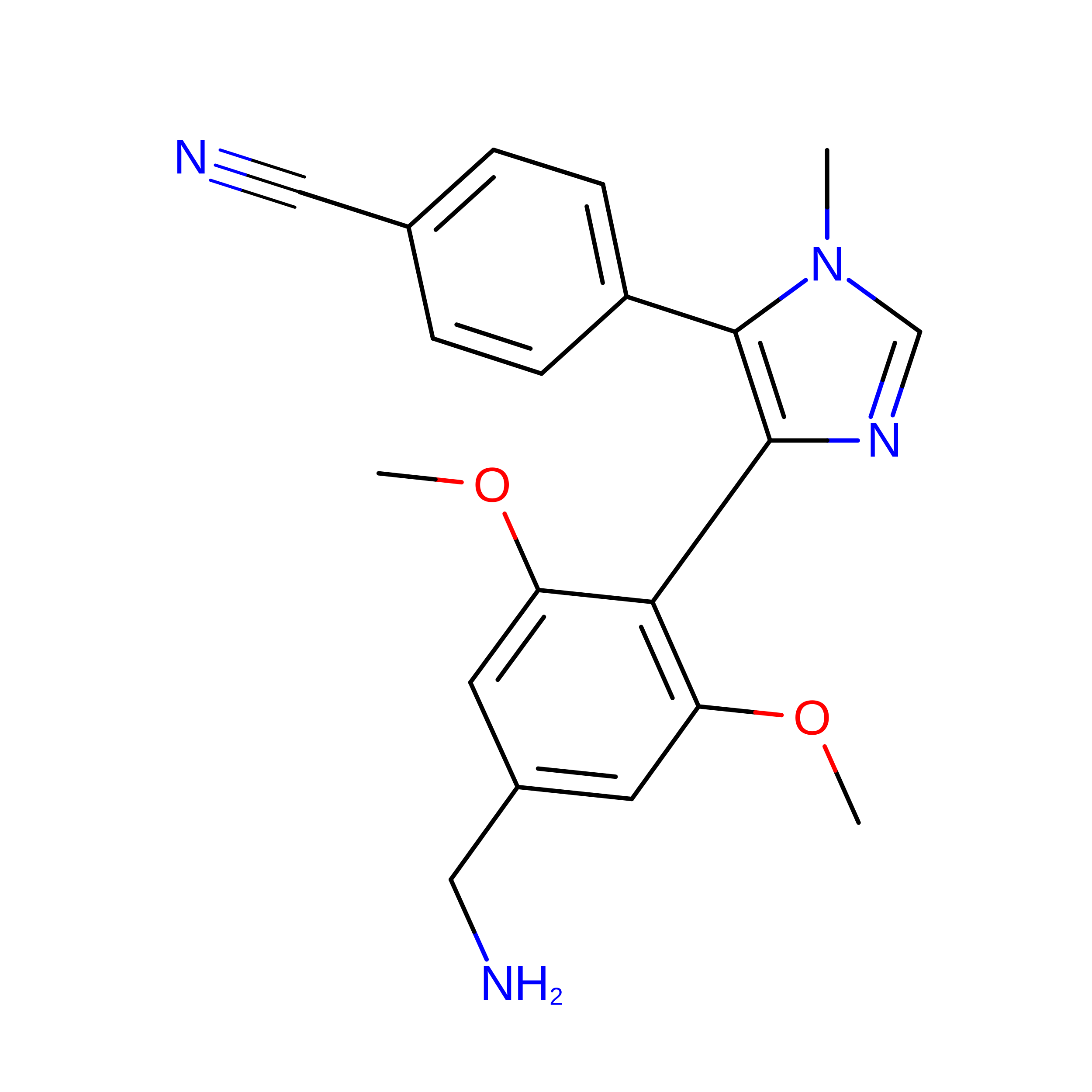
D [auth B]4-[5-[4-(aminomethyl)-2,6-dimethoxy-phenyl]-3-methyl-imidazol-4-yl]benzenecarbonitrile
C20 H20 N4 O2
ZMYTUDHTGNNWHO-UHFFFAOYSA-N

Experimental Data & Validation

Experimental Data

  • Method: X-RAY DIFFRACTION
  • Resolution: 3.09 Å
  • R-Value Free:  0.345 (Depositor), 0.338 (DCC) 
  • R-Value Work:  0.292 (Depositor), 0.294 (DCC) 
  • R-Value Observed: 0.294 (Depositor) 
Space Group: P 31 2 1
Unit Cell:
Length ( Å )Angle ( ˚ )
a = 70.12α = 90
b = 70.12β = 90
c = 230.67γ = 120
Software Package:
Software NamePurpose
PHENIXrefinement
XDSdata reduction
XDSdata scaling
PHENIXphasing

Structure Validation

View Full Validation Report


Ligand Structure Quality Assessment 


Entry History 

& Funding Information

Deposition Data


Funding OrganizationLocationGrant Number
Not funded--

Revision History  (Full details and data files)

  • Version 1.0: 2022-07-06
    Type: Initial release
  • Version 1.1: 2022-07-13
    Changes: Database references
  • Version 1.2: 2022-07-27
    Changes: Database references
  • Version 1.3: 2023-11-29
    Changes: Data collection, Refinement description