7UN3 | pdb_00007un3

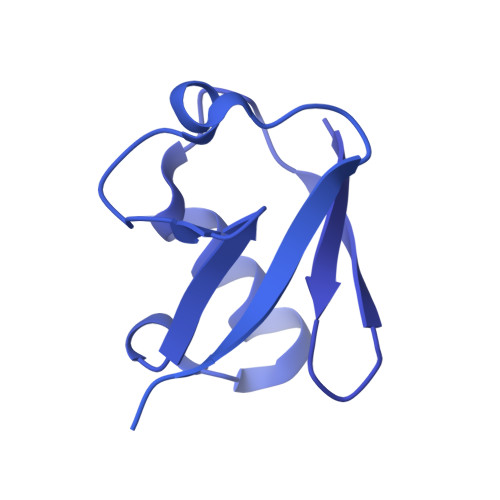
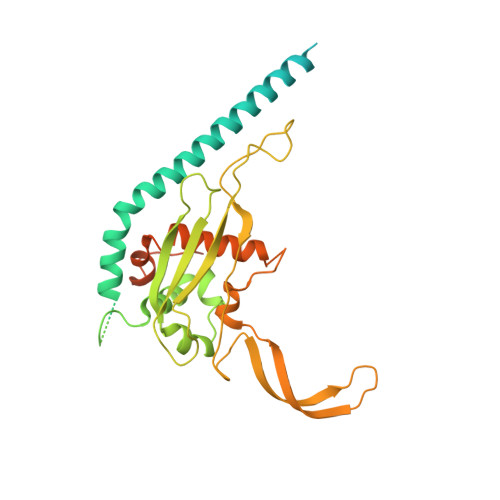
Complex of UBE2O with NAP1L1 and ubiquitylated uL2

  • Classification: CYTOSOLIC PROTEIN
  • Organism(s): Homo sapiens
  • Expression System: Homo sapiens
  • Mutation(s): Yes 

  • Deposited: 2022-04-08 Released: 2022-08-03 
  • Deposition Author(s): Yip, M.C.J., Sedor, S.F., Shao, S.
  • Funding Organization(s): National Institutes of Health/National Institute of General Medical Sciences (NIH/NIGMS), David and Lucile Packard Foundation, The Vallee Foundation, American Heart Association, National Institutes of Health/National Heart, Lung, and Blood Institute (NIH/NHLBI)

Experimental Data Snapshot

  • Method: ELECTRON MICROSCOPY
  • Resolution: 3.50 Å
  • Aggregation State: PARTICLE 
  • Reconstruction Method: SINGLE PARTICLE 

wwPDB Validation 3D Report Full Report

Validation slider image for 7UN3

This is version 1.4 of the entry. See complete history

Literature

Mechanism of client selection by the protein quality-control factor UBE2O.

Yip, M.C.J.Sedor, S.F.Shao, S.

(2022) Nat Struct Mol Biol 29: 774-780

  • DOI: https://doi.org/10.1038/s41594-022-00807-6
  • Primary Citation Related Structures: 
    7UN3, 7UN6

  • PubMed Abstract: 

    The E2/E3 enzyme UBE2O ubiquitylates diverse clients to mediate important processes, including targeting unassembled 'orphan' proteins for quality control and clearing ribosomes during erythropoiesis. How quality-control factors, such as UBE2O, select clients on the basis of heterogeneous features is largely unknown. Here, we show that UBE2O client selection is regulated by ubiquitin binding and a cofactor, NAP1L1. Attaching a single ubiquitin onto a client enhances UBE2O binding and multi-mono-ubiquitylation. UBE2O also repurposes the histone chaperone NAP1L1 as an adapter to recruit a subset of clients. Cryo-EM structures of human UBE2O in complex with NAP1L1 reveal a malleable client recruitment interface that is autoinhibited by the intrinsically reactive UBC domain. Adding a ubiquitylated client identifies a distinct ubiquitin-binding SH3-like domain required for client selection. Our findings reveal how multivalency and a feed-forward mechanism drive the selection of protein quality-control clients.


  • Organizational Affiliation
    • Department of Cell Biology, Harvard Medical School, Boston, MA, USA.

Macromolecule Content 

  • Total Structure Weight: 478.18 kDa 
  • Atom Count: 9,423 
  • Modeled Residue Count: 1,164 
  • Deposited Residue Count: 4,320 
  • Unique protein chains: 2

Macromolecules

Find similar proteins by:|  3D Structure
Entity ID: 1
MoleculeChains  Sequence LengthOrganismDetailsImage
Ubiquitin,60S ribosomal protein L8,(E3-independent) E2 ubiquitin-conjugating enzyme fusionA [auth D],
B [auth A]
1,744Homo sapiensMutation(s): 2 
Gene Names: UBA52UBCEP2RPL8UBE2OKIAA1734
EC: 2.3.2.24
UniProt & NIH Common Fund Data Resources
Find proteins for P62917 (Homo sapiens)
Explore P62917 
Go to UniProtKB:  P62917
GTEx:  ENSG00000161016 
Find proteins for P62987 (Homo sapiens)
Explore P62987 
Go to UniProtKB:  P62987
PHAROS:  P62987
GTEx:  ENSG00000221983 
Find proteins for Q9C0C9 (Homo sapiens)
Explore Q9C0C9 
Go to UniProtKB:  Q9C0C9
PHAROS:  Q9C0C9
GTEx:  ENSG00000175931 
Entity Groups
Sequence Clusters30% Identity50% Identity70% Identity90% Identity95% Identity100% Identity
UniProt GroupsQ9C0C9P62917P62987
Sequence Annotations
Expand
Reference Sequence
Find similar proteins by:|  3D Structure
Entity ID: 2
MoleculeChains  Sequence LengthOrganismDetailsImage
Nucleosome assembly protein 1-like 1C [auth B],
D [auth C]
416Homo sapiensMutation(s): 0 
Gene Names: NAP1L1NRP
UniProt & NIH Common Fund Data Resources
Find proteins for P55209 (Homo sapiens)
Explore P55209 
Go to UniProtKB:  P55209
PHAROS:  P55209
GTEx:  ENSG00000187109 
Entity Groups
Sequence Clusters30% Identity50% Identity70% Identity90% Identity95% Identity100% Identity
UniProt GroupP55209
Sequence Annotations
Expand
Reference Sequence

Experimental Data & Validation

Experimental Data

  • Method: ELECTRON MICROSCOPY
  • Resolution: 3.50 Å
  • Aggregation State: PARTICLE 
  • Reconstruction Method: SINGLE PARTICLE 

Structure Validation

View Full Validation Report


Entry History 

& Funding Information

Deposition Data


Funding OrganizationLocationGrant Number
National Institutes of Health/National Institute of General Medical Sciences (NIH/NIGMS)United StatesDP2GM137415
David and Lucile Packard FoundationUnited States2019-69660
The Vallee Foundation--
American Heart AssociationUnited States287375208
National Institutes of Health/National Heart, Lung, and Blood Institute (NIH/NHLBI)United StatesF31HL157976

Revision History  (Full details and data files)

  • Version 1.0: 2022-08-03
    Type: Initial release
  • Version 1.1: 2022-08-10
    Changes: Database references
  • Version 1.2: 2022-08-17
    Changes: Database references
  • Version 1.3: 2022-08-24
    Changes: Database references
  • Version 1.4: 2024-02-14
    Changes: Data collection