7UCE | pdb_00007uce

Structure of the anti-HIV-1 neutralizing antibody BG24 Fab fragment


Experimental Data Snapshot

  • Method: X-RAY DIFFRACTION
  • Resolution: 2.25 Å
  • R-Value Free: 
    0.245 (Depositor), 0.248 (DCC) 
  • R-Value Work: 
    0.204 (Depositor), 0.204 (DCC) 
  • R-Value Observed: 
    0.206 (Depositor) 

Starting Model: experimental
View more details

wwPDB Validation 3D Report Full Report

Validation slider image for 7UCE

This is version 1.4 of the entry. See complete history

Literature

A naturally arising broad and potent CD4-binding site antibody with low somatic mutation.

Barnes, C.O.Schoofs, T.Gnanapragasam, P.N.P.Golijanin, J.Huey-Tubman, K.E.Gruell, H.Schommers, P.Suh-Toma, N.Lee, Y.E.Cetrulo Lorenzi, J.C.Piechocka-Trocha, A.Scheid, J.F.West Jr., A.P.Walker, B.D.Seaman, M.S.Klein, F.Nussenzweig, M.C.Bjorkman, P.J.

(2022) Sci Adv 8: eabp8155-eabp8155

  • DOI: https://doi.org/10.1126/sciadv.abp8155
  • Primary Citation Related Structures: 
    7UCE, 7UCF, 7UCG

  • PubMed Abstract: 

    The induction of broadly neutralizing antibodies (bNAbs) is a potential strategy for a vaccine against HIV-1. However, most bNAbs exhibit features such as unusually high somatic hypermutation, including insertions and deletions, which make their induction challenging. VRC01-class bNAbs not only exhibit extraordinary breadth and potency but also rank among the most highly somatically mutated bNAbs. Here, we describe a VRC01-class antibody isolated from a viremic controller, BG24, that is much less mutated than most relatives of its class while achieving comparable breadth and potency. A 3.8-Å x-ray crystal structure of a BG24-BG505 Env trimer complex revealed conserved contacts at the gp120 interface characteristic of the VRC01-class Abs, despite lacking common CDR3 sequence motifs. The existence of moderately mutated CD4-binding site (CD4bs) bNAbs such as BG24 provides a simpler blueprint for CD4bs antibody induction by a vaccine, raising the prospect that such an induction might be feasible with a germline-targeting approach.


  • Organizational Affiliation
    • Division of Biology and Biological Engineering, California Institute of Technology, Pasadena, CA 91125, USA.

Macromolecule Content 

  • Total Structure Weight: 47.68 kDa 
  • Atom Count: 3,271 
  • Modeled Residue Count: 426 
  • Deposited Residue Count: 439 
  • Unique protein chains: 2

Macromolecules

Find similar proteins by:|  3D Structure
Entity ID: 1
MoleculeChains  Sequence LengthOrganismDetailsImage
BG24 Fab light chainA [auth L]205Homo sapiensMutation(s): 0 
Find similar proteins by:|  3D Structure
Entity ID: 2
MoleculeChains  Sequence LengthOrganismDetailsImage
BG24 Fab heavy chainB [auth H]234Homo sapiensMutation(s): 0 

Oligosaccharides

Help  
Entity ID: 3
MoleculeChains Length2D Diagram GlycosylationD Interactions
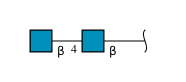
2-acetamido-2-deoxy-beta-D-glucopyranose-(1-4)-2-acetamido-2-deoxy-beta-D-glucopyranoseC [auth A]2N-Glycosylation
Glycosylation Resources
GlyTouCan: G42666HT
GlyCosmos: G42666HT
GlyGen: G42666HT

Experimental Data & Validation

Experimental Data

  • Method: X-RAY DIFFRACTION
  • Resolution: 2.25 Å
  • R-Value Free:  0.245 (Depositor), 0.248 (DCC) 
  • R-Value Work:  0.204 (Depositor), 0.204 (DCC) 
  • R-Value Observed: 0.206 (Depositor) 
Space Group: C 2 2 21
Unit Cell:
Length ( Å )Angle ( ˚ )
a = 66.603α = 90
b = 118.424β = 90
c = 119.656γ = 90
Software Package:
Software NamePurpose
PHENIXrefinement
XDSdata reduction
Aimlessdata scaling
PHASERphasing

Structure Validation

View Full Validation Report


Entry History 

& Funding Information

Deposition Data


Funding OrganizationLocationGrant Number
National Institutes of Health/National Institute Of Allergy and Infectious Diseases (NIH/NIAID)United StatesP01 AI100148
National Institutes of Health/National Institute Of Allergy and Infectious Diseases (NIH/NIAID)United StatesP50 AI150464
Bill & Melinda Gates FoundationUnited StatesOPP1124068

Revision History  (Full details and data files)

  • Version 1.0: 2022-08-17
    Type: Initial release
  • Version 1.1: 2022-08-24
    Changes: Database references
  • Version 1.2: 2022-10-05
    Changes: Structure summary
  • Version 1.3: 2023-10-18
    Changes: Data collection, Refinement description
  • Version 1.4: 2024-11-13
    Changes: Structure summary