7U9G | pdb_00007u9g

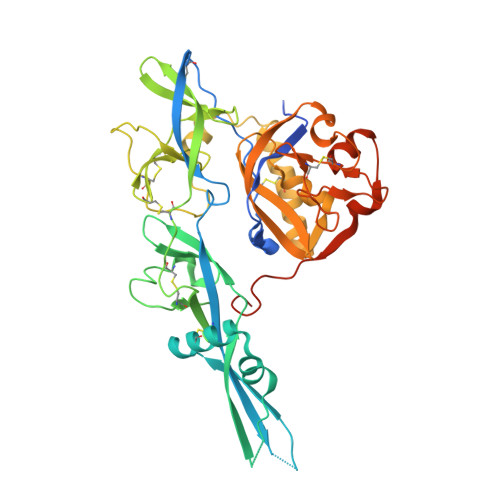
Rabies virus glycoprotein pre-fusion trimer in complex with neutralizing antibody RVA122


Experimental Data Snapshot

  • Method: ELECTRON MICROSCOPY
  • Resolution: 3.39 Å
  • Aggregation State: PARTICLE 
  • Reconstruction Method: SINGLE PARTICLE 

wwPDB Validation 3D Report Full Report

Validation slider image for 7U9G

This is version 1.1 of the entry. See complete history

Literature

Structure of the rabies virus glycoprotein trimer bound to a prefusion-specific neutralizing antibody.

Callaway, H.M.Zyla, D.Larrous, F.de Melo, G.D.Hastie, K.M.Avalos, R.D.Agarwal, A.Corti, D.Bourhy, H.Saphire, E.O.

(2022) Sci Adv 8: eabp9151-eabp9151

  • DOI: https://doi.org/10.1126/sciadv.abp9151
  • Primary Citation Related Structures: 
    7U9G

  • PubMed Abstract: 

    Rabies infection is nearly 100% lethal if untreated and kills more than 50,000 people annually, many of them children. Existing rabies vaccines target the rabies virus glycoprotein (RABV-G) but generate short-lived immune responses, likely because the protein is heterogeneous under physiological conditions. Here, we report the 3.39 Å cryo-electron microscopy structure of trimeric, prefusion RABV-G complexed with RVA122, a potently neutralizing human antibody. RVA122 binds to a quaternary epitope at the top of RABV-G, bridging domains and stabilizing RABV-G protomers in a prefusion state. RABV-G trimerization involves side-to-side interactions between the central α helix and adjacent loops, rather than contacts between central helices, and interactions among the fusion loops at the glycoprotein base. These results provide a basis from which to develop improved rabies vaccines based on RABV-G stabilized in the prefusion conformation.


  • Organizational Affiliation
    • Center for Infectious Disease and Vaccine Research, La Jolla Institute for Immunology, La Jolla, CA, USA.

Macromolecule Content 

  • Total Structure Weight: 304.75 kDa 
  • Atom Count: 14,553 
  • Modeled Residue Count: 1,860 
  • Deposited Residue Count: 2,763 
  • Unique protein chains: 3

Macromolecules

Find similar proteins by:|  3D Structure
Entity ID: 1
MoleculeChains  Sequence LengthOrganismDetailsImage
Glycoprotein
A, B, C
439Rabies virus strain Pasteur vaccinMutation(s): 0 
UniProt
Find proteins for P08667 (Rabies virus (strain Pasteur vaccins / PV))
Explore P08667 
Go to UniProtKB:  P08667
Entity Groups
Sequence Clusters30% Identity50% Identity70% Identity90% Identity95% Identity100% Identity
UniProt GroupP08667
Glycosylation
Glycosylation Sites: 3
Sequence Annotations
Expand
Reference Sequence
Find similar proteins by:|  3D Structure
Entity ID: 2
MoleculeChains  Sequence LengthOrganismDetailsImage
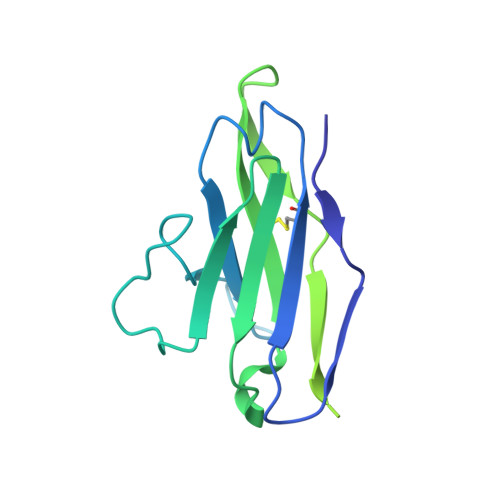
RVA122 Fab Light Chain
D, E, F
217Homo sapiensMutation(s): 0 
Find similar proteins by:|  3D Structure
Entity ID: 3
MoleculeChains  Sequence LengthOrganismDetailsImage
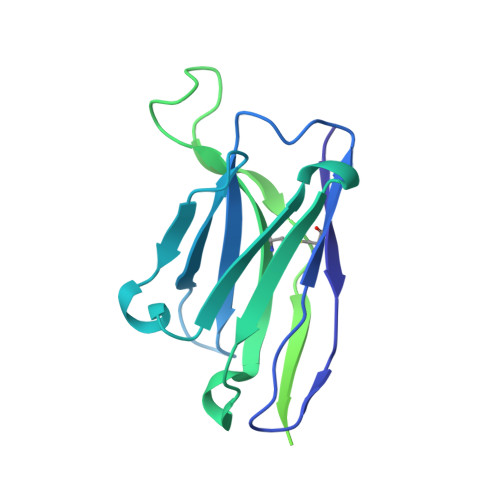
RVA122 Fab Heavy Chain
G, H, I
265Homo sapiensMutation(s): 0 

Small Molecules

Ligands 1 Unique
IDChains Name / Formula / InChI Key2D Diagram3D Interactions
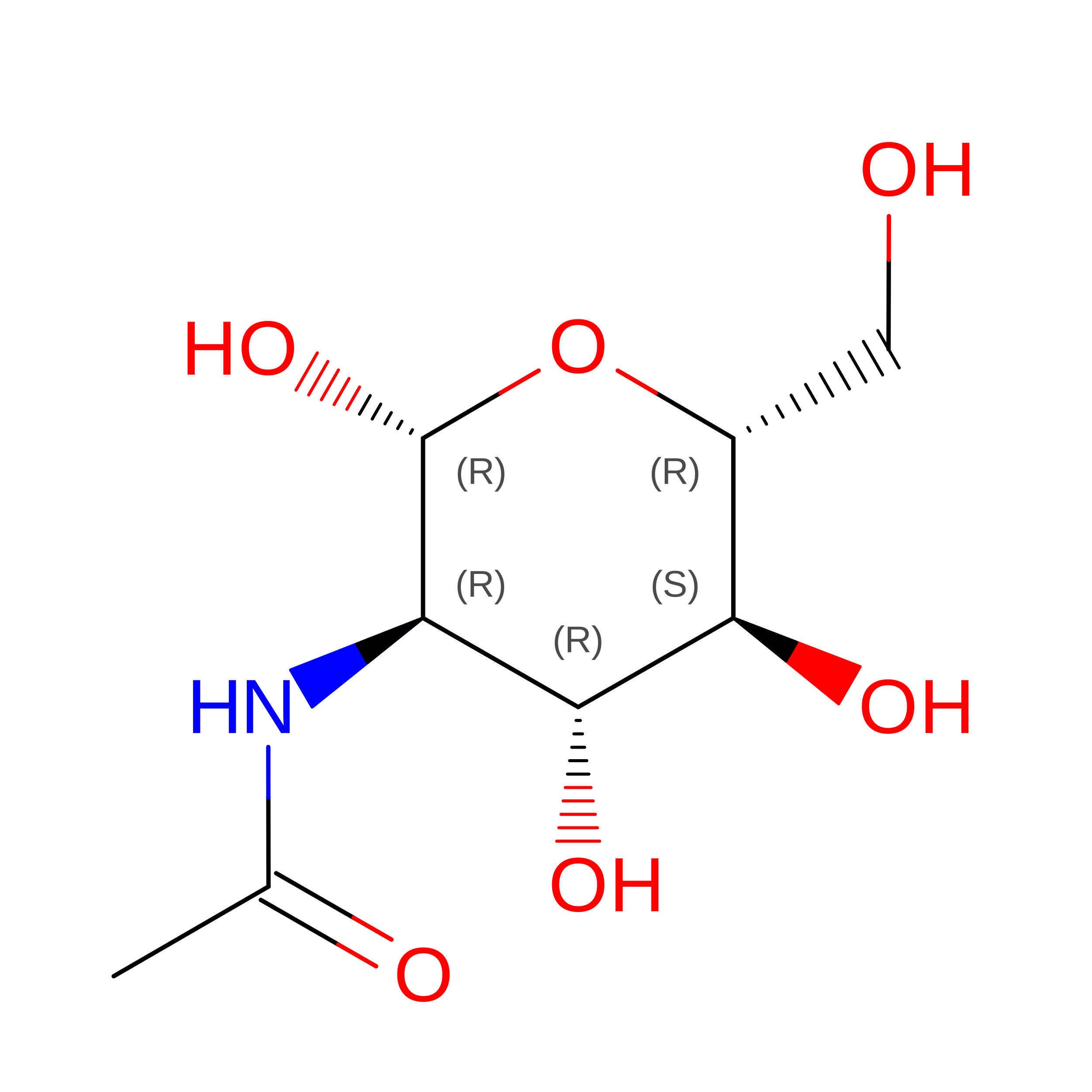
NAG

Query on NAG


Download:Ideal Coordinates CCD File
J [auth A]
K [auth A]
L [auth A]
M [auth B]
N [auth B]
J [auth A],
K [auth A],
L [auth A],
M [auth B],
N [auth B],
O [auth B],
P [auth C],
Q [auth C],
R [auth C]
2-acetamido-2-deoxy-beta-D-glucopyranose
C8 H15 N O6
OVRNDRQMDRJTHS-FMDGEEDCSA-N

Experimental Data & Validation

Experimental Data

  • Method: ELECTRON MICROSCOPY
  • Resolution: 3.39 Å
  • Aggregation State: PARTICLE 
  • Reconstruction Method: SINGLE PARTICLE 
EM Software:
TaskSoftware PackageVersion
RECONSTRUCTIONRELION

Structure Validation

View Full Validation Report


Entry History 

& Funding Information

Deposition Data


Funding OrganizationLocationGrant Number
National Institutes of Health/National Institute Of Allergy and Infectious Diseases (NIH/NIAID)United States5F32AI147531-03
National Institutes of Health/National Institute Of Allergy and Infectious Diseases (NIH/NIAID)United States5T32AI07244-36
Swiss National Science FoundationSwitzerlandP2EZP3_195680

Revision History  (Full details and data files)

  • Version 1.0: 2022-07-20
    Type: Initial release
  • Version 1.1: 2024-10-16
    Changes: Data collection, Structure summary