7TPG | pdb_00007tpg

Single-Particle Cryo-EM Structure of the WaaL O-antigen ligase in its ligand bound state


Experimental Data Snapshot

  • Method: ELECTRON MICROSCOPY
  • Resolution: 3.23 Å
  • Aggregation State: PARTICLE 
  • Reconstruction Method: SINGLE PARTICLE 

wwPDB Validation 3D Report Full Report

Validation slider image for 7TPG

This is version 1.3 of the entry. See complete history

Literature

Structural basis of lipopolysaccharide maturation by the O-antigen ligase.

Ashraf, K.U.Nygaard, R.Vickery, O.N.Erramilli, S.K.Herrera, C.M.McConville, T.H.Petrou, V.I.Giacometti, S.I.Dufrisne, M.B.Nosol, K.Zinkle, A.P.Graham, C.L.B.Loukeris, M.Kloss, B.Skorupinska-Tudek, K.Swiezewska, E.Roper, D.I.Clarke, O.B.Uhlemann, A.C.Kossiakoff, A.A.Trent, M.S.Stansfeld, P.J.Mancia, F.

(2022) Nature 604: 371-376

  • DOI: https://doi.org/10.1038/s41586-022-04555-x
  • Primary Citation Related Structures: 
    7TPG, 7TPJ

  • PubMed Abstract: 

    The outer membrane of Gram-negative bacteria has an external leaflet that is largely composed of lipopolysaccharide, which provides a selective permeation barrier, particularly against antimicrobials 1 . The final and crucial step in the biosynthesis of lipopolysaccharide is the addition of a species-dependent O-antigen to the lipid A core oligosaccharide, which is catalysed by the O-antigen ligase WaaL 2 . Here we present structures of WaaL from Cupriavidus metallidurans, both in the apo state and in complex with its lipid carrier undecaprenyl pyrophosphate, determined by single-particle cryo-electron microscopy. The structures reveal that WaaL comprises 12 transmembrane helices and a predominantly α-helical periplasmic region, which we show contains many of the conserved residues that are required for catalysis. We observe a conserved fold within the GT-C family of glycosyltransferases and hypothesize that they have a common mechanism for shuttling the undecaprenyl-based carrier to and from the active site. The structures, combined with genetic, biochemical, bioinformatics and molecular dynamics simulation experiments, offer molecular details on how the ligands come in apposition, and allows us to propose a mechanistic model for catalysis. Together, our work provides a structural basis for lipopolysaccharide maturation in a member of the GT-C superfamily of glycosyltransferases.


  • Organizational Affiliation
    • Department of Physiology and Cellular Biophysics, Columbia University Irving Medical Center, New York, NY, USA.

Macromolecule Content 

  • Total Structure Weight: 93.33 kDa 
  • Atom Count: 4,777 
  • Modeled Residue Count: 626 
  • Deposited Residue Count: 863 
  • Unique protein chains: 3

Macromolecules

Find similar proteins by:|  3D Structure
Entity ID: 1
MoleculeChains  Sequence LengthOrganismDetailsImage
Putative cell surface polysaccharide polymerase/ligaseA [auth B]413Cupriavidus metalliduransMutation(s): 0 
Membrane Entity: Yes 
UniProt
Find proteins for Q1LJU1 (Cupriavidus metallidurans (strain ATCC 43123 / DSM 2839 / NBRC 102507 / CH34))
Explore Q1LJU1 
Go to UniProtKB:  Q1LJU1
Entity Groups
Sequence Clusters30% Identity50% Identity70% Identity90% Identity95% Identity100% Identity
UniProt GroupQ1LJU1
Sequence Annotations
Expand
Reference Sequence
Find similar proteins by:|  3D Structure
Entity ID: 2
MoleculeChains  Sequence LengthOrganismDetailsImage
Fab Heavy (H) ChainB [auth H]235Homo sapiensMutation(s): 0 
Find similar proteins by:|  3D Structure
Entity ID: 3
MoleculeChains  Sequence LengthOrganismDetailsImage
Fab Light (L) ChainC [auth L]215Homo sapiensMutation(s): 0 

Small Molecules

Ligands 1 Unique
IDChains Name / Formula / InChI Key2D Diagram3D Interactions
GPP
(Subject of Investigation/LOI)

Query on GPP


Download:Ideal Coordinates CCD File
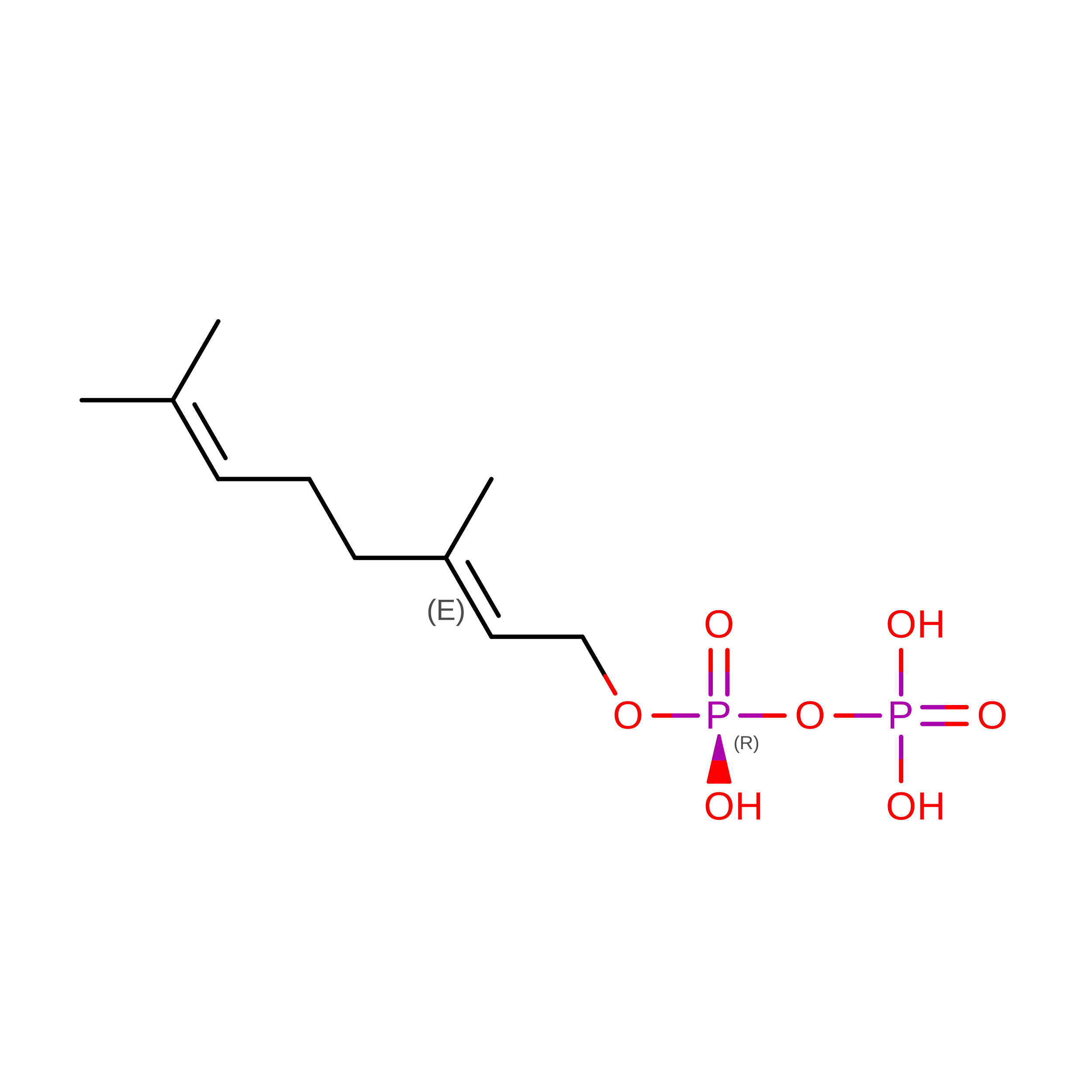
D [auth H]GERANYL DIPHOSPHATE
C10 H20 O7 P2
GVVPGTZRZFNKDS-JXMROGBWSA-N

Experimental Data & Validation

Experimental Data

  • Method: ELECTRON MICROSCOPY
  • Resolution: 3.23 Å
  • Aggregation State: PARTICLE 
  • Reconstruction Method: SINGLE PARTICLE 
EM Software:
TaskSoftware PackageVersion
RECONSTRUCTIONcryoSPARC2.8
MODEL REFINEMENTPHENIX

Structure Validation

View Full Validation Report


Entry History 

& Funding Information

Deposition Data


Funding OrganizationLocationGrant Number
National Institutes of Health/National Institute of General Medical Sciences (NIH/NIGMS)United StatesGM132120
National Institutes of Health/National Institute Of Allergy and Infectious Diseases (NIH/NIAID)United StatesAI150098
National Institutes of Health/National Institute Of Allergy and Infectious Diseases (NIH/NIAID)United StatesAI138576
National Institutes of Health/National Institute Of Allergy and Infectious Diseases (NIH/NIAID)United StatesAI129940
National Institutes of Health/National Institute of General Medical Sciences (NIH/NIGMS)United StatesGM117372
National Institutes of Health/National Institute of General Medical Sciences (NIH/NIGMS)United StatesGM116799
National Institutes of Health/National Institute of Diabetes and Digestive and Kidney Disease (NIH/NIDDK)United StatesDK104309
National Institutes of Health/National Institute Of Allergy and Infectious Diseases (NIH/NIAID)United StatesAI100852
National Institutes of Health/National Institute Of Allergy and Infectious Diseases (NIH/NIAID)United StatesAI146284
Wellcome TrustUnited Kingdom208361/Z/17/Z
Medical Research Council (MRC, United Kingdom)United KingdomMR/S009213/1
Biotechnology and Biological Sciences Research Council (BBSRC)United KingdomBB/P01948X/1
Biotechnology and Biological Sciences Research Council (BBSRC)United KingdomBB/R002517/1
Biotechnology and Biological Sciences Research Council (BBSRC)United KingdomBB/S003339/1
Engineering and Physical Sciences Research CouncilUnited KingdomEP/R029407/1
Engineering and Physical Sciences Research CouncilUnited KingdomEP/P020232/1
Biotechnology and Biological Sciences Research Council (BBSRC)United KingdomBB/M01116X/1
Medical Research Council (MRC, United Kingdom)United KingdomMR/N002679/1

Revision History  (Full details and data files)

  • Version 1.0: 2022-04-06
    Type: Initial release
  • Version 1.1: 2022-04-20
    Changes: Database references
  • Version 1.2: 2022-04-27
    Changes: Database references
  • Version 1.3: 2024-11-13
    Changes: Data collection, Structure summary