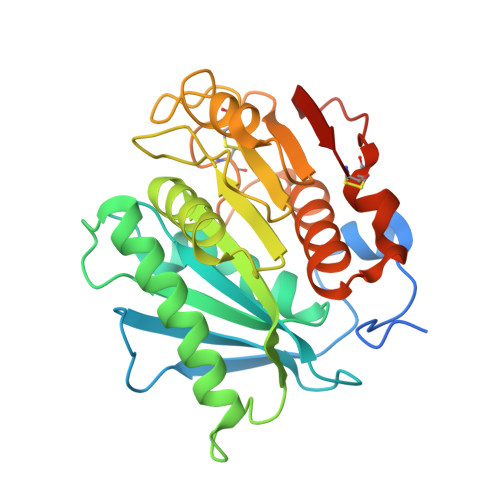
7SH6 | pdb_00007sh6

Crystal structure of a PET hydrolase mutant from Ideonella Sakaiensis


Experimental Data Snapshot

  • Method: X-RAY DIFFRACTION
  • Resolution: 1.44 Å
  • R-Value Free: 
    0.168 (Depositor), 0.168 (DCC) 
  • R-Value Work: 
    0.158 (Depositor), 0.158 (DCC) 
  • R-Value Observed: 
    0.158 (Depositor) 

Starting Model: experimental
View more details

wwPDB Validation 3D Report Full Report

Validation slider image for 7SH6

This is version 1.3 of the entry. See complete history. 

Literature

Machine learning-aided engineering of hydrolases for PET depolymerization.

Lu, H., Diaz, D.J., Czarnecki, N.J., Zhu, C., Kim, W., Shroff, R., Acosta, D.J., Alexander, B.R., Cole, H.O., Zhang, Y., Lynd, N.A., Ellington, A.D., Alper, H.S.

(2022) Nature 604: 662-667

  • DOI: https://doi.org/10.1038/s41586-022-04599-z
  • Primary Citation Related Structures: 
    7SH6

  • PubMed Abstract: 

    Plastic waste poses an ecological challenge 1-3 and enzymatic degradation offers one, potentially green and scalable, route for polyesters waste recycling 4 . Poly(ethylene terephthalate) (PET) accounts for 12% of global solid waste 5 , and a circular carbon economy for PET is theoretically attainable through rapid enzymatic depolymerization followed by repolymerization or conversion/valorization into other products 6-10 . Application of PET hydrolases, however, has been hampered by their lack of robustness to pH and temperature ranges, slow reaction rates and inability to directly use untreated postconsumer plastics 11 . Here, we use a structure-based, machine learning algorithm to engineer a robust and active PET hydrolase. Our mutant and scaffold combination (FAST-PETase: functional, active, stable and tolerant PETase) contains five mutations compared to wild-type PETase (N233K/R224Q/S121E from prediction and D186H/R280A from scaffold) and shows superior PET-hydrolytic activity relative to both wild-type and engineered alternatives 12 between 30 and 50 °C and a range of pH levels. We demonstrate that untreated, postconsumer-PET from 51 different thermoformed products can all be almost completely degraded by FAST-PETase in 1 week. FAST-PETase can also depolymerize untreated, amorphous portions of a commercial water bottle and an entire thermally pretreated water bottle at 50 ºC. Finally, we demonstrate a closed-loop PET recycling process by using FAST-PETase and resynthesizing PET from the recovered monomers. Collectively, our results demonstrate a viable route for enzymatic plastic recycling at the industrial scale.


  • Organizational Affiliation: 
    • McKetta Department of Chemical Engineering, The University of Texas at Austin, Austin, TX, USA.

Macromolecule Content 

  • Total Structure Weight: 30.9 kDa 
  • Atom Count: 2,348 
  • Modeled Residue Count: 261 
  • Deposited Residue Count: 292 
  • Unique protein chains: 1

Macromolecules

Find similar proteins by:|  3D Structure
Entity ID: 1
MoleculeChains  Sequence LengthOrganismDetailsImage
Poly(ethylene terephthalate) hydrolase292Pseudideonella sakaiensisMutation(s): 5 
Gene Names: ISF6_4831
EC: 3.1.1.101
UniProt
Find proteins for A0A0K8P6T7 (Piscinibacter sakaiensis)
Explore A0A0K8P6T7 
Go to UniProtKB:  A0A0K8P6T7
Entity Groups
Sequence Clusters30% Identity50% Identity70% Identity90% Identity95% Identity100% Identity
UniProt GroupA0A0K8P6T7
Sequence Annotations
Expand
Reference Sequence

Small Molecules

Ligands 1 Unique
IDChains Name / Formula / InChI Key2D Diagram3D Interactions
SO4

Query on SO4


Download:Ideal Coordinates CCD File
B [auth A]SULFATE ION
O4 S
QAOWNCQODCNURD-UHFFFAOYSA-L

Experimental Data & Validation

Experimental Data

  • Method: X-RAY DIFFRACTION
  • Resolution: 1.44 Å
  • R-Value Free:  0.168 (Depositor), 0.168 (DCC) 
  • R-Value Work:  0.158 (Depositor), 0.158 (DCC) 
  • R-Value Observed: 0.158 (Depositor) 
Space Group: P 21 21 21
Unit Cell:
Length ( Å )Angle ( ˚ )
a = 50.942α = 90
b = 51.182β = 90
c = 84.047γ = 90
Software Package:
Software NamePurpose
HKL-3000data scaling
PHENIXrefinement
PDB_EXTRACTdata extraction
HKL-3000data reduction
PHENIXphasing

Structure Validation

View Full Validation Report


Entry History 

& Funding Information

Deposition Data


Funding OrganizationLocationGrant Number
National Institutes of Health/National Institute of General Medical Sciences (NIH/NIGMS)United StatesR01GM104896
National Institutes of Health/National Institute of General Medical Sciences (NIH/NIGMS)United StatesR01GM125882

Revision History  (Full details and data files)

  • Version 1.0: 2022-04-06
    Type: Initial release
  • Version 1.1: 2022-05-11
    Changes: Database references
  • Version 1.2: 2023-10-18
    Changes: Data collection, Refinement description
  • Version 1.3: 2024-10-16
    Changes: Structure summary